


 Blog PDF for offline reading
Quick answer: Grease barrier paper stops oil in one of two ways. Some grades are refined so densely that fat cannot wick through the fibre, as with greaseproof, glassine and parchment. Others add a surface or film barrier such as a fluorine-free dispersion, wax, PE or PLA. Specify it with a TAPPI T 559 Kit rating plus a real-food hold test, and require PFAS documentation for each destination market. Then choose the least-coated route that passes, which protects recyclability.
Ask three suppliers for grease barrier paper and you can receive three different materials. One sheet holds a butter croissant for an afternoon. Another goes translucent under fries in ten minutes. A third keeps the oil in but traps steam until the bottom turns soft. All three may be sold as "greaseproof," and each can perform exactly as its maker intended. The real problem is that the purchase order described a word rather than a performance level.
The cost of that gap shows up in several places. Counter staff wrap a second sheet around high-fat items. Buyers move to a heavier basis weight that slows migration but rarely stops it. Meanwhile, the chemistry behind many legacy greaseproof papers has left the market. The U.S. Food and Drug Administration confirmed in February 2024 that PFAS grease-proofing agents are no longer sold for U.S. food packaging[1]. On 12 August 2026, EU concentration limits for PFAS in food-contact packaging[2] began to apply. Specifications written five years ago may no longer describe a product you can legally place on every market.
This guide is for packaging buyers who need to replace vague wording with a specification that can be checked. It explains how each barrier technology works, what Kit ratings can and cannot prove, which documents food-contact compliance now requires, and how the barrier you choose affects recyclability and supplier selection.
What is grease barrier paper?
Grease barrier paper is any paper engineered so that oils and fats from food do not wick through to the outer surface within the expected contact time. Buyers use several labels for these products: greaseproof papers, grease-resistant paper and grease proof papers. In practice, "grease-resistant" usually describes a lower level of resistance than "greaseproof." Neither label is a regulated term, and only a test result turns either one into a specification.
Three ways paper stops oil
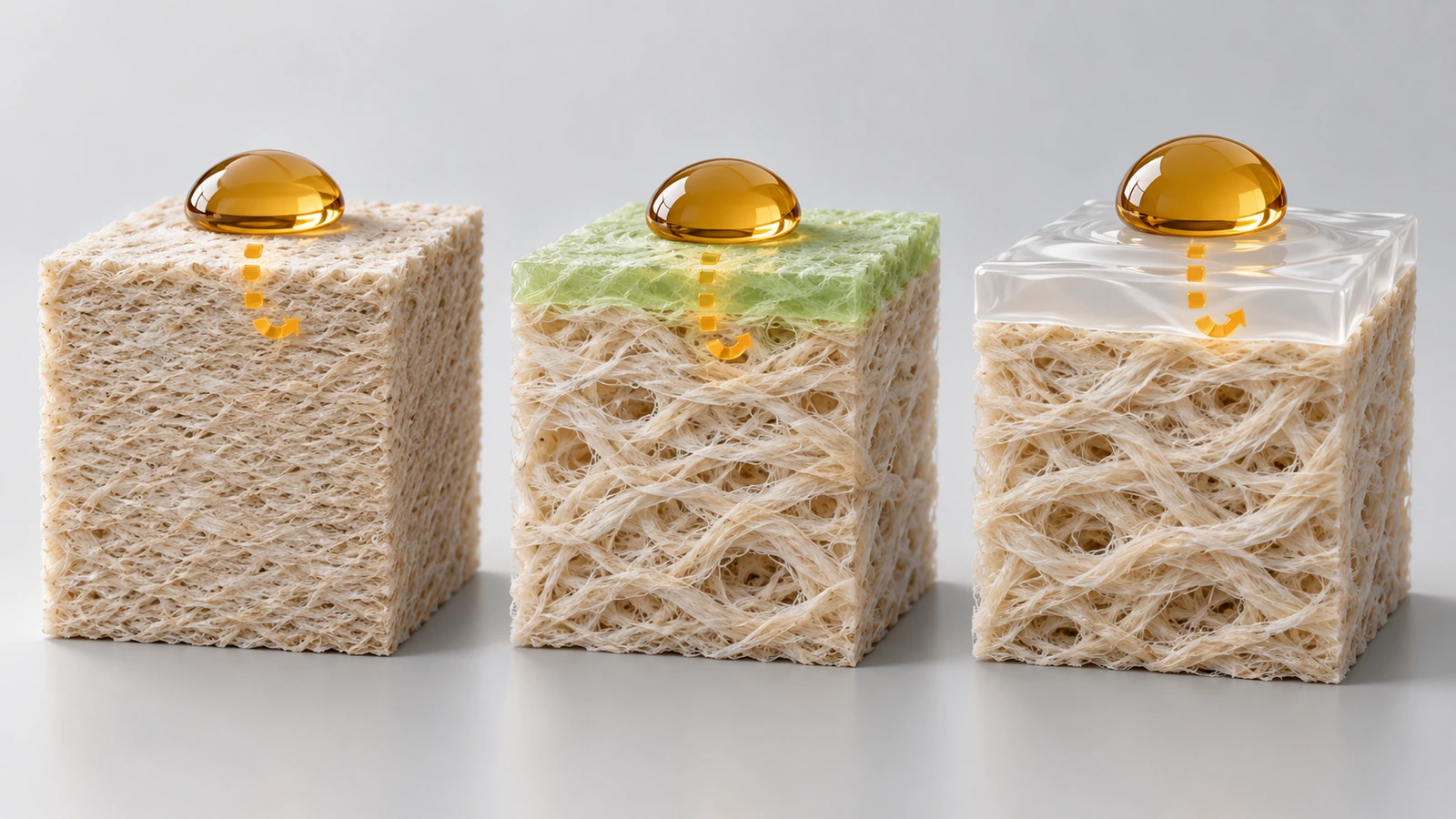
Physical density (refined pulp). The pulp is beaten, or refined, for much longer than ordinary packaging paper. This collapses the fibres into a closed sheet with very few capillary pores for oil to travel through. Classic greaseproof paper is made this way. Glassine adds supercalendering, which gives a denser and more translucent sheet. Vegetable parchment instead treats the fibre with acid to fuse the surface. None of these needs a fluorinated chemical to resist grease.
Chemical surface treatment. Agents such as starch, alginate or carboxymethyl cellulose are applied at the size press. They fill pores and raise the surface's resistance to oil. Until the 2020s, many papers relied on fluorochemical sizing for this job. Today the treatments are non-fluorinated, and their performance has to be checked rather than assumed.
Film or coating barrier. A continuous layer sits on top of the fibre. It can be a water-based barrier dispersion, wax, polyethylene (PE) or polylactic acid (PLA). These layers block oil, and often liquid too. They also change how the paper behaves in recycling and composting.
Thickness is not on this list. A heavier sheet gives oil a longer path, but untreated fibre still wicks. Older national standards made this clear by specifying grease barrier performance alongside weight. India's IS 6622-1972, summarised in a peer-reviewed review of paper food packaging[3], required greaseproof paper to meet four minimums:
- a basis weight of 35 g/m²
- a grease penetration time of 1,200 seconds
- a burst factor of 20
- a tear factor of 30
Weight was a floor, not the barrier itself.
How Kit ratings and the turpentine test work
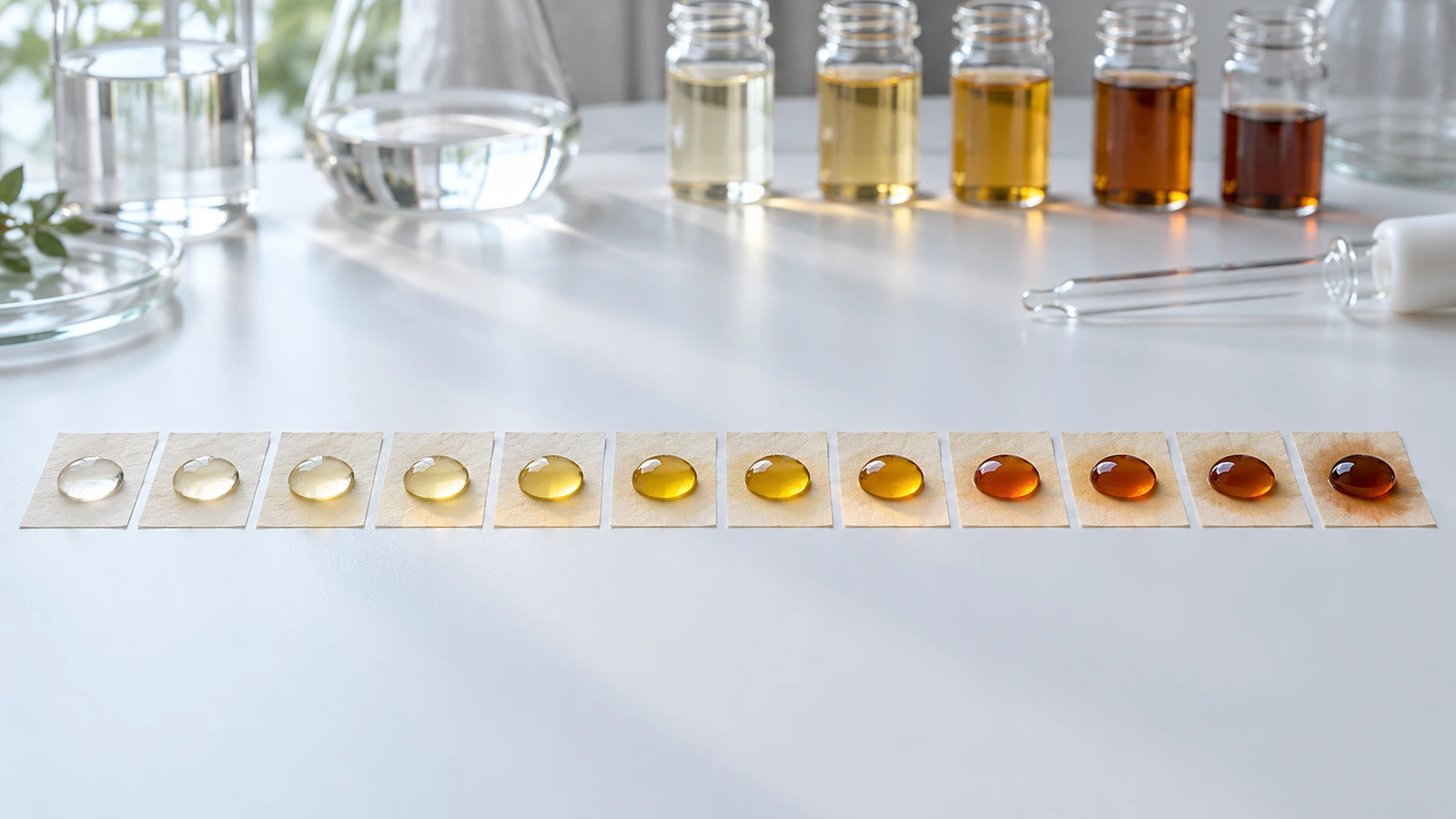
The most quoted figure in any grease barrier specification is the Kit rating from TAPPI T 559, the grease resistance test for paper and paperboard[4]. The method uses twelve numbered reagents made from castor oil, toluene and heptane, each more aggressive than the last. Each reagent is placed on the sheet for a short, fixed contact time. The highest-numbered reagent that does not darken the paper becomes the Kit rating, on a scale of 1 to 12.
TAPPI's own scope statement sets the limit that buyers most often miss. The method was "designed primarily as a surface repellency test for fluorochemical treatments." Its use on papers with film-like barriers or non-fluorochemical treatments "would have to be evaluated." In other words, the Kit test was calibrated for the very chemistry that has now been phased out. A Kit number on a fluorine-free or film-coated sheet is still useful for comparing lots. It is weaker evidence that the paper will hold hot fried food for twenty minutes.
For refined-pulp grades, the companion method is TAPPI/ANSI T 454, the turpentine test for voids in glassine and greaseproof papers[5]. The current edition is om-25, published in October 2025. The test spreads dyed turpentine over sand on the sheet and records how many seconds it takes to come through. TAPPI states that the result is preliminary to testing with prototype end products, "not a substitute" for it. It also notes that the method may not apply to grades that get their resistance from a coating.
The two methods measure different failure modes, so a Kit number cannot be converted into turpentine seconds. Specify both where they apply, and always add a real-food test.
The 2026 regulatory baseline
United States. Food-contact paper components are generally assessed under two parts of the Code of Federal Regulations:
- 21 CFR 176.170 covers paper in contact with aqueous and fatty foods.
- 21 CFR 176.180 covers paper in contact with dry foods.
Some components are instead authorised through a valid Food Contact Notification (FCN). There is no FDA approval for a finished bag. Compliance is built up from the paper, coating, adhesive and ink, each for its intended use.
For grease-proofing specifically, FDA determined that 35 FCNs covering PFAS grease-proofing coatings were no longer effective from 6 January 2025[6]. It set a compliance date of 30 June 2025 for certain paper packaging produced before 6 January 2025.
That is the end of an authorisation, not a statutory ban. As Packaging Dive reported on 30 September 2026[7], no federal restriction on PFAS in food packaging currently exists. More than a dozen states have passed their own bans, and a Senate bill proposes a federal ban from 1 January 2028. You therefore need to check state law for every destination.
European Union. Article 5(5) of Regulation (EU) 2025/40, the Packaging and Packaging Waste Regulation (PPWR)[8] has applied since 12 August 2026. Food-contact packaging cannot be placed on the EU market at or above any of these PFAS limits:
- 25 ppb for any single PFAS measured by targeted analysis
- 250 ppb for the sum of targeted PFAS
- 50 ppm for total PFAS, including polymeric PFAS
The limits apply whether PFAS were added intentionally or not. They measure concentration in the packaging, not migration into food. The European Commission's announcement[9] names fast-food wrappers, takeaway containers and baking paper among the affected uses.
The Commission has also clarified that there is no general sell-through period. Stock made before the date but first placed on the market after it must still comply. PPWR applies on top of the framework rules: Regulation (EC) No 1935/2004 and good manufacturing practice under Regulation (EC) No 2023/2006.
How to specify grease barrier paper in six steps
The steps below cover the material itself. Bag dimensions, closures, artwork and sample sign-off are a separate exercise, covered on our page for custom greaseproof paper bags for branded bakery takeaway.
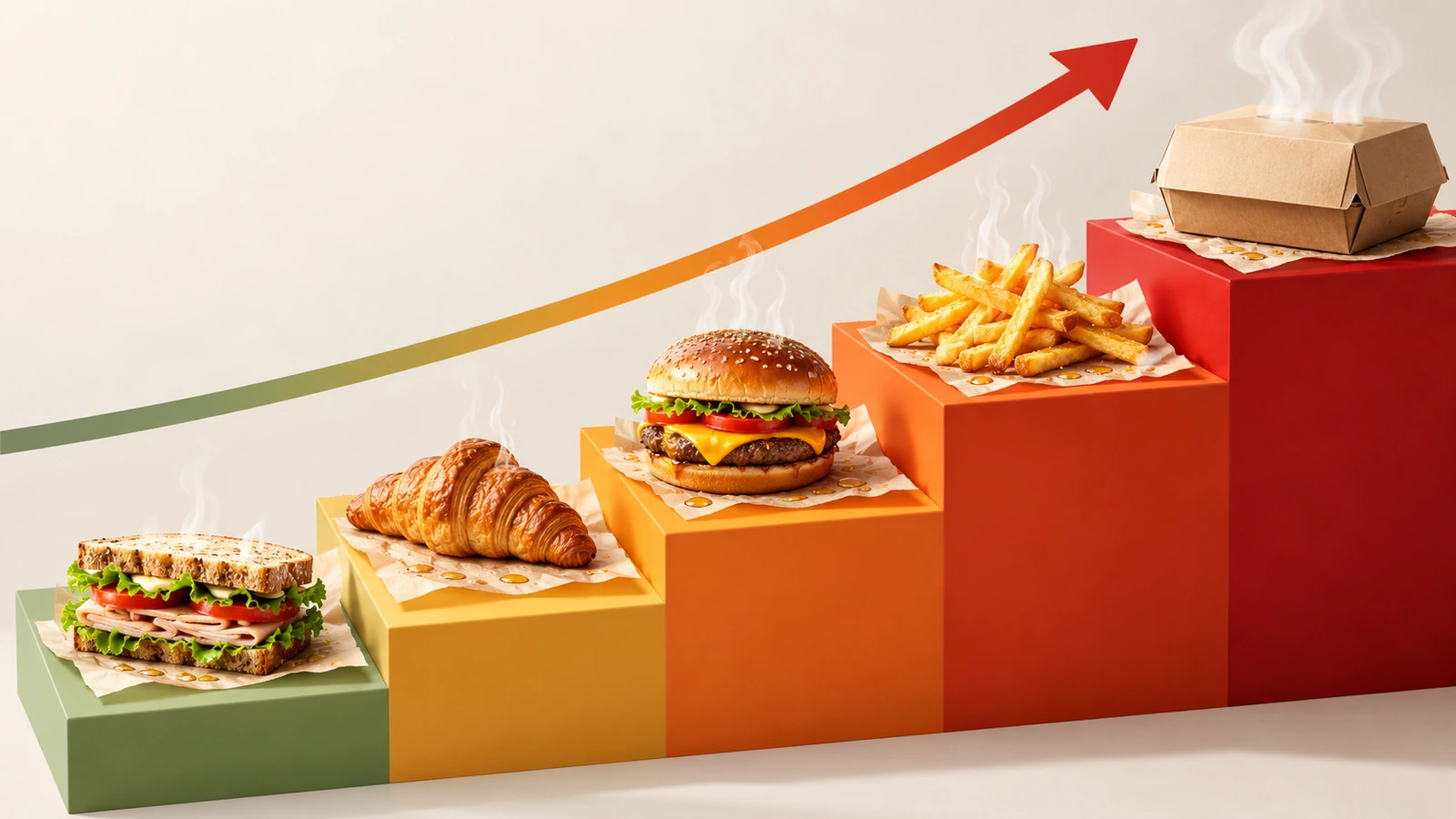
Step 1: Rank every menu item by oil load, temperature and hold time
Barrier demand rises with three things: fat content, heat and enclosed steam. Bag size does not drive it. A useful working ladder runs from low to highest:
- Cold sandwiches
- Pastries and bakery liners
- Hot burgers held under 30 minutes
- Fries or fried items in direct contact with oil
- Hot fried food in a closed pack for 30 to 60 minutes of delivery
Write down the worst case for each product family. One "universal" grade either fails on the fried items or overspends on the croissants.
Step 2: Choose the least-intensive barrier route that survives the worst case
Start with refined-pulp greaseproof or glassine. Move to a fluorine-free surface treatment or dispersion coating only if the real-food test fails. Move to a PE or PLA film only for sauces, wet proteins or long closed-box holds. Each step up adds protection and removes end-of-life options.
Step 3: Write the test methods into the specification
State the target Kit rating under TAPPI T 559. Say which face it applies to, the food-contact face or the printed face. Require the result after printing and folding, because ink layers and creases are where coatings crack. For refined-pulp grades, add TAPPI T 454.
Then define a pass condition for the real food. For example: "no visible strike-through on the outer face after X minutes at serving temperature." Agree in advance whether slight darkening at the edges is acceptable, so a borderline result does not turn into an argument later.
Step 4: Lock the compliance file per destination
For the U.S., ask for these documents:
- a declaration citing 21 CFR 176.170 or 176.180, or the relevant FCN, for the paper and each coating
- food-contact suitability statements for inks and adhesives
- a written statement of no intentionally added PFAS that names the specific paper grade and mill
For the EU, ask for a declaration of compliance under 1935/2004 and 2023/2006. Ask for a PFAS test report with a targeted scope and a total fluorine or polymeric scope, because a targeted "not detected" result alone does not prove the 50 ppm total limit. The EUROSAC Food Contact Guideline[10] notes that paper has no harmonised EU-specific measure. Many buyers therefore also reference Germany's BfR Recommendation XXXVI.
Step 5: Decide the end-of-life claim before choosing the coating
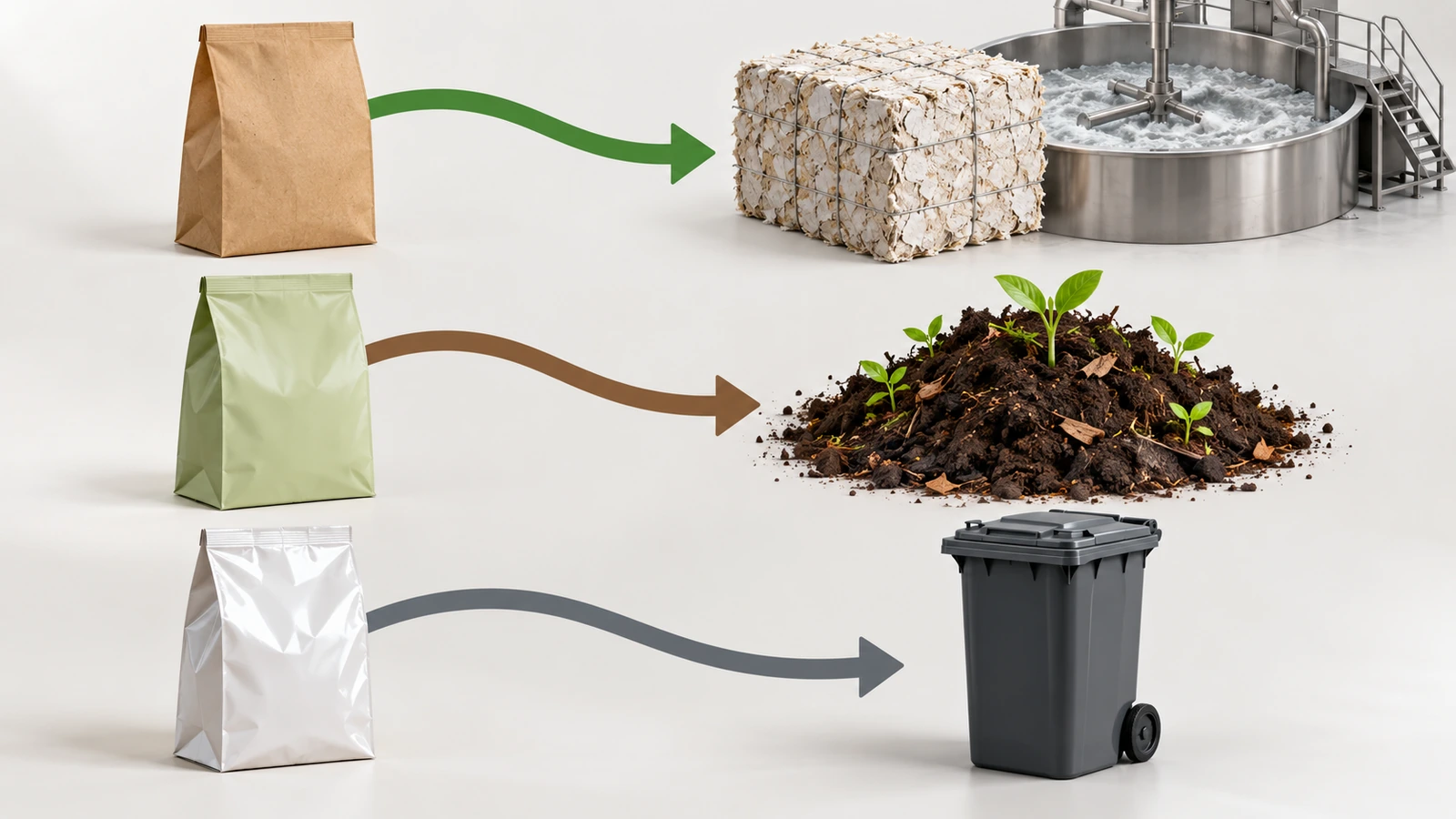
If you want to call the bag recyclable, prefer fibre-only barriers. Ask for repulpability evidence for any coating. If you want to call it compostable, the certification has to cover the finished bag under EN 13432 or the equivalent standard in your market. A certificate for the base paper is not enough. PLA linings also generally need industrial composting.
Be honest about contamination too. Heavily greased takeaway paper is usually not accepted in regular paper recycling, whatever the barrier technology.
Step 6: Treat every material change as a new specification
Any of these changes should trigger a fresh round of Kit testing, real-food testing and PFAS documentation:
- a new mill
- a new coating
- a different basis weight
- a larger printed area
Under the EU limits, recycled fibre and shared production lines can introduce non-intentional fluorine. That makes change notification a contractual clause, not a courtesy.
Supplier questions that separate documented barriers from marketing
Before comparing quotes, ask each supplier these six questions. A supplier who cannot answer them in writing is selling a label rather than a barrier.
- Which mechanism provides the barrier: refining, surface treatment or film?
- On which face, and after which converting steps, was the Kit rating measured?
- Does the PFAS declaration name the paper grade and mill?
- Does the EU test scope include total fluorine?
- Is there repulpability or compostability evidence for the finished item?
- How will you notify us of changes in raw materials?
Barrier technologies compared: which grease barrier paper fits which job?
| Technology | How it blocks grease | Best-fit load | Weak spot | Test method fit | End-of-life notes |
|---|---|---|---|---|---|
| Refined-pulp greaseproof | Heavy refining closes the capillary pores | Bakery, sandwiches, short holds | Hot oil combined with trapped steam | T 454 plus T 559 as a reference, plus real food | Fibre only; most compatible with paper streams when not heavily soiled |
| Glassine | Refined pulp, supercalendered to a dense, translucent sheet | Dry and low-fat bakery, confectionery | Moisture and steam | T 454 | Fibre only |
| Vegetable parchment | Acid-treated, fused fibre surface; often silicone-coated for baking | Oven and release uses | Over-specified and costly for counter takeaway | T 454 | Heavy silicone loads can complicate repulping |
| Fluorine-free surface treatment or dispersion coating | Starch, alginate, CMC or water-based barrier layer | Medium to high oil loads | Often adequate against oil but weaker against moisture | T 559 only after validation, plus real food | Depends on the coating; request repulpability data |
| Wax-coated | Paraffin or plant wax layer | Cold, short contact | Wax softens with heat | Real-food test | Wax can hinder repulping |
| PE or PLA film laminate | Continuous polymer film | Sauces, wet proteins, long closed-box delivery | End-of-life and reporting complexity | Real-food test (T 559 was not designed for films) | PE is hard to recycle; PLA needs industrial composting |
| Legacy fluorochemical sizing | Fluorinated surface repellency | Not for new specifications | U.S. FCNs ended; EU concentration limits apply | T 559 (its original target) | Fails the EU total-fluorine logic |
Moving away from fluorine is not free. According to an OECD analysis reported by Packaging Dive[11], the extra refining needed for mechanical greaseproof paper can slow production by about 30% compared with the old PFAS process. The same report notes that starch, plant-protein and chitosan coatings serve as adequate barriers to oil but not to moisture.
Making a barrier denser does not solve everything either. A materials researcher quoted by New Food Magazine[12] warned that an overly dense replacement keeps grease on the surface and makes fried food soggy. For hot, crisp items, venting and pack design matter as much as the Kit number.
FAQ
FAQ: Is greaseproof paper the same as parchment paper?
No. Greaseproof paper gets its barrier from densely refined fibre and is designed for wrapping and takeaway. Parchment is acid-treated and often silicone-coated so that it releases from baked goods and tolerates oven heat. Using parchment for counter bags usually means paying for heat resistance you do not need, and silicone can complicate recycling.
FAQ: What Kit rating do I need?
There is no universal answer. Kit ratings run from 1 to 12, and the right level depends on the fattiest item, its temperature and the longest hold time. Use the Kit number to compare suppliers and to check incoming lots. Accept the specification only after the actual food passes a timed hold test, because TAPPI itself says non-fluorinated and film barriers need separate evaluation.
FAQ: Is PFAS-free grease barrier paper less effective?
It can match legacy performance against oil, but often through different trade-offs. Refined pulp means slower production. Bio-based coatings tend to resist moisture less well. Film layers make end-of-life harder. Judge PFAS-free paper on a real-food test against your own menu, not on a direct comparison with old fluorochemical Kit numbers.
FAQ: Is there such a thing as "FDA-approved" greaseproof paper?
No. FDA regulates food-contact substances, not finished bags. Ask for a declaration that the paper, coatings, inks and adhesives comply with 21 CFR 176.170 or 176.180, or a valid FCN, for your food type. Ask for a separate statement on PFAS. Remember that state laws may go further than federal practice.
FAQ: Does thicker paper resist grease better?
Only marginally. Extra weight lengthens the path oil has to travel, but it does not close the pores that carry it. A lighter sheet with a validated barrier will outperform a heavier untreated sheet. Spend the budget on the barrier mechanism and the testing, not on extra weight.
FAQ: Can I still sell older greaseproof stock in the EU?
Only if it meets the PPWR limits. Since 12 August 2026, packaging first placed on the EU market must comply even if it was manufactured earlier. There is no general stock exemption, so test existing inventory before shipping it.
Key takeaways
- The Kit test was built for fluorochemicals, so pair it with real-food testing. — The Kit scale runs 1 to 12, and TAPPI says non-fluorinated barriers "would have to be evaluated" (Source)
- U.S. PFAS grease-proofing authorisations have ended, but there is no federal statute yet. — 35 FCNs ended on 6 January 2025 (Source)
- State laws, not only FDA, decide what you can ship within the U.S. — More than a dozen states have their own bans, and a proposed federal ban would start on 1 January 2028 (Source)
- EU limits count unintentional PFAS and give no stock grace period. — 25 ppb per substance, 250 ppb in total, 50 ppm total PFAS (Source)
- Mechanical barriers cost production speed rather than compliance risk. — Production can be about 30% slower than with the old PFAS process (Source)
- Weight was always a floor, not the barrier. — IS 6622 paired a 35 g/m² minimum with a 1,200-second grease penetration minimum (Source)
Conclusion: specify the barrier, not the word
"Greaseproof" stopped being a sufficient specification once fluorochemicals left the market. A robust grease barrier paper specification rests on five points:
- the barrier mechanism
- a Kit rating measured on the right face after converting
- a pass condition based on the real food
- a PFAS file matched to each destination market
- an end-of-life claim the coating can actually support
Choose the least-coated route that survives your fattiest menu item, and require change notification from every supplier.
If you are turning this specification into branded packaging for pastries, cookies or other counter takeaway, see our custom greaseproof paper bags and send us your menu, hold times and target markets. We will recommend a barrier route and quote against your approved specification.
References
- U.S. Food and Drug Administration. "FDA, Industry Actions End Sales of PFAS Used in US Food Packaging." 28 February 2024. fda.gov ↩
- Food Packaging Forum. "PPWR PFAS limits apply from August 12." 12 August 2026. foodpackagingforum.org ↩
- Deshwal, Panjagari and Alam. Review of paper-based food packaging, Journal of Food Science and Technology (PMC6801293), citing IS 6622-1972. pmc.ncbi.nlm.nih.gov ↩
- TAPPI. T 559 cm-12 (R2022), "Grease Resistance Test for Paper and Paperboard." tappi.org ↩
- TAPPI/ANSI. T 454, "Turpentine Test for Voids in Glassine and Greaseproof Papers" (current edition om-25, October 2025). tappi.org ↩
- U.S. Food and Drug Administration. "FDA Determines Authorization of 35 Food Contact Notifications Related to PFAS Are No Longer Effective." 3 January 2025. fda.gov ↩
- Packaging Dive. Report on federal PFAS food packaging legislation. 30 September 2026. packagingdive.com ↩
- Regulation (EU) 2025/40 on packaging and packaging waste (PPWR), Article 5(5). eur-lex.europa.eu ↩
- European Commission, DG Environment. "New EU rules on packaging enter into application." 11 August 2026. environment.ec.europa.eu ↩
- EUROSAC. "Food Contact Guideline." 2025. eurosac.org ↩
- Packaging Dive. Report on PFAS alternatives in food packaging, citing OECD (2020). packagingdive.com ↩
- New Food Magazine. "New Food explains what viable PFAS-free food packaging really requires." 23 September 2026. newfoodmagazine.com ↩












The information below is required for social login
Sign In
Create New Account