We use cookies to enable our websites to remember information, to help some website functionalities to work properly, to understand how you interact with and use our websites and to display you content and ads that are relevant and engaging for you.
By clicking Accept All you consent to the use of these cookie.
The store will not work correctly when cookies are disabled.
Quick answer: For glass, use single-color cut vinyl transfers for storefront lettering, door signage, and anything that must look clean from both sides. Use printed transfers only when the artwork needs full color. Then choose the adhesive and mounting side based on how the glass will be cleaned, washed, weathered, and eventually stripped.
Most buyers searching for custom transfer stickers for glass have already seen a "transfer" order go wrong. A logo looks sharp from the sidewalk but shows a flat white silhouette to staff inside. Branded tumblers start lifting at the rim after a few dishwasher cycles. Seasonal window graphics leave adhesive ghosts that the cleaning crew has to scrape off before the next campaign goes up.
None of these failures are random. Glass is one of the easiest surfaces to bond to, so problems rarely come from the glass itself. They come from choosing the wrong construction for the viewing side, the cleaning routine, and the removal date. Fixing them after installation means reprinting, re-booking installers, and possibly re-shooting store photography. This guide works through those decisions in the order a B2B buyer has to make them, then compares cut vinyl, printed transfers, and the alternatives for each type of glass job.
What Counts as a Transfer Sticker on Glass?
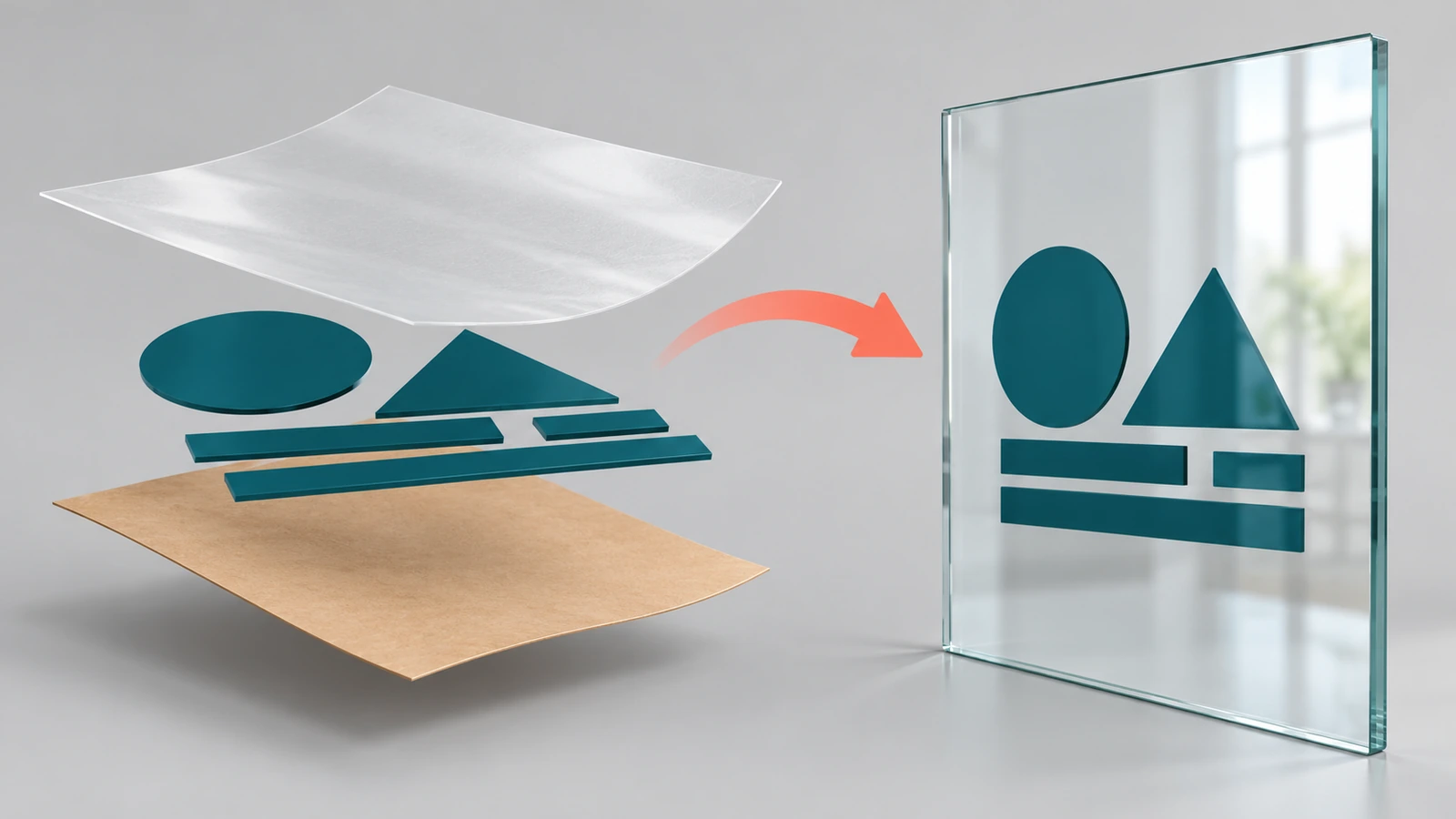
A transfer sticker is a decal with no background film between its parts. Letters, shapes, or printed pieces sit on a release liner. A sheet of application tape holds them in register, and once applied, only the artwork stays on the glass. On a window that matters a great deal: the glass itself becomes the background, so there is no clear or white rectangle catching glare or collecting dirt along its edge. The product page explains how cut vinyl transfer decals with application tape are built in more detail, so this guide focuses on how that construction behaves on glass.
On glass, two families dominate:
Cut vinyl transfers. These are cut from solid-color film. Because the color runs through the film, there is no ink to scratch or fade, but each color is a separate layer.
Printed transfer stickers. These are printed in full color on a base film, usually white, and then cut into pieces. They can reproduce gradients and photos, but they carry the durability limits of the ink and of any protective coating.
A third route, UV DTF image transfers, competes on drinkware and small glass items. "Vinyl" is not a single specification either. An independent review makes the point that "vinyl sticker" does not identify one material system[1]. It can mean printed film with or without laminate, computer-cut colored film, or conformable cast film. The same review concludes that UV DTF is not a universal upgrade. Vinyl remains the easier route to specify when a job depends on a particular adhesive, removability, or large-format window work.
How to Choose Custom Transfer Stickers for Glass, Job by Job
Work through these five decisions in order. Each one narrows the options for the next.
Step 1: Decide which side of the glass the viewer stands on
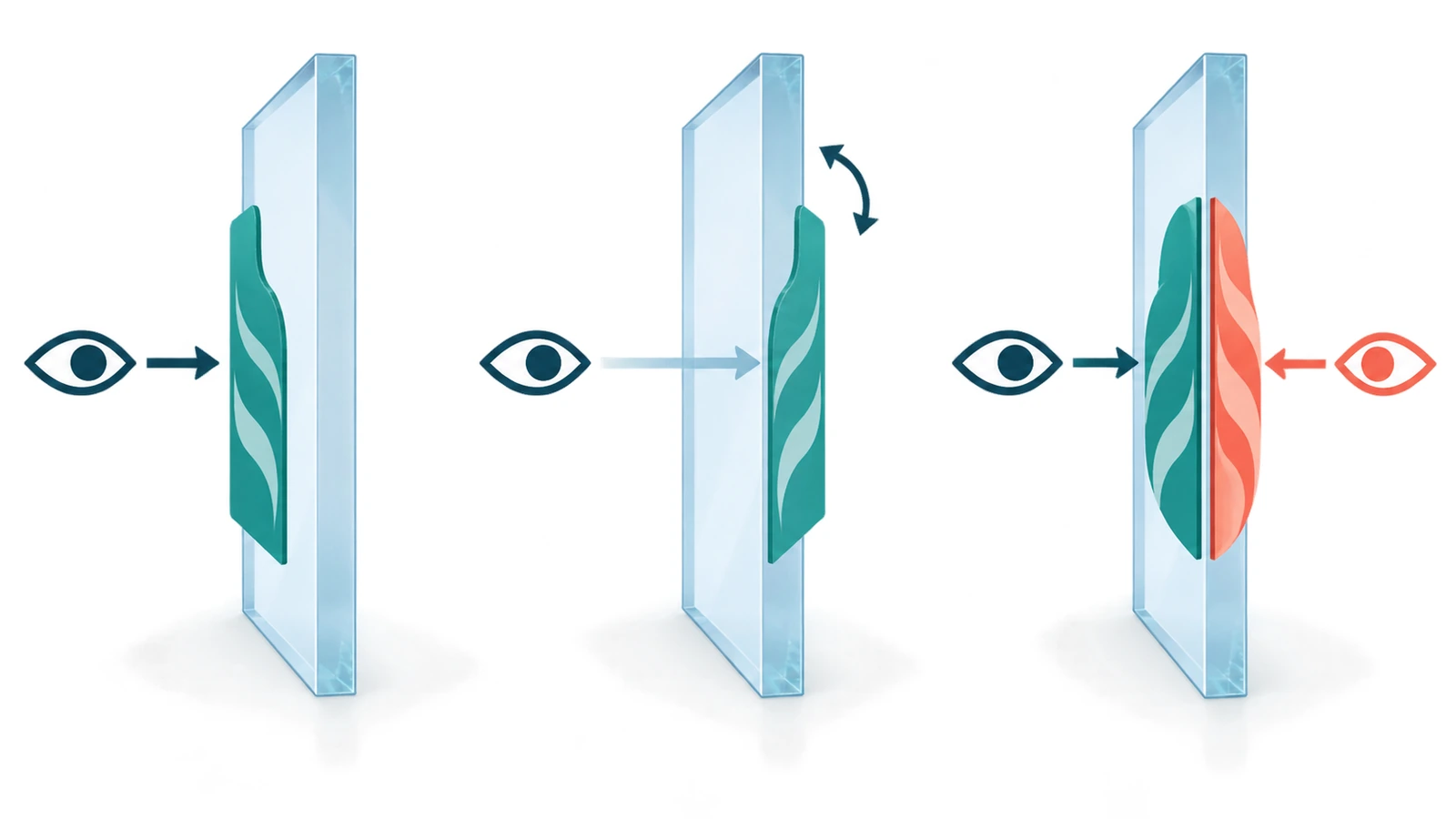
Glass is the only common substrate people see from both sides, and this is where most transfer orders fail. There are three viewing setups:
First-surface mount (outside face, read from outside). Colors look most saturated and there is no reflection layer in front of the graphic. The trade-off is that the decal faces weather, squeegees, and anyone with a fingernail.
Second-surface mount (inside face, read through the glass). The artwork must be mirrored, and the adhesive side becomes the viewing side. Weather and vandalism stop being a concern, but the glass adds reflection, and any adhesive haze shows.
Two-way viewing. Glass doors and partitions are seen from both sides. A single cut vinyl layer shows its face from one side and its back from the other. The back may not match the face color, so ask for a swatch. A printed transfer on white film shows a white silhouette from the reverse. For true two-sided branding, the usual answer is two registered layers, one of them mirrored.
Step 2: Match the construction to the glass job
Storefront windows. These need brand marks, opening hours, and promotions that change by season. Solid-color cut vinyl handles lettering and simple marks best. Mounting on the inside avoids exterior window cleaning, but it requires mirrored files. Large printed promotions are better treated as short-term graphics with removable adhesive.
Glass doors. Push/pull markers, hours, and logos at hand height get touched hundreds of times a day. Keep transfers out of the hand zone where you can. Inside-mounted text survives cleaning better, and two-way doors need the two-layer build described in Step 1.
Branded glassware. Tumblers, pint glasses, and jars curve in at least one direction. Hot water, alkaline detergent, and constant handling attack the decal edges. This is the hardest glass job for any pressure-sensitive decal.
Bottles. Cold-chain bottles collect condensation, and wet glass is a poor surface to apply anything to. Apply decals before filling and chilling. If the bottle is sold as packaging, the regulatory questions in the compliance section below apply as well.
Step 3: Rate the exposure honestly
Exposure on glass falls into three tiers, and each one calls for a different construction:
Interior-protected. Inside mount, read through the glass, wiped occasionally. Most constructions work here. Window glass filters part of the UV spectrum but not all of it, so printed colors still fade more slowly than cut film.
Exterior-vertical. Rain, sun, and squeegees. Cut vinyl outlasts unlaminated print here. Film makers publish durability ratings for flat, vertical exposure, so ask your supplier which film is specified and what its rating assumes.
Wash-cycle. Glassware and reusable bottles. Treat "dishwasher safe" as a claim that needs evidence. Many printed transfers ship without a protective laminate. Some UV DTF wash tests published online come from the sellers themselves rather than independent labs. For commercial dishwashing at volume, etched or fired ceramic decoration may be a better choice than any sticker.
Step 4: Plan the removal before the install
Glass is a high-surface-energy material, which is good news on both ends. Adhesives wet out well on it, and removable adhesives usually let go cleanly. Permanent adhesive builds bond strength with time and heat, especially on sunlit exterior glass. For campaign graphics that come down within a season, specify removable adhesive. For brand marks expected to stay for years, specify permanent. Plastic or razor scrapers are generally safe on plain glass. Check before scraping coated, tinted, or film-covered panes, because a blade can damage the coating.
Step 5: Ask for adhesion evidence, not adjectives
Words like "strong grip" and "clean release" can't be compared between suppliers. Test methods can. The label industry association FINAT publishes a catalogue of test methods[4], including FTM 1 (180° peel adhesion at 300 mm/min), FTM 9 (loop tack), and FTM 14 (dimensional stability). The trade publication Labels & Labeling has a plain-language overview of pressure-sensitive test methods[5]. Ask for peel results on glass, or for the film and adhesive data sheet reference, and request a physical sample on your actual glass before you approve a volume run. Letter-size limits and pre-shipment checks are covered on the custom vinyl transfer stickers product page.
Compliance Signage and Packaging Rules on Glass
Custom transfer decals often carry required information: opening hours, door instructions, warnings, or product labeling on bottles. No single U.S. standard covers "transfer stickers." Instead, a handful of separate rules apply depending on what the decal does and where the product is sold.
Safety markings on equipment. If a glass panel belongs to a machine, appliance, or enclosure and the decal carries safety information, the relevant standard is UL 969, Marking and Labeling Systems. Its 6th edition, published in 2025[6], evaluates the whole system: face material, ink, any laminate, and the specified substrate. A UL-recognized adhesive component does not make a finished decal compliant. Storefront promotional graphics normally fall outside this scope.
Accessibility and door-safety markings. Permanent room-identification signs under accessibility rules usually require raised characters and Braille, which flat vinyl cannot provide. Some jurisdictions also require visibility markings on full-height glass. Check requirements with the local code official before ordering, not after installation.
California Proposition 65. Products sold into California may need warnings. The industry association SEMA summarizes the Prop 65 warning format[7]: a yellow triangle symbol, the word "WARNING," at least one listed chemical, and the P65Warnings website. Flexible PVC is a common source of DEHP, a listed chemical. In addition, OEHHA added bisphenol S (BPS) to the list[8], with warning obligations effective from 29 December 2024. Ask your supplier to state whether the inks, adhesives, or coatings contain BPS.
Children's products. A glass decal sold to adults does not need CPSIA testing just because it is vinyl. If the decal or its packaging is designed for children 12 and under to play with, the CPSC phthalate limit of 0.1% (1,000 ppm)[9] applies to accessible plasticized parts.
Bottles and jars shipped to the EU. Since 12 August 2026, food-contact packaging above the PFAS thresholds in Regulation (EU) 2025/40 may not be placed on the EU market. FINAT's May 2026 PFAS note[10] explains that the limits apply to the finished package, not to the label alone. Each component's contribution still has to be assessed and documented, and there is no transition period for existing stock.
Sustainability claims. Avoid calling vinyl decals "compostable" or "plastic-free." Even where regulators are looking at sticker waste, the conclusions have been cautious. A 2025 Washington Department of Ecology assessment[11] recommended that the state wait before banning plastic produce stickers or requiring compostable ones, because the alternatives are not yet mature.
Cut Vinyl vs. Printed Transfers vs. Alternatives on Glass
The table compares the main options on the criteria that matter for glass. Ratings are relative, and actual performance depends on the specific film, adhesive, and installation.
Criterion
Cut vinyl transfer
Printed transfer
UV DTF image transfer
Clear printed sticker
Look on glass
No background; solid color reads like paint
No background around pieces; full color
No visible film; slightly raised ink
Clear film edge visible on glass
Reverse-side view
Back of film; ask for a swatch
White silhouette unless double-layered
Back of the ink layer
Mirrored print through the film
Color range
Solid colors, one layer each
Gradients and photos
Gradients and photos
Gradients and photos
Exterior vertical glass
Strongest of the four with suitable film
Shorter without laminate
Not the usual choice for signage
Depends on laminate
Wash cycles (glassware)
Hand wash recommended
Weakest without laminate
Often claimed; ask for test evidence
Laminated versions are better
Removal
Clean with removable adhesive; one piece at a time
Clean with removable adhesive; one piece at a time
Usually permanent
Fastest; comes off in one piece
Best glass job
Storefront lettering, door hours, simple logos
Color logos on interior glass
Tumblers, jars, small glass items
Full-color packaging and short campaigns
Two patterns stand out. For anything read from the street over several years, cut vinyl is the default. For anything washed repeatedly, no transfer construction should be approved without wash-test evidence on your own glassware.
FAQ
FAQ: Can one transfer sticker read correctly from both sides of a glass door?
Not if it is printed. A single printed layer looks correct from one side only. Two-way doors need two registered layers, one with mirrored artwork, or a single cut vinyl color whose back you have checked and approved from a physical swatch.
FAQ: Should storefront graphics go on the inside or outside of the window?
Inside mounting protects graphics from weather, scrapers, and exterior cleaning, but the files must be mirrored and the glass adds reflection. Outside mounting gives the most saturated color. It suits cut vinyl better than unlaminated print.
FAQ: Are custom transfer decals dishwasher safe on glassware?
Treat any dishwasher claim as unproven until it is tested on your own glassware with your own detergent and wash cycle. Unlaminated printed transfers are the weakest option here. For commercial dishwashing at volume, consider etching or fired ceramic decoration instead.
FAQ: Will transfers leave residue on glass when removed?
Removable adhesive usually releases cleanly from plain glass. Permanent adhesive bonds more strongly over time and in sun-heated conditions. Specify the adhesive based on when the graphic will come down, and check before using a blade on coated or film-covered glass.
FAQ: Can a vinyl transfer be used for required signage?
It works for informational text such as opening hours. Safety markings on equipment fall under UL 969 system evaluation, and accessible room-identification signs usually need raised characters, which flat vinyl cannot provide. Confirm the requirements with your code official first.
Key Takeaways
Safety labels are judged as a complete system, not as a sticker alone. — UL 969, 6th edition, 2025 (Source)
Compare suppliers on peel test data, not on adjectives. — FINAT FTM 1: 180° peel at 300 mm/min (Source)
Glass bottles sold as EU food packaging must meet PFAS limits. — 25 ppb for any individual PFAS, from 12 August 2026 (Source)
Children's decals trigger U.S. phthalate rules. — 0.1% (1,000 ppm) limit for products designed for ages 12 and under (Source)
Ask suppliers about BPS in inks and adhesives for products sold in California. — Prop 65 warnings required from 29 December 2024 (Source)
Compostable sticker claims are still ahead of the technology. — 2025 state assessment recommended waiting before any ban (Source)
Conclusion
Choosing custom transfer stickers for glass comes down to four answers, decided before the artwork is approved: which side people see the decal from, what the glass is exposed to, when the graphic comes down, and what rules apply to its content. Cut vinyl covers most storefront and door work. Printed transfers suit protected full-color graphics. Glassware needs wash evidence before any construction is approved. If you have a glass project to quote, send us the glass type, the viewing side, the exposure, and the removal plan. We will recommend a construction and supply a sample before the production run. See the custom vinyl transfer stickers page to start your inquiry.
Hi there! I'm Bruce, proud dad to my amazing son. I'm the founder of Zigpac, a printing and packaging company empowering small and medium-sized businesses with custom solutions. Let's create something great together!



 Blog PDF for offline reading









The information below is required for social login
Sign In
Create New Account