


 Blog PDF for offline reading
Quick answer: UV transfer stickers are full-color designs printed in stacked layers of UV-cured ink and adhesive between a backing liner and a clear carrier film. You press the sticker onto a smooth, hard surface and peel the film away, so only the artwork stays on the product, with no background.
If you searched "what are UV transfer stickers," you have probably seen the term next to "UV DTF," "metal transfer," "foil transfer," and "chrome decal," and it is not clear whether these are the same product. They are not. This guide explains how a UV transfer is built and which hard-surface products it suits. It also covers where it stops being the right tool, and why a brand that needs a logo that looks and feels like real metal is usually better served by an electroformed nickel transfer.
Why "Transfer Sticker" Orders Go Wrong
The problem: Buyers, and even suppliers, use one word for several processes. A request for "transfer stickers" (or the common misspelling "tranfer stickers") can return a printed UV transfer, a cut metallic vinyl decal, a hot-stamped foil, or a solid electroformed metal logo. Each one is made differently, fails differently, and costs a different amount.
The pain: The same failures appear again and again in public reviews and maker forums. Fine lettering stays stuck to the carrier film instead of releasing onto the product. Edges lift a few weeks after a batch ships because the adhesive did not match a powder-coated or textured surface. A "gold" logo arrives flat because it was metallic ink, not metal. Hobbyists who use small metal transfers on models report the same split. Large, flat applications look excellent. Tiny pieces over curved or angled edges pop off.
The solution: Once you understand the layers inside each product, you can match the process to the surface, the handling it will see, and the look your brand needs. You can do this before you approve artwork, not after a full run has failed.
What Are UV Transfer Stickers, Exactly?
A UV transfer sticker is a die-cut-free graphic. There is no white or clear sticker face around the design. Ink is printed directly onto a release liner and then hardened ("cured") almost instantly by ultraviolet light. Because UV ink cures before it can spread, the printer can stack several layers in exact register: adhesive, a white base, the color layer, and a clear protective coat. A clear transfer film then holds every separate part of the design in position until it is applied.
The trade name you will most often see is "UV DTF" (UV direct-to-film). For a buyer, the practical meaning is simple. You get photographic color, gradients, and small type on a hard surface, applied by hand pressure with no heat press. You do not get a tactile metal part. Any "metallic" UV transfer is printed or foil-laminated color sitting on an ink film.
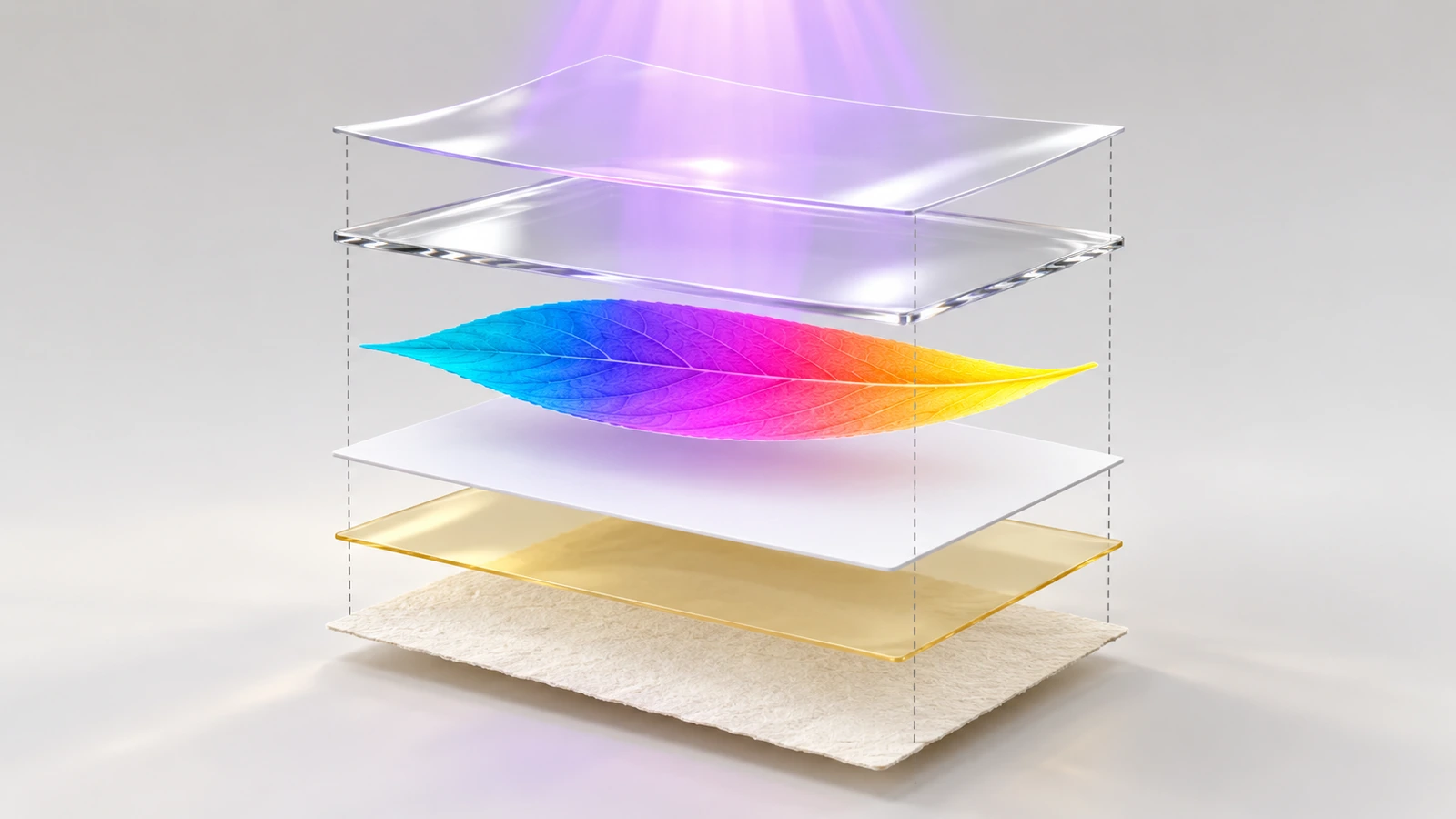
How the Layered UV-Cured Construction Works
Each layer has one job. If one layer is wrong for your product, the whole sticker fails. From the bottom up:
- Release liner (backing). This is a coated sheet the ink is printed on. It has to let go of the adhesive cleanly. When it holds too tightly, fine details stay behind on the liner, which is the most common complaint in public reviews of transfer products.
- Adhesive layer. This pressure-sensitive layer is what actually bonds to your product. It is the layer most affected by surface energy. Glass and smooth metal bond easily. Low-energy plastics, silicone-treated finishes, and textured powder coat often do not.
- White base. This layer makes colors opaque on clear glass or dark housings. If it is left out, the color turns translucent on a clear surface.
- Color layer. CMYK plus spot colors, cured under UV LEDs. This is why UV transfers handle gradients and photos that metal or cut vinyl cannot.
- Clear varnish. A top coat for gloss, raised texture, and scratch and water resistance. It protects the color, but it is still a polymer film. It is not metal.
- Clear transfer film. A tacky carrier that keeps every letter aligned. You remove it after the design is burnished onto the product. Its tack has to be lower than the adhesive's grip on your surface, or it pulls the graphic back off.
Two limits come straight from this construction. First, the final layer the user touches is cured ink and varnish, so a fingernail or key ring meets polymer, not metal. Second, most UV transfer constructions are marketed as water-resistant but not heat-resistant. Suppliers commonly advise against dishwasher cycles and hot surfaces, so treat any "dishwasher safe" claim as something to verify by testing.
Which Hard-Surface Products They Suit
UV transfers do well on smooth, rigid, clean surfaces that are hand-washed or rarely washed:
- Glass candle jars, cosmetic and spirit bottles with gentle curves
- Rigid paperboard gift boxes, tins, and acrylic displays
- ABS and polycarbonate housings for small electronics, after a sample test
- Stainless or painted metal bottles and tool cases kept out of the dishwasher
- Promotional and event items where full color matters more than long service life
They are a poor fit for fabric and stretch materials (those need heat-applied transfers), surfaces that get hot in use, tight curves with a small radius, and freshly painted or powder-coated parts that have not fully cured. The general rule that pressure-sensitive graphics should not go on grills, exhausts, or other hot surfaces applies here as well.

How to Apply a UV Transfer Sticker Correctly
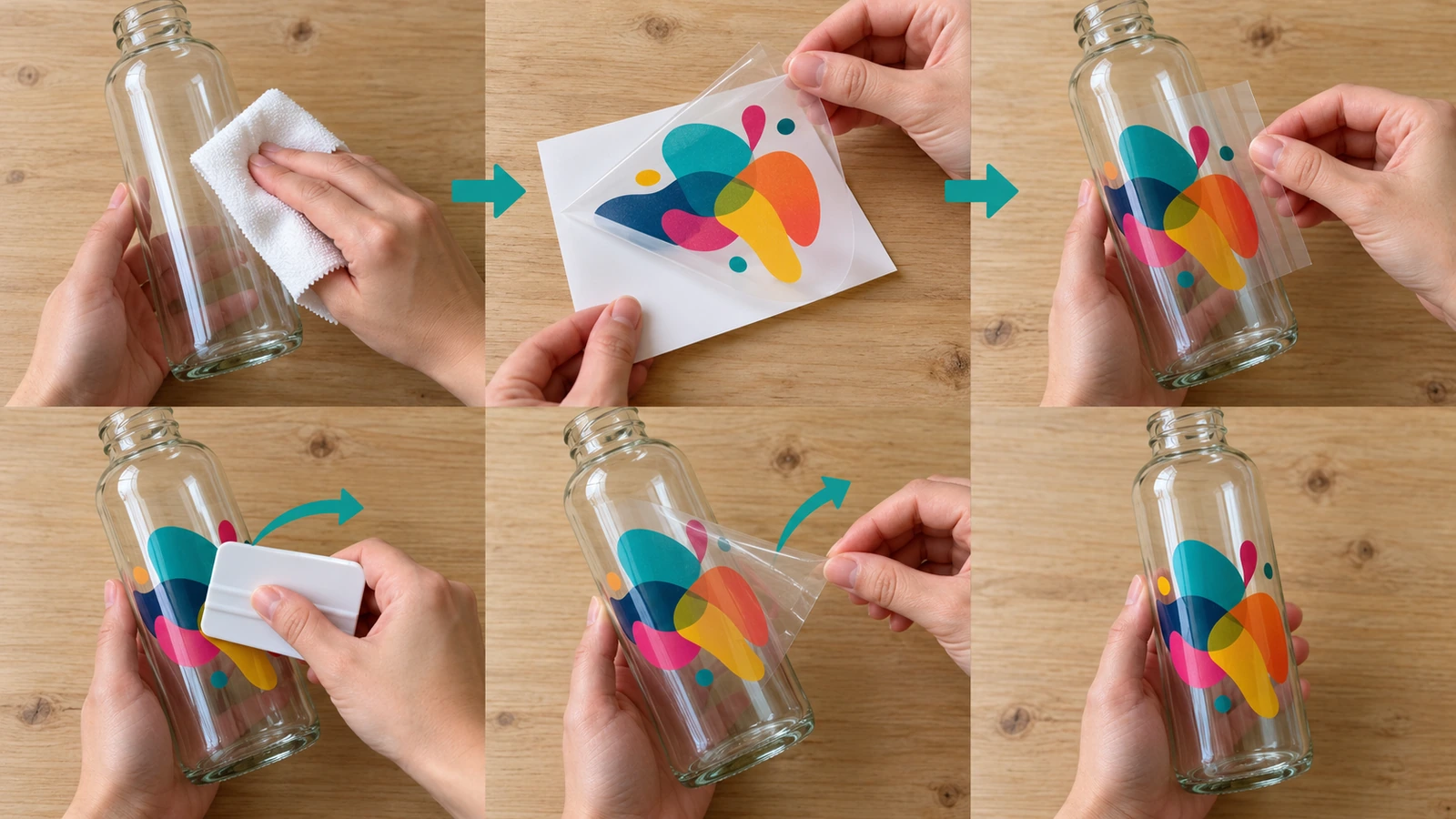
Most UV transfer failures are application failures. Put this sequence in your packing instructions or your assembly-line SOP:
- Prepare the surface. Degrease with a neutral cleaner, then wipe with isopropyl alcohol and let it dry completely. Avoid glass cleaners that contain ammonia or shine additives, which leave a film the adhesive cannot grip.
- Check the temperature. Work in shade at roughly 50–90°F (10–32°C). Cold makes the adhesive sluggish. Heat makes it grab before you have positioned the graphic.
- Peel the liner, film side up. Lift the clear film and graphic away from the backing slowly. If small details stay on the liner, lay it flat, rub over those areas again, and retry.
- Position and burnish. Place the graphic, then press from the center outward with a squeegee or your thumb to push out air. Spend extra time on thin strokes and small letters.
- Remove the film low and slow. Fold the transfer film back on itself and peel at a low angle. If any element starts to lift, lay the film back down and burnish that spot again.
- Let it cure. Avoid washing, abrasion, or stacking pressure for about a day so the adhesive can wet out fully.
Before you approve a bulk run, apply samples to the actual product, not a test sheet. A quick way to compare finishes is to borrow the crosshatch method from ASTM D3359[1]. Its six-step scale runs from 5B (no removal) to 0B (more than 65% removed). It was written for coatings, not finished stickers, so use it to screen and compare options, not as a durability guarantee.
UV Transfer vs. Metal Logo: Where the Line Falls
The real decision is between printed color and actual metal. The table compares the four processes buyers most often confuse.
| Attribute | UV transfer (UV DTF) | Metallic vinyl decal | Hot-stamped foil | Electroformed nickel transfer |
|---|---|---|---|---|
| What you touch | Cured ink and varnish | Metallized plastic film | Microns-thin foil on top surface | Solid nickel |
| Full color and gradients | Yes | Limited | No, solid areas only | No, a few metal tones |
| Fine text | Strong | Weak below small letter heights | Bold strokes only | Good, within the factory's minimum line width |
| Tactile relief | Slight, from varnish | None | None | Yes, a raised metal edge |
| Scuff behavior | Protected by varnish | Moderate | Scuffs fastest | Metal resists scuffing; adhesive edges are the weak point |
| Heat | Generally not heat-resistant | Limited | Process-dependent | Depends on the adhesive system |
| Best for | Colorful labels on glass, boxes, housings | Low-cost, short-life metallic look | Packaging accents | Premium brand marks on bottles, devices, gift boxes |
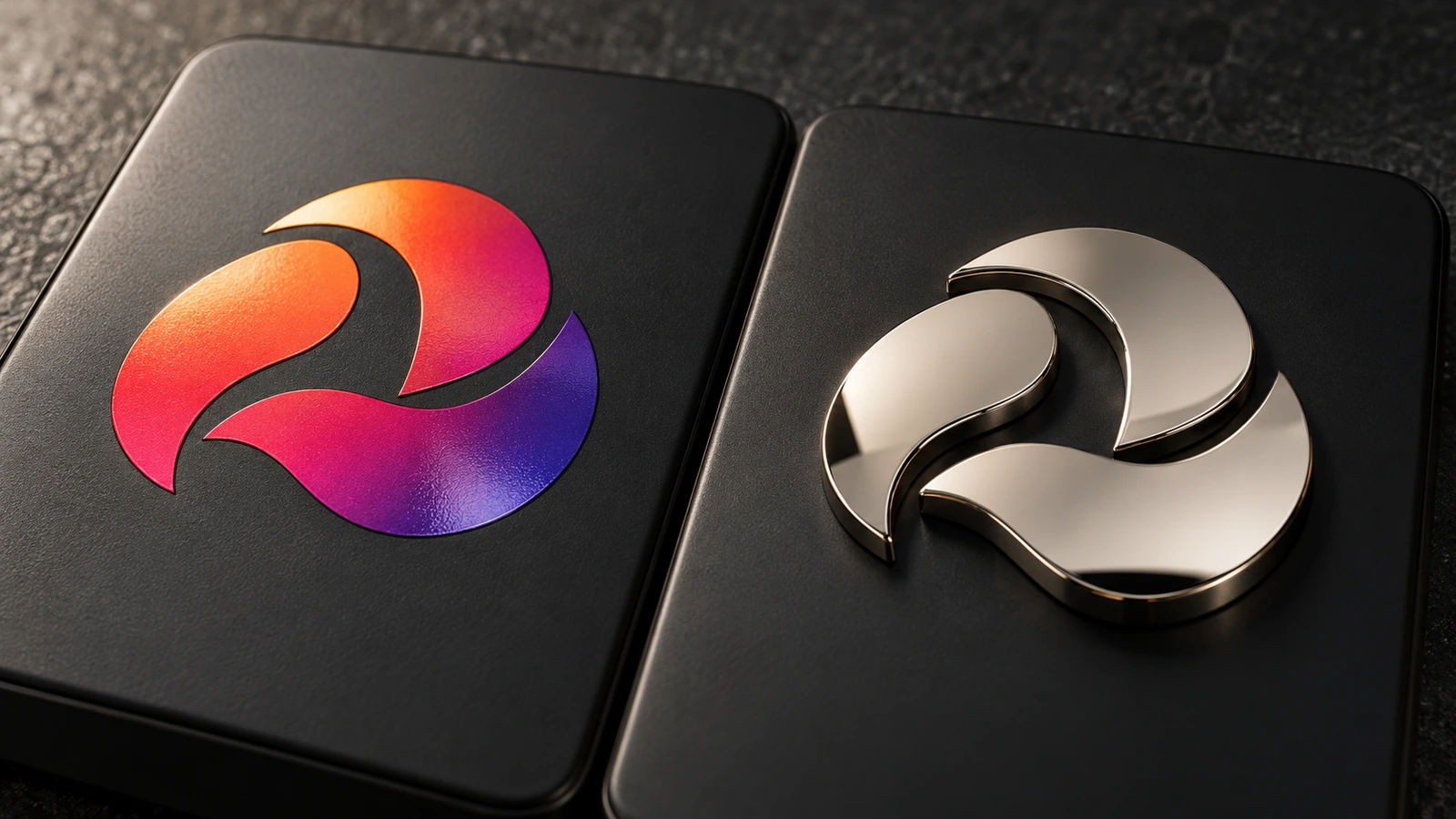
A UV transfer is the right call when the brief says "full-color logo, hard surface, quick turnaround." It stops being the right call when the brief says "it must look and feel like a metal badge." No amount of metallic ink reproduces the reflection and edge of real nickel. On mirror-finish printed effects, small features such as QR codes and thin negative space also lose contrast.
Electroformed logos are made by depositing nickel onto a patterned master. They are a different family from printed transfers, closer to the fine-metal etching and plating described in patent literature such as KR101289806B1[2], which records metal substrates of 0.04–0.3 mm and photoresist of 15–40 µm. The trade-offs mirror the UV transfer. You get real metal and relief, but no gradients, only a small palette of metal finishes, and you need careful sample approval. If that is the look you need, see our custom electroformed metal transfer logos. That page covers specification, finishes, and approval, so we will not repeat them here.
The market split reflects this division. Future Market Insights[3] valued metal decals at USD 1.3 billion in 2025 with a 3.6% CAGR to 2036. Packaging Market Insights[4] puts the 2026 figure at USD 3.12 billion. The two firms measure different scopes, so neither number should be quoted alone. The broader metallic-look label segment, which includes printed and foil effects, was put at USD 2.9 billion in 2025 by a separate FMI metallic labels study[5]. Most "metallic" stickers on the market are printed effects, not metal.
Standards and Compliance Questions to Ask
No single ISO or ASTM product standard covers UV transfer stickers. The standards that matter depend on where the sticker goes:
- Permanent markings on electrical equipment. If the sticker carries safety or rating information, ask whether the construction (face, ink, adhesive, and target surface together) is evaluated under UL 969 Edition 6 (2025)[6]. Recognition applies to specific listed constructions through the UL marking and labeling program[7]. A recognized adhesive does not make every finished sticker compliant.
- Parts of electrical and electronic equipment sold in the EU. RoHS Directive 2011/65/EU[8], as amended, restricts 10 substances. A label on a gift box does not fall under RoHS just because it looks metallic.
- Nickel logos in prolonged skin contact. REACH Annex XVII, entry 27[9] limits nickel release to 0.5 µg/cm² per week. This is relevant for jewelry boxes or wearables. It usually is not relevant for appliance panels.
- Safety history. Our review of the CPSC recall database[10] found no dedicated recalls for transfer or metal logo stickers. Recalls of metal wall plates or metallic mugs involve different products and should not be read as sticker incidents.
Also plan for removal. Strong permanent adhesives can leave residue or discolor bare metal, and hard scraping scratches it. The Spruce's removal guide[11] recommends softening the adhesive and testing solvents in a hidden spot first. If your product is meant to be rebranded or rented, specify a removable adhesive from the start.
FAQ
FAQ: Are UV transfer stickers the same as UV DTF stickers?
In practice, yes. "UV DTF" is the printing-industry name for the same construction: UV-cured layers printed onto film and transferred to a hard surface by pressure. Some sellers also use "UV transfer" loosely for foil-laminated versions, so ask whether the metallic areas are ink, foil, or metal.
FAQ: Can UV transfer stickers go on clothing or tote bags?
No. They are designed for rigid surfaces and crack or peel on flexible fabric. Textiles need heat-applied transfers, such as DTF or heat transfer vinyl, pressed at the temperature and time specified for that film.
FAQ: Are UV transfer stickers dishwasher safe?
Do not assume they are. Most constructions are described as water-resistant but not heat-resistant, and dishwashers combine heat, alkaline detergent, and spray force. If the end product is drinkware, test on the real cup through actual wash cycles, or label it hand-wash only.
FAQ: Why did small letters stay on the backing when I peeled the film?
The transfer film grips the graphic less firmly than the liner holds the adhesive, usually because the design was not burnished long enough or the room was too cold. Lay the film back down, rub firmly over the fine details, and peel again slowly. For designs with very small type, ask for a sample first.
FAQ: When should I choose a metal logo instead of a UV transfer?
Choose metal when the logo is the product's main brand signal and has to read as a real metal part: raised edges, true mirror or brushed reflection, and no printed look up close. Perfume bottles, premium audio housings, and luxury gift boxes are typical examples. Stay with UV transfers when you need full color, gradients, or photographic artwork.
FAQ: How do I compare two suppliers' samples fairly?
Apply both on the same substrate under the same conditions, let them cure, then run identical checks. Use a crosshatch tape test, an alcohol wipe, a fingernail scratch, and a few days at the heat and humidity the product will see. Record the results with photos rather than relying on words like "waterproof" or "durable."
Key Takeaways
- Use the ASTM crosshatch scale to compare samples, not to promise lifespan. — 6 rating levels, from 5B (0% removal) to 0B (>65% removal) (Source)
- Labels that carry safety information need a recognized construction, not just a recognized adhesive. — UL 969 Edition 6, published 2025 (Source)
- RoHS applies only when the sticker is part of electrical or electronic equipment. — 10 restricted substances (Source)
- Nickel logos on items in prolonged skin contact need a nickel-release check. — 0.5 µg/cm² per week limit (Source)
- Metal decal market estimates differ by scope, so cite the firm and the year. — USD 1.3 billion (2025, FMI) vs. USD 3.12 billion (2026, PMI) (Source)
- Most "metallic" labels are printed or foil effects, not solid metal. — USD 2.9 billion metallic labels market in 2025, growing at 5.0% CAGR (Source)
Conclusion
UV transfer stickers are layered, UV-cured graphics that bring full color to glass, rigid boxes, and plastic housings with no background and no heat press. Their strengths, which are color, gradients, and fine type, come from the ink stack. Their limits, which are a polymer surface, sensitivity to heat, and poor results on tight curves, come from that same stack. Match the process to the surface and the brand signal. Use UV transfers for colorful, smooth-surface branding. When the logo has to be real metal, move to an electroformed metal transfer logo and request a sample on your own product before committing to volume.
Sources
- ASTM International, D3359 Standard Test Methods for Rating Adhesion by Tape Test ↩
- Google Patents, KR101289806B1 (fine metal etching process parameters) ↩
- Future Market Insights, Metal Decal Market (updated 2026-05-21) ↩
- Packaging Market Insights, Metal Decal Market (updated 2026-07-14) ↩
- Future Market Insights, Metallic Labels Market (2025-10-12) ↩
- ANSI Webstore, UL 969 Ed. 6-2025, Marking and Labeling Systems ↩
- UL Solutions, Marking and Labeling Systems Program ↩
- EUR-Lex, Directive 2011/65/EU (RoHS), consolidated version ↩
- EUR-Lex, Regulation (EC) No 1907/2006 (REACH), Annex XVII ↩
- U.S. Consumer Product Safety Commission, Recalls ↩
- The Spruce, How to Remove Stickers From Metal (2021-11-08) ↩













The information below is required for social login
Sign In
Create New Account