


 Blog PDF for offline reading
Quick answer: A fin seal bonds the pouch's inner sealant layer to itself and folds flat as a raised fin, so it works with almost any laminate that has one heat-sealable inside layer, including foil and metallized structures. A lap seal overlaps the inner layer onto the outer surface. It lies flatter and uses less film, but it only runs when both film surfaces can be heat-sealed together. For most barrier laminates used for dry products, specify a fin seal. Choose a lap seal when you use a both-sides-sealable mono film and want to save film or keep the back panel flat.
When you compare a fin seal vs lap seal pouch, you are really choosing how the long seam on the back of a center-seal (also called back-seal, T-seal or pillow) pouch is built. That choice decides which films you can use, how the seam carries load, how much film each pouch consumes, and where your artwork gets interrupted. Buyers often leave it off the RFQ entirely, and that one gap explains many quotes that cannot be compared.
Why the Back Seal Type Belongs in Your Specification
The problem: Two suppliers both quote a "center seal pouch." One prices a reverse-printed PET/PE laminate with a fin seal. The other prices a coextruded film with a lap seal. Unit prices, film widths and lead assumptions all differ, and nobody has said which construction will actually run on your form-fill-seal line.
Why it hurts: The back seam and the point where it crosses the top and bottom seals are where flexible pouches most often fail. The FDA's Bacteriological Analytical Manual guidance on flexible packaging lists channel leaks, contaminated seals and corner leakers as defects, and directs inspectors to look closely where the head seal crosses the side seal FDA BAM flexible packaging examination[1]. The cost is not hypothetical. A 2025 peer-reviewed analysis of FDA recalls from January 2019 to January 2025 found 791 seal-integrity-related product IDs. Pouches or bags accounted for 74.8% of them, and 54% (430 of 791) were classified as "incomplete or defective seal" seal-integrity recall study[2]. Those are medical products, not snack pouches, but the failure mechanics of heat seals are the same.
The fix: Decide the back seal type deliberately, write it into your brief, and ask every supplier to quote the same construction. The sections below explain the trade-offs so you can make that call before you ask for prices.
What Is the Difference Between a Fin Seal and a Lap Seal?
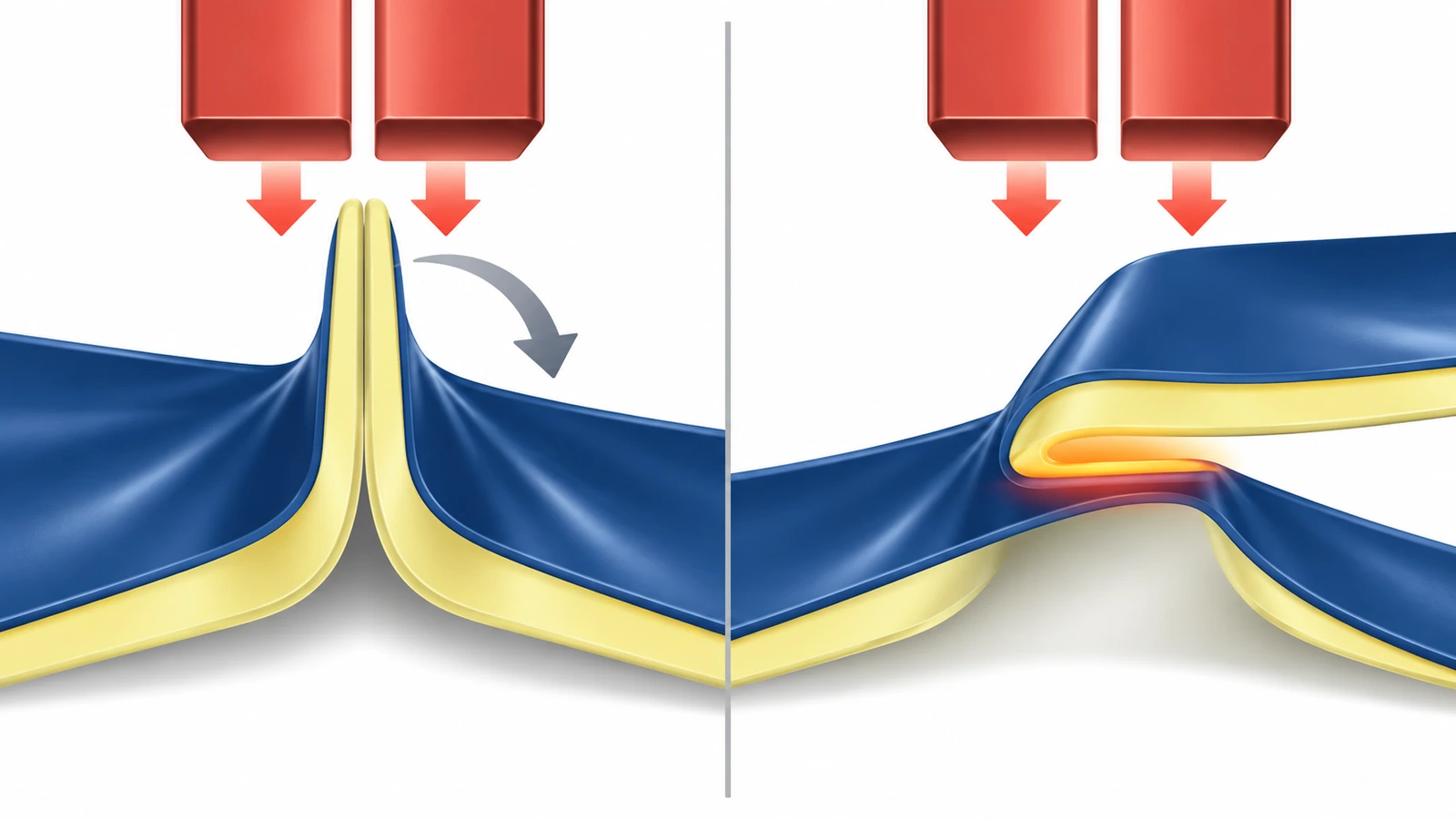
Both are back seal pouch seal types. A single web of film is wrapped around a forming tube, the two long edges are joined into a vertical seam, and cross seals close the top and bottom. Only that vertical seam differs.
- Fin seal (inside-to-inside): The two edges are brought together so the inner sealant faces the inner sealant. The bonded strip stands up from the back panel like a fin and is then folded flat to one side. Because the same material fuses to itself, the film only needs one heat-sealable surface.
- Lap seal (inside-to-outside): One edge overlaps the other, and the inner sealant of the top edge fuses onto the outer surface of the bottom edge. Nothing stands up, so the back stays nearly flat. That only works when the outer surface can also bond at the jaw temperature.
The top and bottom cross seals are built the same way on both styles. In use, then, lap seal vs fin seal packaging comes down to film compatibility, seam mechanics, film consumption and back-panel appearance.
Fin Seal Pouch Film Requirements, and What a Lap Seal Adds
A fin seal is the default for laminated films because it asks very little of the structure. Any laminate with a heat-sealable inner layer qualifies: clear PET/PE, metallized PET/VMPET/PE, or foil PET/AL/PE. The outer PET has a higher melting point than the PE sealant, so the jaws can melt the inside without sticking to the outside. That same property rules out a lap seal. At normal sealing temperatures, a PET outer surface will not fuse to a PE inner layer.
A lap seal needs one of two things. The first is a film that is sealable on both faces, typically a coextruded film with heat-seal skins on both sides. The second is a heat-seal lacquer or coating applied over the outer surface in the overlap zone. Each option narrows your material choices, and the coating route adds a layer you must qualify.
Food-contact documentation follows the same split. On either style, the inner sealant that touches food is usually an olefin polymer, and in the US it is checked against the conditions of use in 21 CFR 177.1520 (olefin polymers)[3]. A lap seal adds two less obvious exposures. First, the inner edge of the overlap sits inside the pouch, so a narrow strip of the outer surface (and any ink or coating on it) can face the product. Second, the cut edge of the overlapping web is inside the pouch, so with a foil laminate the foil edge faces the contents. A fin seal keeps both cut edges at the tip of the fin, outside the product space. If you choose a lap seal, ask for an ink-free overlap zone and written confirmation that the coating suits food contact.
Coatings also matter if the pouch will ever ship to Europe. Since 12 August 2026, EU food packaging cannot contain PFAS at or above 25 ppb for any single substance, 250 ppb for the sum of targeted PFAS, or 50 ppm total fluorine. These limits apply to concentration in the packaging, not migration, and they also cover stock made before that date but placed on the market after it EU PFAS limits under the PPWR[4]. Heat-seal lacquers and barrier coatings belong on your test list.
Recyclability can push you toward a lap seal. A mono-material film that is sealable on both faces is exactly what a lap seal needs, and that is also the direction recyclable designs are heading. Be careful with the claim, though. How2Recycle's store drop-off label exists only in the US, and it is not the same as curbside acceptance How2Recycle store drop-off guidance[5]. In the EU, recyclability performance grades are still being defined, and from 1 January 2038 packaging must reach at least grade B to be placed on the market Regulation (EU) 2025/40[6].
Seal Strength: How Each Back Seam Carries Load
The two seams fail in different ways because they are loaded differently. When a filled pillow pouch is squeezed in a carton, inflated with nitrogen, or flown at altitude, internal pressure pulls the two walls apart.
- Fin seal: peel loading. Pressure tries to unzip the fin from its root, the way you open a bag of chips. Peel is the weaker direction for any heat seal, so fin seal performance depends on a well-fused, uncontaminated root.
- Lap seal: shear loading. Pressure slides the overlapped layers across each other instead of prying them apart. Seals generally resist shear better than peel. The trade-off is that the bond relies on the outer surface, where slip additives, ink, coating weight or dust can vary from roll to roll.
The T-junction is where the vertical seam meets a cross seal, and the two styles behave very differently there. A folded fin puts two extra plies on top of the back wall, so the cross-seal jaw has to go from two plies to four within a few millimeters. A lap seal steps from two plies to three. The steeper the step, the harder it is to fully fuse the edges of that step, and a tiny unfused path becomes a channel leak. This is why fin-seal lines often need extra jaw pressure or a slightly higher temperature at the cross seal. Ask your supplier to inspect the T-junction on first articles, not just the flat seal areas.
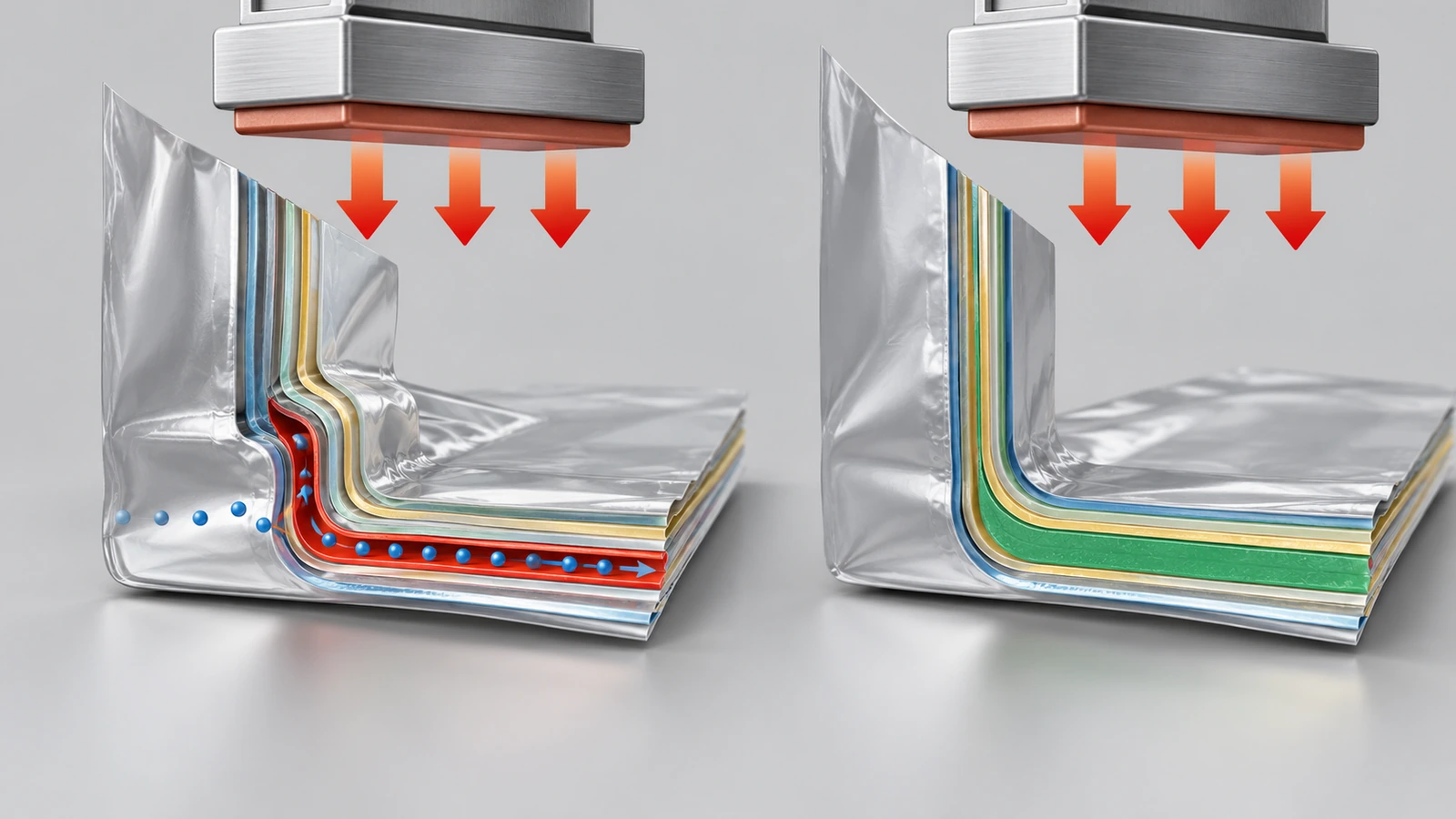
Testing needs the same care. ASTM F88 measures how much force it takes to pull a seal apart. A fin-seal specimen is pulled in peel. A lap-seal specimen pulled the same way is mostly loaded in shear, so the two results are not directly comparable, even when the units match. Ask for F88 results on the back seam and both cross seals separately, with the mean and the minimum reported. For a sense of scale, the US Defense Logistics Agency's quality provisions for ration pouches classify an average seal strength below 6 lb per inch of width, or any single specimen below 5 lb per inch, as a major defect. The same document defines an effective seal as an uncontaminated, fusion-bonded, continuous path at least 1/16 inch wide DLA ration pouch quality provisions[7]. The military flexible food pouch specification goes further and requires conventional heat seals at least 1/8 inch wide, with no embossing pattern that hides defects MIL-PRF-44073J[8]. These are reference points for demanding applications, not universal pass lines for a dry-snack pouch. Agree your own limits in writing.
Agree on how defects will be classified, too. The World Food Programme's flexible packaging defect guidance rates a channel leaker as a major defect and an incomplete seal in a multi-ply folded area as critical WFP defect classification[9]. That folded-area language fits the T-junction of a fin seal well. Use it so a pouch that "looks sealed" cannot be accepted on appearance alone.
Film Usage and Print Area
Film usage. A fin consumes film from both edges of the web, roughly twice the fin height. A lap seal consumes only the overlap width, once. For the same finished pouch, a lap-seal web is therefore narrower. On one pouch the saving is small, but on high-volume reels it adds up. Ask suppliers to state the web width for each option so you can calculate film per thousand pouches instead of guessing.
Print area. Both styles keep the front panel free of seams, and that remains the main branding advantage of a center-seal pouch. The back panel behaves differently:
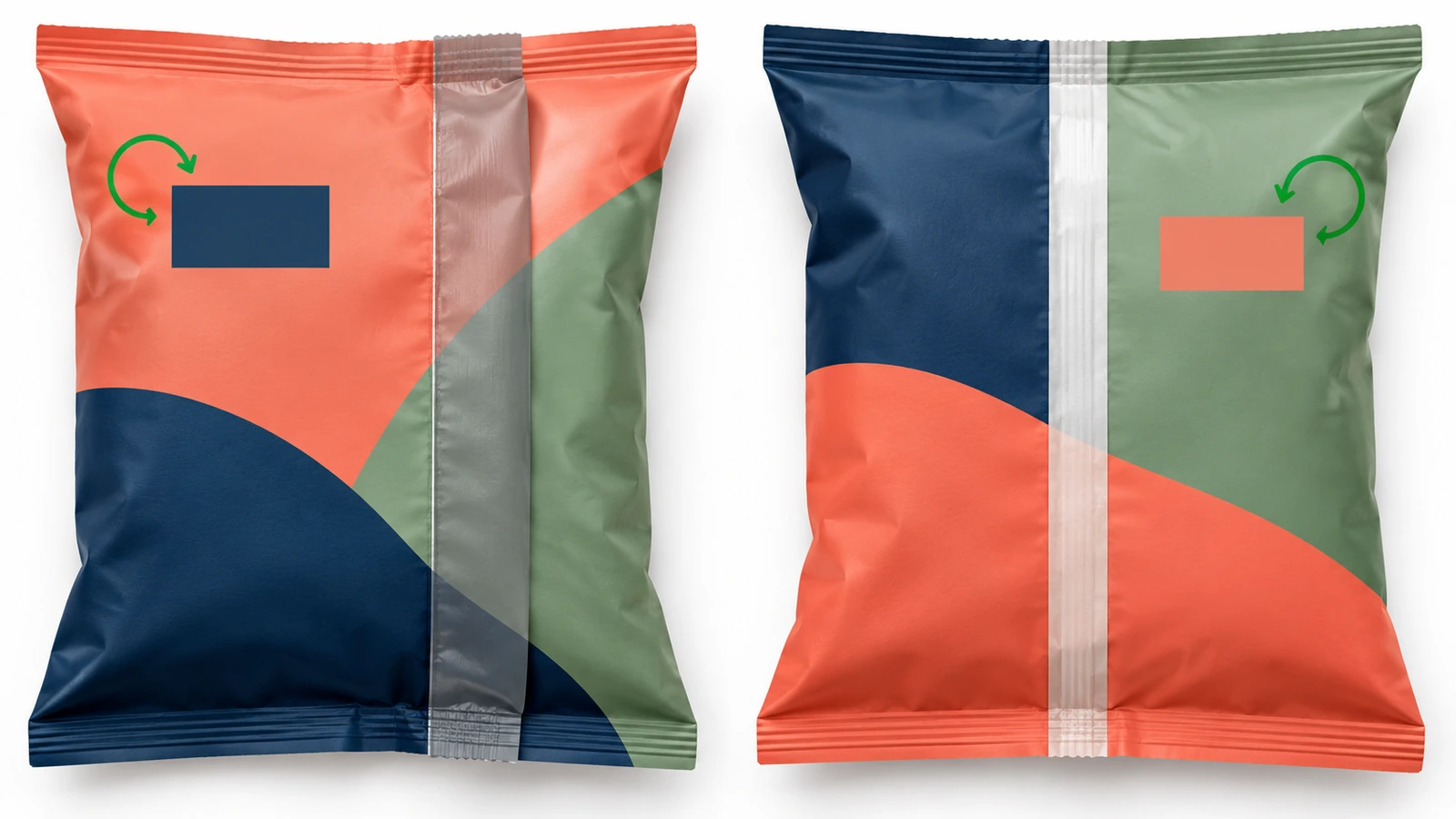
- Fin seal: Any artwork printed in the fin zone disappears into the seam. When the fin folds flat, it also covers a strip of the back panel on one side. Specify the fold direction (left or right) so designers know which side is hidden.
- Lap seal: The back stays flatter, which suits labels, date codes and carton stacking. The overlapped strip of outer artwork is hidden, and ink in the bonding zone can weaken the seal, so the overlap usually needs an ink-free or coated band.
For either style, keep barcodes, nutrition panels and lot-code windows clear of the seam and the T-junctions. Full artwork setup is covered on our custom center seal pouches page, so it is not repeated here.
When to Use a Lap Seal Pouch: A Five-Step Decision for Dry Products
- Start from the barrier you need, not the seal. If your product needs a metallized or foil laminate with a PET outer layer, the decision is already made: fin seal. As an upper benchmark, the military pouch specification limits material O2TR to 0.06 cc/m²/24 h/atm and WVTR to 0.01 g/m²/24 h [8]. Most dry retail goods need far less, so confirm your real target before you pay for foil.
- Look at the fill. Fine powders such as spices, flour and drink mixes can dust the seal area. Dense or heavy fills put weight on the bottom T-junction. Nitrogen-flushed snacks keep the pillow under pressure throughout distribution. In all three cases, build in margin at the T-junction and ask for test data on filled pouches, not empty ones.
- Consider a lap seal when the film already allows it. Lighter dry goods packed in a both-sides-sealable mono film, where a flat back or film savings matter, are the natural lap-seal case. Do not force a lap seal onto a laminate that needs an extra coating just to bond.
- Check the machine. Forming collars and back-seal units are set up for one style. Switching on an existing VFFS line usually means change parts and a new sealing validation. A pouch that cannot be sealed on your filler is not a saving.
- Write it into the RFQ. State the seal type, fin fold direction or lap overlap side, which film surfaces must be sealable, any ink-free zone, and the seal test method with mean and minimum reporting. This makes quotes comparable line by line.
Fin Seal vs Lap Seal Pouch: Side-by-Side Comparison
| Factor | Fin seal | Lap seal |
|---|---|---|
| Bond | Inner sealant to inner sealant | Inner sealant to outer surface |
| Film requirement | One heat-sealable inside layer | Both faces sealable, or a heat-seal coating on the outer face |
| Typical structures | PET/PE, PET/VMPET/PE, PET/AL/PE laminates | Coextruded both-sides-sealable films; coated films |
| Load on the seam under pressure | Peel (weaker direction) | Shear (generally stronger direction) |
| Ply step at the T-junction | 2 to 4 plies when the fin is folded | 2 to 3 plies |
| Cut edges | Outside the product space | One edge inside the pouch (foil edge exposed if foil laminate) |
| Film consumption | About twice the fin height | One overlap width |
| Back panel | Raised fin folded to one side | Flatter, with a slight overlap step |
| Sealing window depends on | One material fusing to itself | Two surfaces, including ink, coating and additives on the outside |
| Best fit for dry products | Barrier laminates, powders, gas-flushed snacks, coffee and spices in foil or metallized film | Lighter dry goods in mono films where flatness or film savings matter |
Frequently Asked Questions
FAQ: Is a fin seal or a lap seal stronger?
Under internal pressure, a lap seal is loaded in shear and generally resists opening better than a fin seal, which is loaded in peel. In practice, the T-junction and seal contamination decide more failures than seam geometry does. A well-validated fin seal outperforms a poorly bonded lap seal. Judge strength with ASTM F88 data on your own film, reported separately for each seal and with the minimum value shown.
FAQ: Can any laminate be lap sealed?
No. A lap seal needs the outer surface to fuse with the inner sealant. Standard reverse-printed PET/PE and PET/AL/PE laminates have a PET outer layer that will not bond to PE at sealing temperatures. They need a heat-seal coating in the overlap zone, or a fin seal instead.
FAQ: Which back seal is better for coffee, spices and powders?
These products usually need metallized or foil barrier laminates, which points to a fin seal. Powders can also dust the seal area, so ask for filled-pouch testing at the T-junction and for a defect classification that treats channel leaks as major defects.
FAQ: Does a lap seal pouch always cost less?
A lap seal uses a narrower web, so film per pouch is lower. That saving can disappear if the film needs a special coating or a more expensive both-sides-sealable structure, or if your filler needs change parts. Compare total cost on quotes that state web width, structure and coatings.
FAQ: Are fin seal and lap seal pouches recyclable?
Recyclability depends on the film, not the seam. Mono-material PE or PP films, which often suit lap seals, are designed for recycling streams. Multi-material foil laminates usually are not. In the US, store drop-off acceptance is not the same as curbside collection, so make recyclability claims only for the specific film and stream that apply.
FAQ: What food-contact documents should I ask for?
Ask for a layer-by-layer material declaration and a compliance statement tied to your food type and use conditions, not a generic "food grade" claim. For meat and poultry, USDA FSIS expects establishments to keep guaranty letters for packaging materials on file for inspection FSIS packaging materials guidance[10]. For a lap seal, also confirm the coating and any ink near the overlap.
Key Takeaways
- Seal integrity is the most common reason pouches are recalled, so the back seam deserves an explicit specification. — 54% (430 of 791) of seal-related FDA recall product IDs were "incomplete or defective seal," and 74.8% involved pouches or bags (Source)
- Fin seals fit almost any barrier laminate; lap seals need both film faces to be sealable. — inner sealants are typically olefin polymers checked under 21 CFR 177.1520 (Source)
- Use published benchmarks as references when you set seal acceptance limits. — ration pouches treat an average below 6 lb/in or any specimen below 5 lb/in as a major defect (Source)
- Seal width and hidden defects matter as much as strength. — conventional heat seals of at least 1/8 inch, with no embossing that hides defects, in MIL-PRF-44073J (Source)
- Coatings that make lap seals possible must also pass EU PFAS limits if you export. — 25 ppb single, 250 ppb sum, 50 ppm total fluorine since 12 August 2026 (Source)
Conclusion
The fin seal vs lap seal pouch decision follows from your film. If your dry product needs a PET-faced metallized or foil laminate, specify a fin seal, state the fold direction, and ask for testing at the T-junction. If you run a both-sides-sealable mono film and value a flat back or film savings, a lap seal is worth quoting, provided you control the overlap zone and validate it on your own filler. Either way, put the seal type, sealable surfaces and test method in writing so every supplier quotes the same pouch. When your back-seal choice is ready, send your brief through our center seal pouch quotation page and we will quote the construction you specified.
References
- U.S. FDA, Bacteriological Analytical Manual, Testing Flexible Packaging (hosted by University of Wisconsin–Madison Food Safety). https://foodsafety.wisc.edu/wp-content/uploads/sites/1026/2024/02/BAM_TestingFlexiblePkg.pdf ↩
- Lungren M., Okezue M., "Seal integrity–related recalls," AAPS Open 11:30, published 2025-12-15. https://link.springer.com/article/10.1186/s41120-025-00134-2 ↩
- eCFR, 21 CFR 177.1520 Olefin polymers (current text). https://www.ecfr.gov/current/title-21/section-177.1520 ↩
- Food Packaging Forum, "PPWR PFAS limits apply from August 12," 2026-08-12. https://foodpackagingforum.org/news/ppwr-pfas-limits-apply-from-august-12 ↩
- How2Recycle, "Store Drop-Off (US only)," 2023-11-22. https://how2recycle.info/about-the-how2recycle-label/store-drop-off-us-only/ ↩
- Regulation (EU) 2025/40 on packaging and packaging waste, EUR-Lex. https://eur-lex.europa.eu/eli/reg/2025/40/oj ↩
- Defense Logistics Agency, PKG&QAP A-A-20177E, 2013-08-01. https://www.dla.mil/Portals/104/Documents/TroopSupport/Subsistence/Rations/cids/qapkg/Q-20177E.pdf ↩
- MIL-PRF-44073J, Packaging of Food in Flexible Pouches, w/Change 01, 2024-02-13. https://www.dla.mil/Portals/104/Documents/TroopSupport/Subsistence/Rations/mil/44073J_ch01.pdf ↩
- World Food Programme, flexible packaging defect guidance (WFP-0000156789). https://docs.wfp.org/api/documents/WFP-0000156789/download/ ↩
- USDA Food Safety and Inspection Service, "Meat and Poultry Packaging Materials." http://www.fsis.usda.gov/food-safety/safe-food-handling-and-preparation/food-safety-basics/meat-and-poultry-packaging ↩












The information below is required for social login
Sign In
Create New Account