


 Blog PDF for offline reading
Quick answer: In flyers and leaflets printing, choose a single-sheet flyer when the campaign has one offer, one call to action and a reader who gives the piece only a few seconds. Choose a folded leaflet when the message needs several content blocks, the piece will sit on a counter or travel home in a bag, and the goal is to explain rather than to trigger an instant response. Decide the format first, then request the quote.
Why the format decision usually goes wrong before the quote
Most print buyers start with a quantity and a deadline, not a format. The marketing team writes copy, someone asks a printer for a price on "flyers", and the question of whether the message should be flat or folded is answered by default rather than by design. The format then gets locked in at the proof stage, when changing it is most expensive.
The cost shows up in two predictable ways. A single sheet asked to carry a full service menu, price tiers, a map and terms becomes a wall of small type that people skim and discard. A tri-fold leaflet commissioned for a one-line weekend offer leaves four of its six panels padded with stock photos. In both cases the buyer pays for the wrong piece, and if the layout has to be rebuilt after proofing, the reprint can push a campaign past its event date. Missed deadlines are one of the most frequent complaints in public reviews of online flyer orders, and a late format change is one of the easiest ways to create one.
The fix is a short decision process run before anyone asks for a price. This guide gives you that process: four factors, a scoring table, a mock-up test and a brief that a printer can quote without guessing.
What flyers and leaflets printing covers, and where the terms blur
The words are used loosely. In North American usage, a flyer is normally a single unfolded sheet printed on one or both sides. In British English, "leaflet" often means the same thing. Many B2B buyers and printers, however, reserve "leaflet" for a sheet that is folded into panels, and "brochure" for heavier multi-panel or bound pieces. Because a quote depends on construction rather than vocabulary, this guide defines the two formats by how they are built:
- Single-sheet flyer: one flat sheet with two printable faces and no fold.
- Folded leaflet: one sheet scored and folded into panels that the reader opens in a set sequence.
Both belong to the same product family. The ISO technical specification on print durability, ISO/TS 21139-1:2019[1], groups flyers and brochures together as commercial production prints that combine text, images and artwork. The difference that matters for a campaign is how much reading space each format gives you and how the reader moves through it.
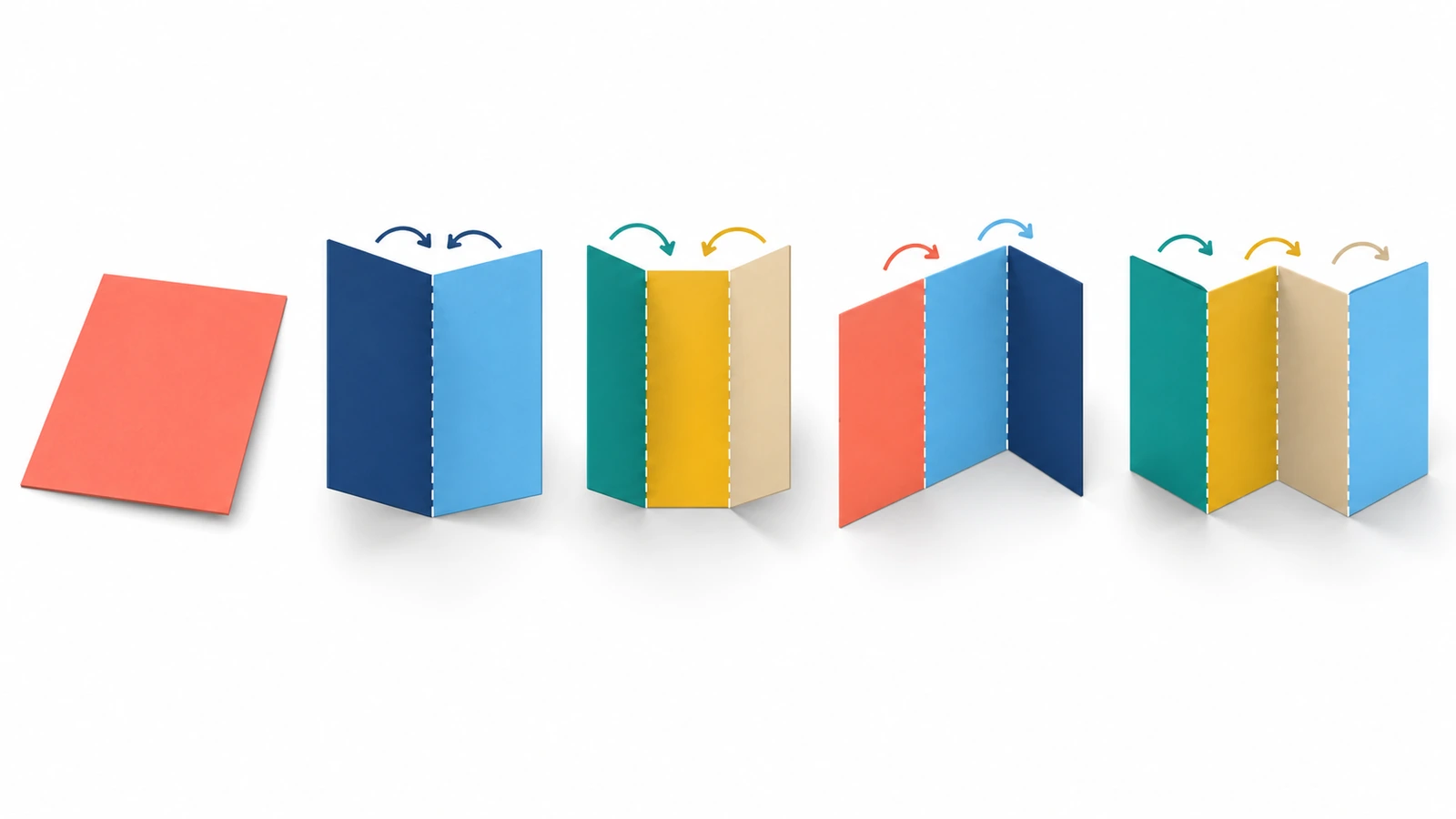
Folding changes the number of faces, not the size of the sheet. The panel arithmetic is simple:
| Construction | Usable faces / panels | Reading pattern |
|---|---|---|
| Flat sheet, one side printed | 1 | Seen all at once |
| Flat sheet, both sides printed | 2 | Front, then flip |
| Half fold | 4 | Cover, open spread, back |
| Tri-fold (letter fold) | 6 | Cover, inside flap, three-panel spread, back |
| Z-fold | 6 | Unfolds like a zig-zag, readable as one long strip |
| Four-panel accordion | 8 | Sequential strip, suits steps or timelines |
Supplier context makes a clear format decision more valuable, not less. The Target Report describes commercial printing as consolidating at an accelerated pace[2], and PRINTING United Alliance tracks shifting business conditions for the sector in its State of the Industry commercial printing report[3]. When the supplier list changes, a brief that states format, panel order and goal is what keeps quotes comparable from one round to the next.
How to decide: the four-factor method
Run these steps before you write the request for quotation. Each one produces something you can paste into the brief.
Step 1: Inventory the message before choosing the format
List every distinct content block the piece must carry. A content block is anything a reader would treat as a separate idea: the headline offer, a price list, opening hours, a map, a service menu, testimonials, terms and conditions, a QR code with its explanation, contact details. Count them honestly, including the legal lines that always get added at the end.
One or two blocks fit comfortably on a flat sheet. Three or four can work on a double-sided flyer if the back carries the supporting detail. Five or more almost always need panels, because each block needs its own space to be readable.
Step 2: Map the distribution moment
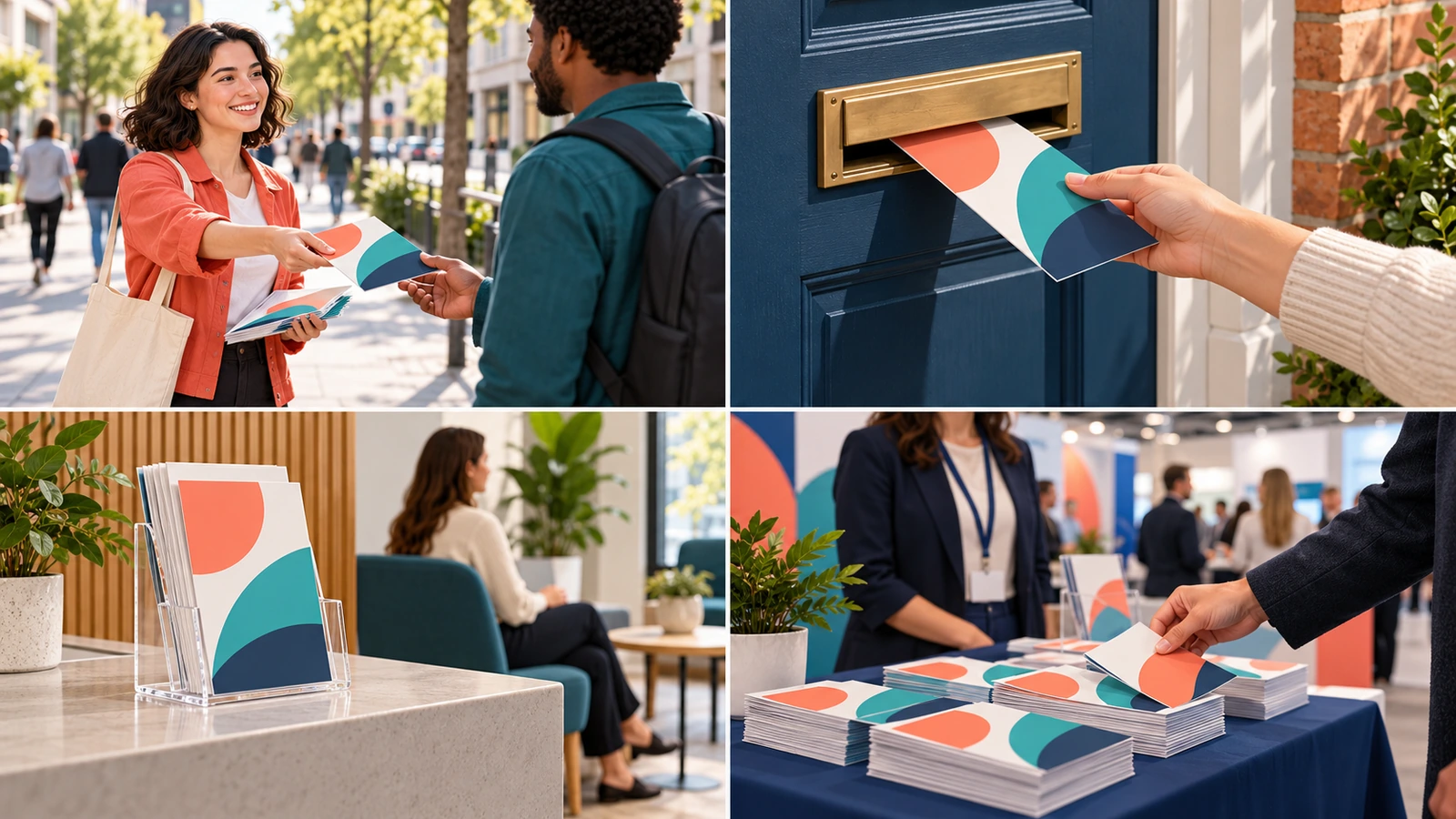
Write down exactly where the piece meets the reader and what that person is doing at that moment. A flyer handed out on a sidewalk meets someone walking. A bag stuffer meets someone unpacking at home. A leaflet in a reception rack meets someone waiting with time to spare. A trade show handout meets a visitor collecting material from a dozen booths. The channel tells you how the piece is held, how long it is held, and whether it will be opened at all.
Folded pieces need a reason to be opened. If the channel gives the reader no time or no reason to unfold anything, the inside panels are invisible.
Step 3: Estimate dwell time
Dwell time is how long the reader actually looks at the piece. You rarely have measured data for your own campaign, so classify it into three bands: a glance (seconds, often while moving), a single read (a minute or two, usually at home), or retention (the piece is kept and consulted again, like a menu, class schedule or price list). Glance-band channels reward a single-sheet layout with one dominant message. Retention-band channels reward panels, because the reader will come back to find specific information.
Step 4: Name one campaign goal
Pick the single result the piece is responsible for. Immediate action, such as attending an event on a date or redeeming a coupon, favours a flyer: one offer, one deadline, one next step. Consideration, such as comparing service tiers or understanding a process, favours a leaflet, because the reader needs to move through information in order. If the brief lists three goals, the piece will serve none of them well. Split the campaign into two pieces instead.

Step 5: Score the format
Score each factor from 0 to 2 and add the totals. The table turns the four steps above into a decision you can defend to a manager or client.
| Factor | 0 points (flyer) | 1 point (either) | 2 points (leaflet) |
|---|---|---|---|
| Message capacity | 1–2 content blocks | 3–4 content blocks | 5 or more content blocks |
| Distribution channel | Hand-to-hand, street team, bag stuffer, notice board | Door drop, mail insert | Counter rack, reception desk, trade show table, in-pack reference |
| Dwell time | Glance | Single read | Kept and re-read |
| Campaign goal | Immediate action | Awareness plus one next step | Consideration or education |
0–3 points: single-sheet flyer. 4–5 points: try a double-sided flyer first, and move to a leaflet only if the mock-up test fails. 6–8 points: folded leaflet.
Step 6: Test a full-scale paper dummy
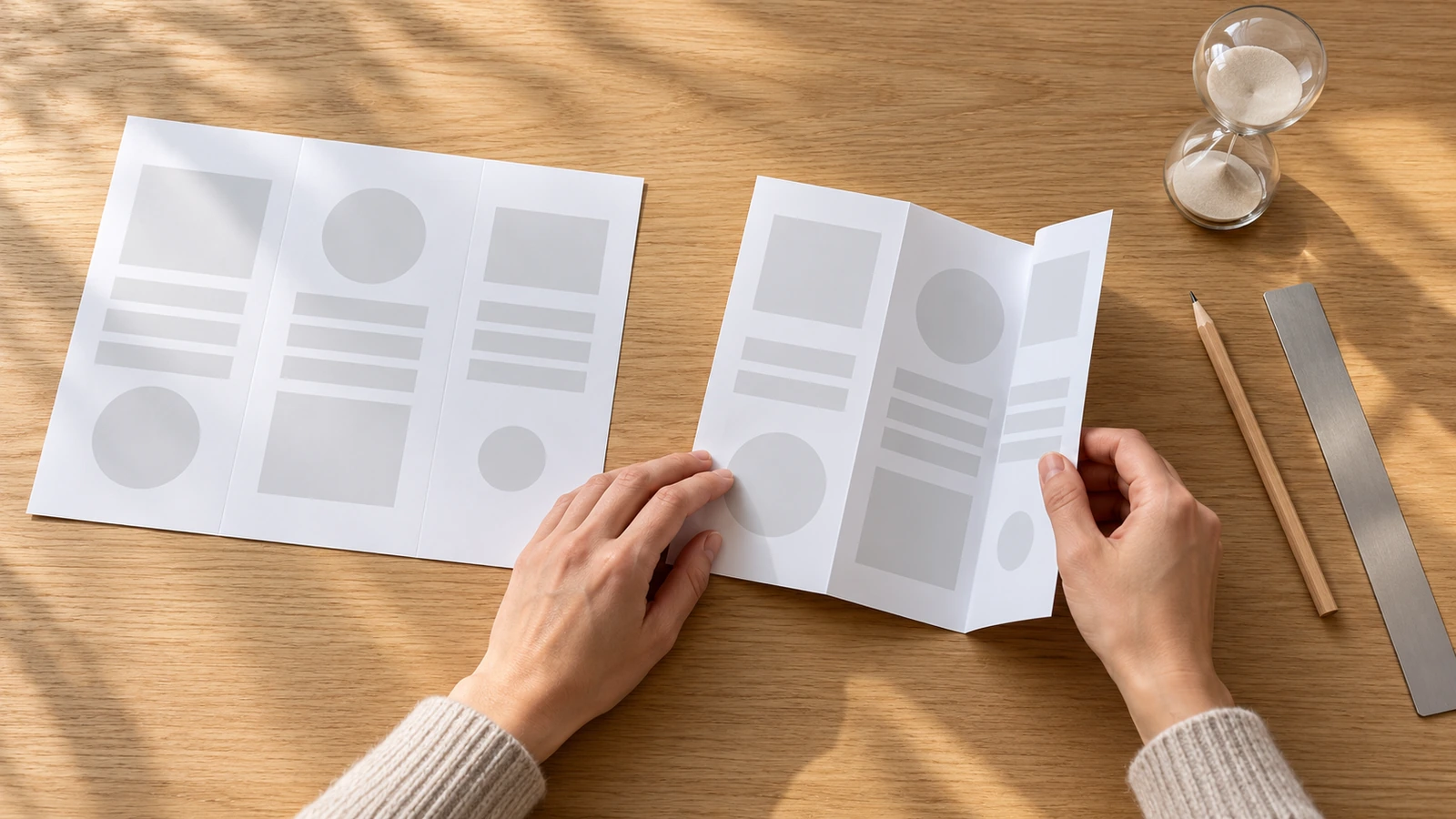
Print the draft layout at actual size on ordinary office paper. For a leaflet, fold it by hand in the intended fold type. Then hand the dummy to a colleague who has not seen the brief, take it back after the time a real recipient would give it (a few seconds for a street handout, longer for a counter piece), and ask two questions: what was the offer, and what should you do next? If they cannot answer both, the format or the hierarchy is wrong. This test costs nothing and catches the most expensive mistake before a printer is involved.
Step 7: Write the format-specific parts of the brief
Folding adds decisions that a flat sheet does not have, and each one belongs in the brief:
- Fold type and panel order: state which panel is the closed cover, which is the back, and which opens first. Send a folded dummy photo or a marked-up flat layout, so the printer can impose the panels correctly.
- Fold behaviour on the chosen stock: heavier sheets usually need scoring before folding to keep the fold from cracking through the ink. Ask the printer to confirm scoring for your stock and whether the fold runs with the paper grain.
- Colour reference: if brand colour matters across a flyer and a leaflet in the same campaign, ask both to be printed to a named condition, such as the GRACoL specification[4] calibrated with the G7 method[5], or the offset process control in ISO 12647-2 listed in the ISO/TC 130 guidelines[6].
- Sourcing claims: a leaflet usually consumes a larger sheet per piece than a flyer, so paper sourcing weighs more. If you plan to print a certification logo, the printer needs a valid chain of custody under FSC paper and print rules[7]. Pieces distributed in the EU may also fall under the deforestation regulation covering paper and printed products, which Intergraf has analysed for printers[8].
- Supplier environmental compliance: buyers with procurement policies sometimes ask printers to confirm compliance with the U.S. EPA control techniques guidelines for printing materials[9] and the VOC standards in 40 CFR Part 59[10]. The requirement applies the same way to both formats, so add it once to your supplier questionnaire.
Size, paper surface, artwork preparation and proof approval for a single sheet are covered step by step on our single-sheet custom flyer printing page, so this guide stops at the format decision.
Flyer vs leaflet: side-by-side comparison
Once the score points one way, use this table to confirm the choice and to explain it to stakeholders who expected the other format.
| Criterion | Single-sheet flyer | Folded leaflet |
|---|---|---|
| Construction | One flat sheet | One sheet, scored and folded |
| Usable faces | 1–2 | 4–8 panels depending on fold |
| Message capacity | One offer, one call to action, contact details | Several content blocks in a planned reading order |
| Best channels | Hand-to-hand, street teams, notice boards, bag stuffers, door drops | Counter racks, reception areas, trade show tables, in-pack inserts, follow-up mailings |
| Reader behaviour | Scanned in one look | Opened panel by panel, often kept |
| Goal fit | Immediate response, dated events, coupons | Explaining services, comparing options, reference material |
| Extra production steps | None beyond print and trim | Scoring and folding, plus a folded proof check |
| Typical failure | Overcrowding when the brief grows | Wrong panel order, cracked folds, padded panels |
| Quote is driven by | Quantity, sheet, sides, finish | The same plus fold type and finishing |
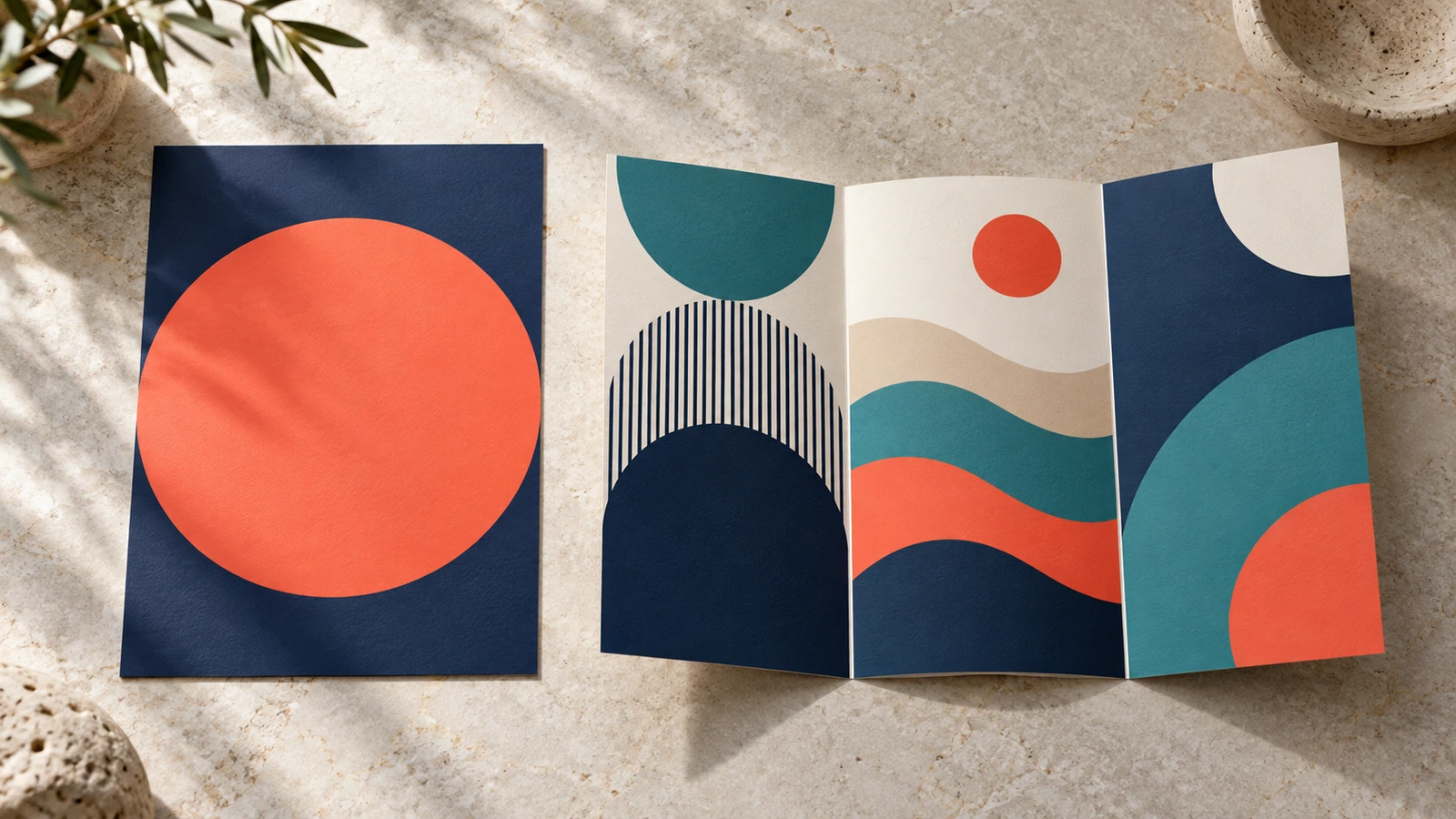
Two middle-ground options deserve a look before you commit to folding. A double-sided flyer doubles the usable faces without adding a finishing step: put the offer and call to action on the front and the supporting detail on the back. A flyer with a QR code that leads to a dedicated web page moves the depth online, which also gives you response data that paper alone cannot. Both options keep the speed and simplicity of a flat sheet while relieving pressure on the layout.
For larger campaigns, the strongest answer is often both formats in sequence. Promotional flyers printing for the street or door-drop phase creates the first contact, and a leaflet waits at the point of conversion, at the counter, the booth or the consultation, for readers who are ready to compare options.
Which format fits common campaigns
The same four factors produce consistent answers across the use cases that dominate business flyers. The scores below assume a typical brief; your own inventory may move a campaign up or down.
| Campaign | Likely score | Recommended format | Why |
|---|---|---|---|
| Restaurant grand opening handout | 1–2 | Flyer | One date, one offer, read on the move |
| Restaurant takeaway menu | 6–7 | Leaflet | Many content blocks, kept in a kitchen drawer and re-read |
| Real estate open house | 2–3 | Flyer | Address, time, key photo and agent contact |
| Real estate listing pack at the viewing | 5–6 | Leaflet or double-sided flyer | Room details and features read on site |
| B2B service overview at a trade show | 6–8 | Leaflet | Service tiers and process need ordered panels |
| Nonprofit fundraiser event | 2–4 | Flyer | Date, cause, single donation step |
| Gym or studio class timetable | 6–7 | Leaflet | Retention-band reference material |
| Seasonal retail sale bag stuffer | 1–2 | Flyer | One offer with a short deadline |
When printing business flyers for several locations or clients, keep the score sheet with the order record. On reorder, re-score only the factors that changed: a new channel or a longer service list is a reason to revisit the format, while a new date alone is not.
FAQ
FAQ: Is a leaflet the same thing as a flyer?
Sometimes. In British English the words are often interchangeable, while many North American buyers use "flyer" for a flat sheet and "leaflet" for a folded one. To avoid a quote for the wrong product, describe the construction in the brief, flat or folded, and the fold type, rather than relying on the name.
FAQ: Is a double-sided flyer enough instead of a folded leaflet?
For campaigns that score 4–5 on the four-factor table, often yes. A double-sided flyer gives two faces with no folding step. It stops working when the content has a natural reading order of more than two stages, such as a step-by-step process or a multi-tier service menu.
FAQ: Which format works better for door-to-door distribution?
It depends on the goal. A door drop for a dated offer works as a flyer because the resident decides in a glance. A door drop that introduces a new local service with several options can justify a leaflet, because the resident reads it at home. Score the dwell time and goal rather than the channel alone.
FAQ: Do folded leaflets take longer to produce?
They add scoring and folding after printing, and the proof should be checked in folded form, so the production schedule usually has more steps than a flat sheet. Ask for the timeline in writing with the quote, measured from proof approval, and include the event date in your brief.
FAQ: Can one campaign use both formats?
Yes, and for larger campaigns it is often the most efficient setup. Use flyers where readers give you seconds, such as street teams, bag stuffers and door drops, and leaflets where they give you minutes, such as counters, booths and consultations. Keep colour and typography consistent by printing both to the same named print condition.
FAQ: What should I send to get an accurate quote?
Send the format decision (flat or folded, fold type, panel order), the distribution channel, the in-hand date and the score sheet from this guide. For a single sheet, the remaining specifications are listed on our custom flyer printing page; if your brief points to a folded piece, describe it in your inquiry and we will tell you what we can quote.
Key takeaways
- Flyers and leaflets are one product family, so the choice is about reading space, not category. — ISO/TS 21139-1:2019 groups flyers and brochures as commercial production prints (Source)
- Use the same colour reference across both formats when they run in one campaign. — ISO 12647-2 is the offset process-control reference in the January 2024 ISO/TC 130 guidelines (Source)
- Folded leaflets use more paper per piece, so check sourcing claims before printing a logo. — EU Regulation 2023/1115 covers paper and printed products, with most requirements originally set from 30 December 2024 before postponement (Source)
- Supplier environmental compliance applies equally to both formats, so ask once. — VOC standards for consumer and commercial products sit in 40 CFR Part 59 (Source)
- A precise brief matters more as the supplier base shifts. — Commercial printing is consolidating "at an accelerated pace" (Source)
Conclusion
Good flyers and leaflets printing starts with a decision that most buyers skip: how much the message has to say, where the reader meets it, how long they look, and what they should do next. Score those four factors, test a paper dummy at full size, and the format becomes obvious. The quote that follows is faster to prepare and easier to compare.
If your score lands on a single sheet, review the specifications on our custom flyer printing page and send your brief with the channel and in-hand date. If it lands on a folded piece, include the fold type and panel order in your inquiry, and we will confirm what we can quote.
Sources
- International Organization for Standardization. ISO/TS 21139-1:2019, Permanence and durability of commercial prints, scope covering flyers and brochures. iso.org ↩
- The Target Report. Coverage of commercial printing consolidation, accessed 2026. thetargetreport.com ↩
- PRINTING United Alliance. State of the Industry: Commercial Printing Report, Fall 2025. printing.org ↩
- PRINTING United Alliance. GRACoL, Specifications for Print Production. printing.org ↩
- Idealliance. The Science of G7. idealliance.org ↩
- ISO/TC 130 Graphic technology. Guidelines for using print production standards, v2, January 2024. committee.iso.org ↩
- Forest Stewardship Council. Paper and print guidance. fsc.org ↩
- Intergraf. Compliance to the EU Deforestation Regulation in the EU printing industry, 27 September 2024. intergraf.eu ↩
- U.S. Environmental Protection Agency. Consumer and Commercial Products, Group IV Control Techniques Guidelines. epa.gov ↩
- Electronic Code of Federal Regulations. Title 40, Part 59, National Volatile Organic Compound Emission Standards for Consumer and Commercial Products. ecfr.gov ↩












The information below is required for social login
Sign In
Create New Account