We use cookies to enable our websites to remember information, to help some website functionalities to work properly, to understand how you interact with and use our websites and to display you content and ads that are relevant and engaging for you.
By clicking Accept All you consent to the use of these cookie.
The store will not work correctly when cookies are disabled.
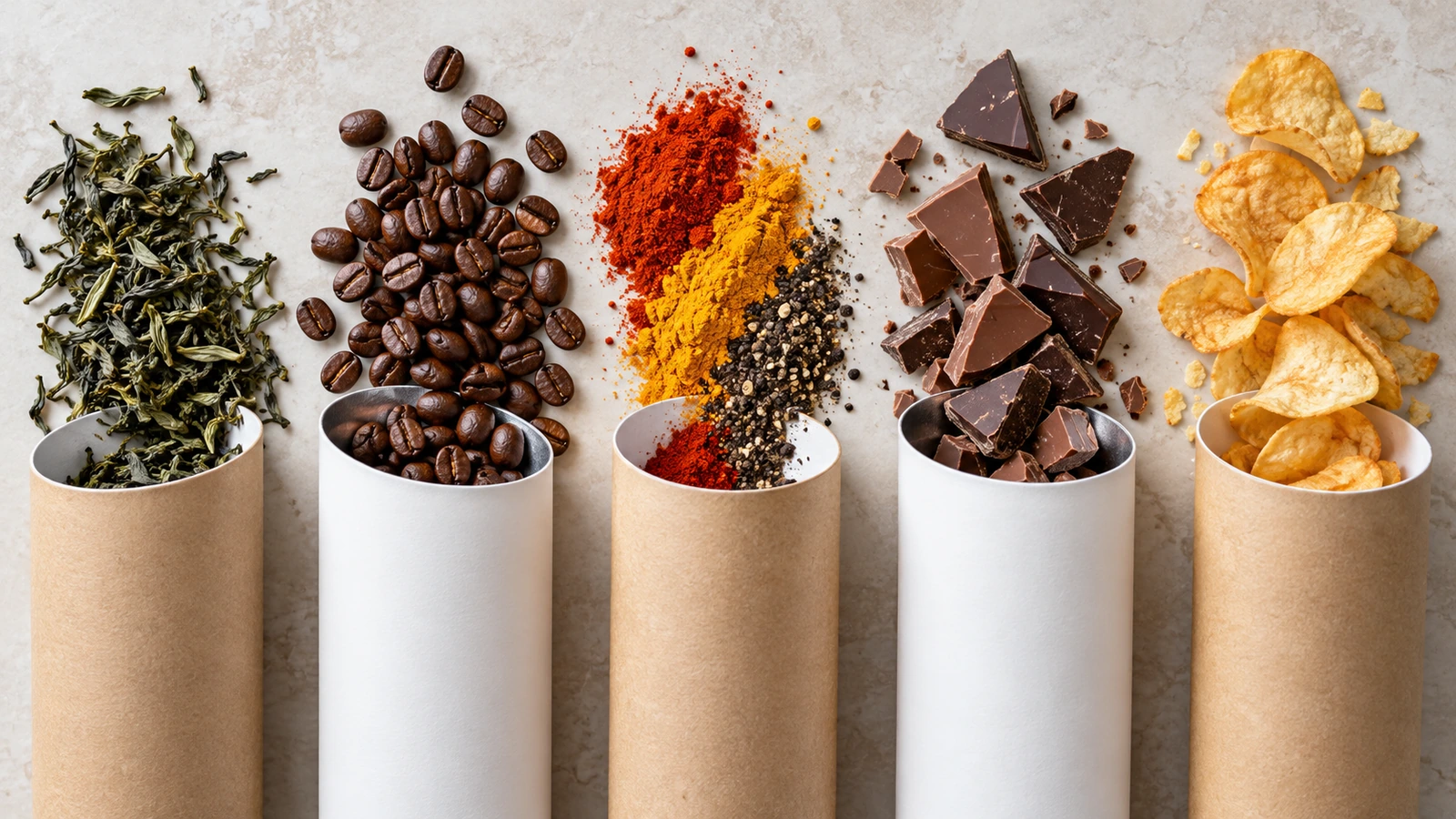
Quick answer: Food tube packaging is a paperboard tube that has a food-contact inner liner and a closure system. Tea, coffee, spices, confectionery and snacks all use it. To choose the right specification, start from the food's sensitivity to moisture, oxygen, grease and aroma. Next, set a shelf-life target. Then match the liner, seal and compliance paperwork to that target.
Food tube packaging is no longer reserved for premium gift sets. Tea houses, specialty roasters, spice blenders, chocolatiers and snack brands now use paperboard tubes for everyday SKUs. A tube gives them a large print surface and a rigid, crush-resistant body, and paper fiber helps their sustainability story. Most failures with food packaging tubes do not come from the outer artwork. They come from the inside: the liner, the seal and the documentation behind them. This guide explains how those three layers work and how your shelf-life requirement should drive each choice.
Why Do Food Tubes Fail on Shelf Instead of at the Printer?
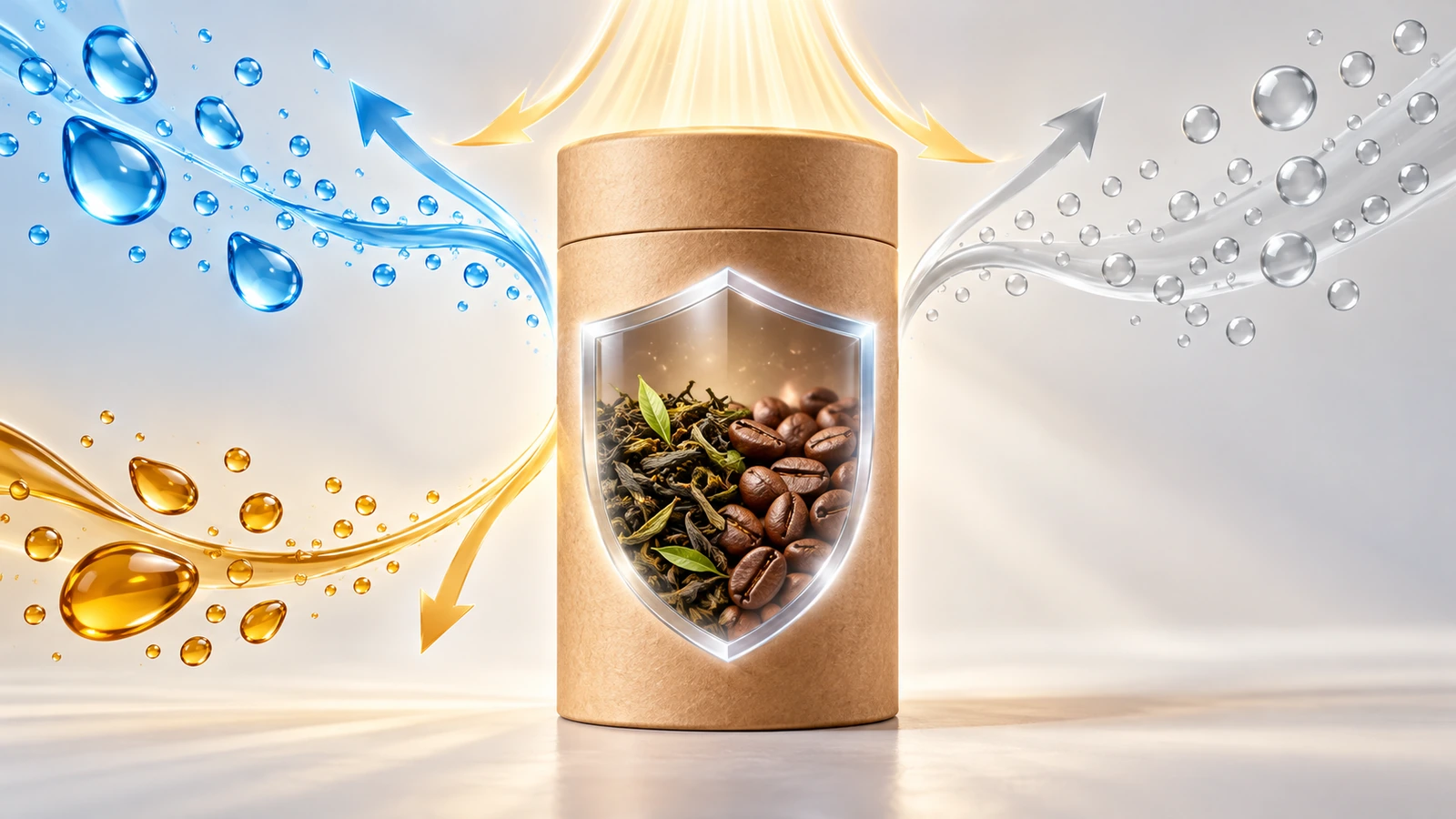
The problem: A tube can pass a visual approval and still let the food degrade. Loose-leaf tea absorbs moisture and kitchen odors, and its aroma goes flat. Ground spices cake and lose their volatile oils. Chocolate transfers fat into unprotected paperboard and leaves dark stains on the outer ply. Freshly roasted coffee keeps releasing carbon dioxide, so a tightly sealed lid can bulge or pop. Snacks go soft when moisture gets in and rancid when oxygen does.
The pain: These defects usually appear weeks after launch, when the stock is already in distribution. They also bring a second cost. Retailers and importers increasingly ask for food-contact declarations, migration test reports and, since 2026, evidence that liners are free of intentionally added PFAS in the EU. Without these documents, a listing can stall even if the product tastes fine. Paper tubes are also a growing category: in one industry market report, food and beverages already account for 38.6% of the push-up paperboard tube market[1]. That means more competitors whose tubes do perform.
The solution: Build the specification from the food outward. First identify what damages your product. Then decide how long it must survive and under what conditions. Only after that should you select the liner, closure and compliance evidence. The sections below follow that order.
What Is Food Tube Packaging?
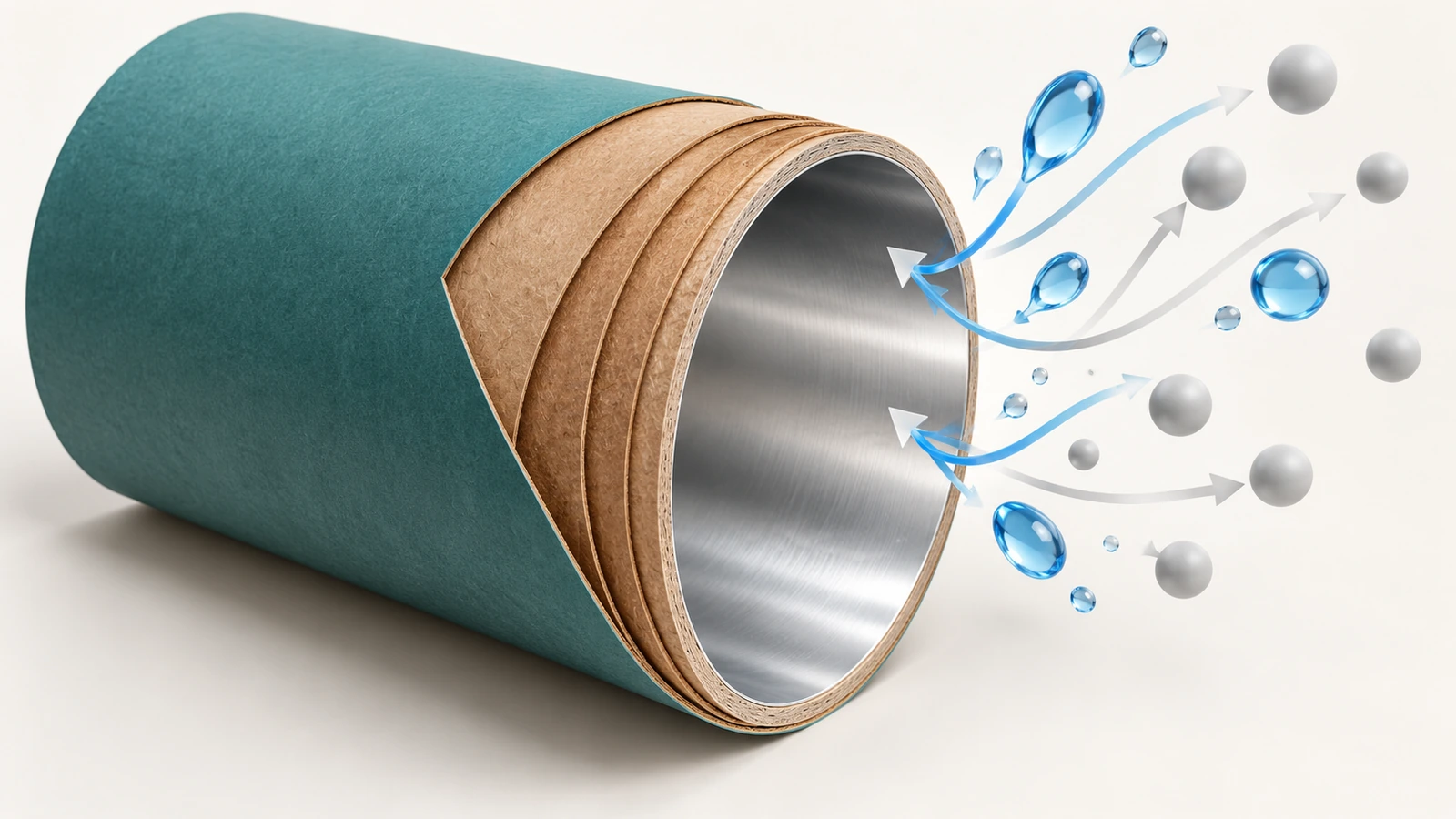
A food tube is a cylindrical container made from several plies of paperboard. The plies are wound around a mandrel, either spirally or convolutely, and bonded with adhesive. Each layer of a food-grade tube has its own job:
Outer ply: a printable label stock or kraft sheet that carries the brand.
Structural plies: the core board that gives the tube its stiffness and crush resistance. Wall thickness is usually checked with a caliper method such as TAPPI T 411[2].
Inner liner: the only layer that touches the food. It controls moisture, oxygen, grease and aroma transfer.
Ends: a bottom closure and a top closure, which may be a lid, a membrane seal or a dispensing cap.
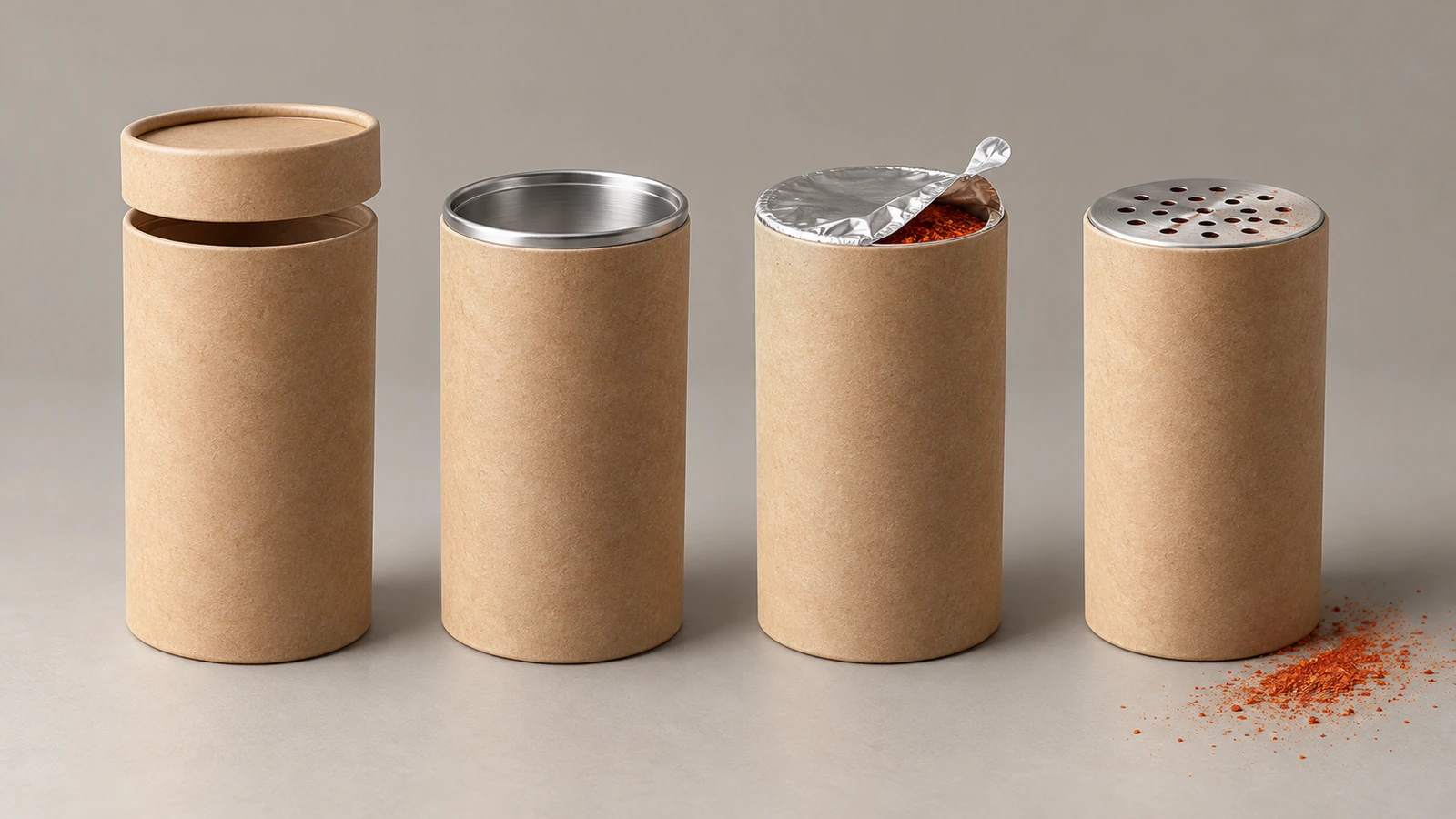
Food tubes come in three common formats. Two-piece telescoping tubes, where the lid slides over the base, are popular for tea, gift confectionery and whole-bean coffee. Canister formats with a peelable membrane and a reclosable overcap suit snacks and ground coffee. Shaker tubes with perforated sifter tops serve spices, seasonings and sugar toppings. A fourth format, the push-up tube with a sliding base, is mainly used for solid sticks in personal care. If your range also includes balms or solid bars, our page on custom push-up paper tubes for solid personal care products covers that format separately.
Which Threats Does Each Food Category Face?
Every dry food has one or two dominant failure modes. Your liner and seal budget should go to those, not spread evenly across every possible barrier. Water activity (aw) is a useful starting point. Most dry goods sit below roughly 0.6, where microbial growth essentially stops. Below that level, the realistic shelf-life risks are physical and chemical rather than microbiological.
Food category
Dominant threats
What failure looks like
Barrier priority
Loose-leaf and bagged tea
Moisture, aroma loss, odor pickup
Flat cup profile, musty notes, absorbed ink or adhesive odor
Moisture and aroma barrier; low-odor inks and adhesives
Whole-bean and ground coffee
Oxygen, CO2 pressure, moisture
Stale taste, bulging or popped lids
Oxygen barrier plus a pressure-release path (one-way valve or vented membrane)
Ground and whole spices
Moisture, volatile oil loss, light
Caking, color fading in paprika or turmeric, weak aroma
Grease migration, odor pickup, temperature cycling
Oil stains on the outer ply, fat bloom, off-flavors
Grease barrier; functional barrier against recycled-fiber contaminants
Crisps, nuts and baked snacks
Moisture, oxygen, crushing
Soft texture, rancid taste, broken pieces
Moisture and oxygen barrier; hermetic membrane; rigid wall
Chocolate needs extra care for a reason that is easy to overlook. When the structural board contains recycled fiber, mineral oil hydrocarbons from old printing inks can migrate into fatty foods through the gas phase. A virgin-fiber inner ply or a dedicated functional barrier liner is the standard way to control this risk for high-fat products.
How to Build a Food Tube Specification from Shelf Life Backward
These steps cover only the food-specific decisions. General tube validation and inspection are outside the scope of this article.
Step 1: Define the shelf-life claim and the storage conditions
Write down the target "best before" period, then add the worst realistic storage conditions: a humid summer warehouse, a sunny shop window or a cold export container. A tube that keeps tea fresh for six months in an air-conditioned café may last much less in a coastal market. The barrier you need depends on both the time and the conditions.
Step 2: Translate the claim into measurable barrier targets
Turn "keeps fresh" into numbers your supplier can test against. The usual metrics are water vapor transmission rate, measured with methods such as ASTM F1249, and oxygen transmission rate, measured with ASTM D3985. Testing should cover the liner material and, ideally, the finished closed tube, because seams and lid fit often leak more than the liner itself. The ASTM paper and packaging standards[3] collection is a good place to choose methods that both parties accept.
Step 3: Pick the lightest liner that meets the target
Over-specifying the liner raises cost and can damage recyclability. For example, an aluminum foil laminate gives a near-total barrier, but some paper mills reject or downgrade multi-material structures. If the product only needs a short shelf life in dry conditions, a glassine or greaseproof paper liner may be enough and keeps the tube closer to mono-material. The comparison table further down shows the trade-offs.
Step 4: Match the closure to the weakest point
Air usually enters a tube through the closure, not the wall. A slip-fit telescoping lid is not hermetic, so it relies on the product tolerating some air exchange or on an inner pouch. For oxygen-sensitive snacks and ground coffee, use an induction-sealed or heat-sealed foil membrane under a reclosable cap. Coffee packed soon after roasting also needs a one-way degassing valve, so CO2 can escape while oxygen stays out. Nitrogen flushing before sealing further reduces the oxygen trapped in the headspace.
Step 5: Lock down the compliance file before production
Collect a declaration of compliance for every material that touches food: the liner, the inner adhesive and any coating or sealing layer. Request migration test results using food simulants that represent your product, such as dry, fatty or aqueous types. Also confirm the PFAS status of grease-resistant liners. The next section explains which rules apply.
Step 6: Run a shelf-life test with the real food
Fill filled-and-sealed samples with your actual product, not a placeholder. Store them at your worst-case condition, plus an accelerated condition if your quality team uses one. Then check moisture content, sensory profile, color and grease show-through at set intervals. Empty-tube data cannot reveal fat migration in chocolate or caking in spices.
Which Food-Contact Regulations Apply to Paper Tubes?
United States
The FDA treats packaging components that may migrate into food as food contact substances. The FDA packaging and food contact substances program[4] recognizes several routes to authorization. Paper and paperboard components are mainly covered by 21 CFR Part 176. Section 176.170 covers contact with aqueous and fatty foods, and section 176.180 covers dry food. This distinction matters: a liner cleared only for dry food is not automatically suitable for chocolate or nut snacks. You can check individual substances against the FDA inventory of substances listed in 21 CFR[5]. The FDA's guide to determining the regulatory status of components[6] explains how to document each layer. In 2024, the FDA also announced that PFAS-based grease-proofing agents were no longer being sold for food-contact use in the US market. Even so, ask for written confirmation for any imported greaseproof liner.
European Union
Every food-contact material in the EU must meet the Framework Regulation (EC) No 1935/2004 and the good manufacturing practice rules in Regulation (EC) No 2023/2006. Paper itself has no harmonized EU-specific measure, so suppliers often refer to national recommendations. Plastic coatings and sealing layers, however, fall under Regulation (EU) No 10/2011. In addition, the Packaging and Packaging Waste Regulation (EU) 2025/40[7] has applied since 12 August 2026. It restricts PFAS in food-contact packaging above set concentration thresholds, which directly affects older fluorochemical greaseproof papers. Its design-for-recycling requirements, summarized by the European Commission's packaging waste page[8], also make heavy foil laminates harder to justify for products that do not need them.
Fiber sourcing and end-of-life claims
FSC chain-of-custody certification, described on the FSC paper and packaging page[9], verifies responsible fiber sourcing. It is not a food-safety certificate, so it does not replace a declaration of compliance. For recycling claims, keep in mind that paper and paperboard packaging reached an 80.9% recycling rate in the US according to the US EPA[10] (2018 data). Recyclers can only capture that value if the liner and metal ends can be separated, or if they are compatible with the fiber stream. Oil-saturated tubes from fatty foods are often sorted out as contaminated waste, so word your on-pack disposal guidance carefully.
Food Tube Packaging Liner and Closure Options Compared
The table below gives relative barrier performance. The exact values depend on grammage, coating weight and seam quality, so confirm them with test data on your specific construction.
Inner liner
Moisture
Oxygen
Grease
Recyclability notes
Typical fit
Uncoated virgin kraft
Low
Low
Low
Best fit with paper stream
Over-packs for pre-wrapped items
Glassine or greaseproof paper (non-fluorinated)
Low–medium
Low
Medium–high
Generally paper-compatible
Short-shelf-life tea, wrapped confectionery
Aqueous dispersion barrier coating
Medium
Low–medium
Medium–high
Designed for repulpability; verify with mill
Spices, tea, dry snacks with moderate shelf life
PE-coated paper
Medium–high
Low
Medium
Plastic layer; falls under plastics FCM rules
Products needing moisture control without foil
Metallized film laminate
High
Medium–high
High
Multi-material; separation often required
Coffee, premium tea
Aluminum foil laminate
Very high
Very high
Very high
Hardest to recycle in fiber stream
Long-shelf-life snacks, ground coffee
Closure or seal
Hermetic?
Reclosable?
Best for
Telescoping paper lid
No
Yes
Tea, gift confectionery, inner-bagged coffee
Rolled metal end
Yes, when seamed
No (base only)
Rigid bases for canisters
Peelable foil membrane plus overcap
Yes
Overcap only
Snacks, ground coffee, nitrogen-flushed fills
Membrane with one-way valve
Yes, with venting
Overcap only
Freshly roasted coffee
Sifter or shaker top
No (unless under a membrane)
Yes
Spices, seasonings, sugar toppings
Shrink band or paper seal label
No
—
Tamper evidence on any format
For quoted dimensions, minimum quantities or lead times on a particular construction, send us your product, target shelf life and destination markets. We will reply with an engineered proposal rather than a catalog figure.
FAQ
FAQ: Can paper tubes hold coffee without a foil liner?
Only for short shelf lives or when the beans sit inside a valved inner bag. Coffee is highly sensitive to oxygen, and freshly roasted beans release CO2. Unbagged coffee therefore usually needs a high-oxygen-barrier liner, such as metallized film or foil, together with a membrane that includes a one-way valve.
FAQ: Is a "food-grade" claim enough for compliance?
No. "Food-grade" is not a regulatory status. Ask for a declaration of compliance that names the applicable rules, such as 21 CFR 176.170 or 176.180 in the US or Regulation (EC) No 1935/2004 in the EU. Also ask for migration results that match your food type and fill conditions.
FAQ: Do greaseproof liners contain PFAS?
Older greaseproof papers often used fluorochemical treatments. Modern options rely on dense glassine, aqueous dispersion coatings or film layers instead. For EU-bound goods, PPWR PFAS limits have applied since 12 August 2026, so get written confirmation of PFAS status from your liner supplier.
FAQ: Why is my chocolate staining the outside of the tube?
Cocoa butter migrates through any ply that lacks a grease barrier, and repeated temperature changes speed this up. Use a grease-resistant liner and test it with your actual recipe at warm storage conditions. If the board contains recycled fiber, also add a functional barrier to control mineral oil migration.
FAQ: Are food tubes with metal ends recyclable?
They are recyclable where consumers or sorting facilities separate the metal from the paperboard. If you need easier end-of-life handling, consider all-paper ends combined with a paper-compatible barrier coating, and tell consumers clearly how to dispose of each part.
FAQ: How long does a food tube keep spices fresh?
It depends on the liner, the closure and the storage humidity, so no single figure applies. Set your target first. Then confirm it with a real-product test that checks moisture uptake, caking and aroma at fixed intervals.
Key Takeaways
Food is already a major end use for paperboard push-up tubes — 38.6% application share (Source)
The broader push-up paperboard tube market is growing steadily — USD 1.4 billion in 2025 to USD 2.1 billion by 2035, a 4.2% CAGR (Source)
EU packaging rules, including PFAS limits for food-contact packaging, now apply — from 12 August 2026 (Source)
US paper liner clearance depends on food type — 2 key sections: 21 CFR 176.170 for aqueous and fatty foods, 176.180 for dry foods (Source)
Paperboard's recycling advantage holds only if the liner and ends allow it — 80.9% US recycling rate for paper and paperboard packaging (Source)
Conclusion
A good food tube is designed from the inside out. First identify whether moisture, oxygen, grease or aroma is the main threat to your product. Then commit to a shelf-life claim under realistic storage conditions. Choose the lightest liner and the simplest closure that meet that claim, and back every food-contact layer with documentation for each market you sell in. Brands that follow this order avoid the most expensive kind of packaging failure, the one that only appears after the stock has shipped. If you are planning a tea, coffee, spice, confectionery or snack tube, share your product details and markets, and we will help you shape a specification you can test.
Hi there! I'm Bruce, proud dad to my amazing son. I'm the founder of Zigpac, a printing and packaging company empowering small and medium-sized businesses with custom solutions. Let's create something great together!



 Blog PDF for offline reading












The information below is required for social login
Sign In
Create New Account