


 Blog PDF for offline reading
Quick answer: Tin cans packaging involves two separate choices: how the body is built (two-piece seamless or three-piece seamed) and how the tin closes (hinged, slip-lid or screw-top). Choose the closure based on how often the product is opened, choose the construction based on shape and height, and add a sealed inner liner whenever shelf life depends on keeping out moisture or holding in aroma.
Most tin cans packaging projects start with a mood board rather than a specification, and the problems that follow are predictable. A slip-lid tea caddy looks beautiful but lets the tea's aroma escape within weeks. The loose lid of a pocket mint tin gets lost on day three. A tall printed cylinder arrives with its hero illustration cut in half by the side seam.
These mistakes are expensive to fix late in a project. Changing the closure or body construction usually requires new tooling, a new sample round and fresh artwork approval, often after launch dates are already committed. There is also a common false assumption behind many of these failures. Because tinplate is rigid and opaque, buyers tend to treat every tin as a barrier package. It is not one. The metal wall blocks light and gas, but moisture and aroma move through the joint between lid and body.
This guide separates the two decisions, body construction and closure, and maps each combination to product category, shelf-life need and brand goal. The aim is to help you narrow the field to one or two formats before you request quotes for custom tin cans.
Contents
- What Is Tin Cans Packaging? Two Decisions, Not One
- Body Construction: Two-Piece vs. Three-Piece
- Closure Styles: Hinged, Slip-Lid and Screw-Top
- How to Shortlist the Right Tin Format in Six Steps
- Tin Formats Compared by Product, Shelf Life and Brand Goal
- Frequently Asked Questions
- Key Takeaways
- Conclusion
- References
What Is Tin Cans Packaging? Two Decisions, Not One
Despite the name, a "tin" is mostly steel. Decorative and food tins are made from tinplate, which is low-carbon steel sheet with a very thin electrolytic coating of tin. The tin coating resists corrosion and gives a surface that accepts lacquers and inks (tin box[1]). The base material has an international specification: ISO 11949:2016[2] sets requirements for single and double cold-reduced low-carbon mild steel electrolytic tinplate, supplied as sheets or coils. A peer-reviewed review of metal packaging describes tinplate as cheaper and heavier than aluminum, magnetic (which makes it easy to separate for recycling), easy to decorate and impermeable to moisture and gases (metal packaging review[3]).
Every tin is defined by two independent choices:
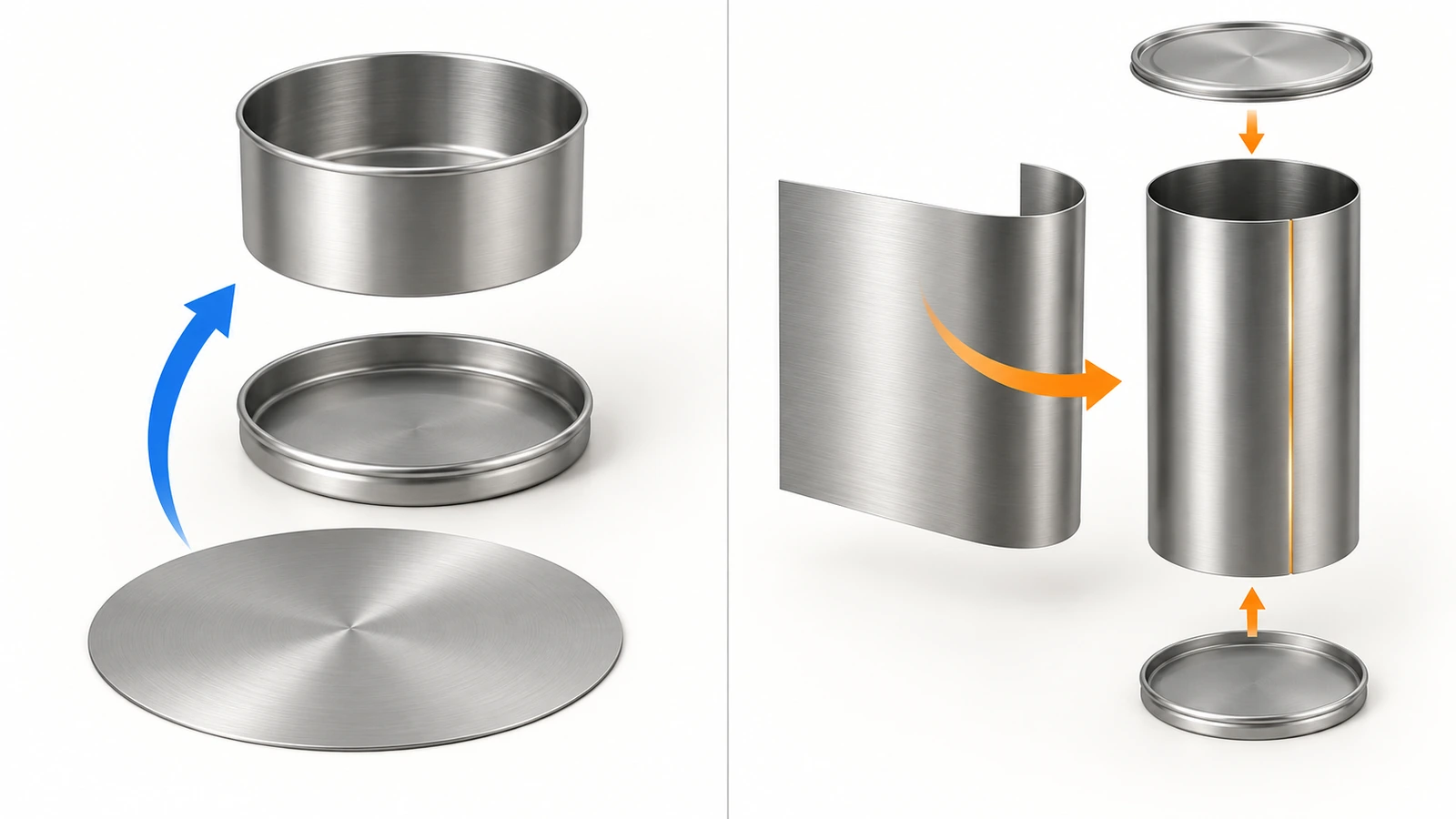
- Body construction: two-piece (a seamless, drawn body plus a lid) or three-piece (a rolled body with a side seam plus two ends).
- Closure: hinged, slip-lid or screw-top. Sliding lids and lever (plug) lids are less common options.
A round slip-lid tea caddy is often three-piece, while a shallow round screw-top balm tin is usually two-piece. When buyers mix up these two layers, spec sheets become confusing and quotes stop being comparable. Keep them separate from the first conversation.
Body Construction: Two-Piece vs. Three-Piece
Two-piece (seamless, drawn) tins
The body is pressed from a single flat blank into a cup shape, and a separate lid completes the container. Because there is no vertical joint, there is no seam to interrupt artwork or to inspect for gaps, and corners come out softly rounded. That rounded, seamless feel is why most pocket, mint and cosmetic tins are two-piece.
The main limitation is depth. Steel can only stretch so far relative to the footprint before it thins or wrinkles, so very tall seamless bodies are impractical. Deep draws also distort artwork that was printed flat before forming. Wall graphics therefore need to be pre-distorted and checked on a physical sample rather than judged from a flat proof.
Three-piece tins
A rectangular printed sheet is rolled into a cylinder (or a square or oval profile), joined along a side seam, and closed with a top and a bottom end. Height is set by the length of the sheet rather than by draw depth, so tall caddies and large cylinders are straightforward. The body wall gives brands a wide, continuous print panel.
There are trade-offs. The side seam is an artwork "dead zone," and every extra part adds an assembly step. The same construction, fitted with a double-seamed end and a lacquered interior, is the familiar processed-food can. That is the only common tin format engineered to be hermetic, meaning airtight. Decorative three-piece tins with slip lids are not.
Closure Styles: Hinged, Slip-Lid and Screw-Top
Hinged lid
The lid is permanently attached to the body, so it cannot be lost. The tin opens with one hand and swings fully open to show the whole contents. These traits suit products that are opened repeatedly or carried around: mints, solid cosmetics, small accessories, card and game sets, and gift assortments where the reveal matters.
Hinge styles behave differently. On medium and large tins, simpler hinges may not hold the lid upright, while wire or bar hinges can. Like other decorative closures, a standard hinged tin is not airtight. If a hinged format is on your shortlist, the custom hinged tin boxes page covers sizing, finishes, hinge options and quoting in detail, so this guide does not repeat that material.
Slip-lid (friction lid)
The lid slides over the body or over a stepped neck and is held only by friction. This is the simplest and most versatile closure. It works on round, square, rectangular and many custom shapes, stacks well, and is a common choice for tea, cookies, chocolates and seasonal gift tins. The fit tolerance determines whether the lid feels snug or loose. Because the lid comes off completely, it can be misplaced, which matters for products that are carried around but much less for products kept on a pantry shelf.
Screw-top (threaded)
The lid and body have matching threads. Among common decorative closures, this gives the most positive reclosing action and the strongest resistance to opening accidentally inside a bag. Those qualities make it a good fit for balms, salves, loose powders, spice rubs and refill products. The constraints are that the shape is effectively limited to round, opening takes slightly longer, and the threaded neck reduces how much of the lid surface is usable for decoration.

How to Shortlist the Right Tin Format in Six Steps
The steps below are designed to reach a shortlist. Detailed artwork preflight, production workflow and acceptance testing belong at the specification stage, after the format is chosen.
Step 1: Characterize what goes inside
Begin with the contents. Are they dry solids, oily or waxy, acidic, salty or moist? Will food touch the metal directly? Each answer affects the interior coating. In the US, coatings used as a food-contact surface on a metal substrate fall under 21 CFR 175.300[4], which addresses resinous and polymeric coatings applied as a continuous film. The metal packaging review cited above lists tin and bisphenol A (BPA) among the substances that can migrate from metal packaging. It notes that acidic and moist contents raise the risk of corrosion when the coating is wrong or damaged[3].
BPA deserves its own check. The FDA states that BPA has been used in metal can coatings[5] and that any substance migrating from packaging into food is subject to FDA premarket authorization. The EU has gone further, adopting a ban on BPA in food contact materials[6] that covers metal can coatings, under Regulation (EU) 2024/3190. Polyester and acrylic systems are the main BPA-non-intent alternatives[7]. Ask suppliers which coating system they propose for your specific contents rather than accepting a single generic "food-grade" claim.
Step 2: Decide where the barrier lives
If shelf life depends on keeping moisture out or aroma in, as with loose-leaf tea, ground coffee, hygroscopic powders and some confectionery, the closure gap is the weak point whichever decorative lid you choose. The reliable approach is to treat the tin as the printed, reusable outer package and put the primary barrier inside it, such as a sealed pouch, sachet or inner liner. Only a double-seamed, hermetically closed can provides a barrier on its own, and that is a cannery format, not a gift tin.

Step 3: Match the closure to opening frequency and context
- Opened many times a day, carried in a pocket or bag: hinged (lid can't be lost) or screw-top (won't open by accident).
- Opened occasionally at home, or given as a gift: slip-lid. It is simple, stacks well, and the lid-lift moment works as a reveal.
- Soft, greasy or loose contents that could escape in transit: screw-top, or any closure combined with an inner seal.
Step 4: Choose construction from shape and height
Shallow and pocket formats point to two-piece construction. Tall caddies and large cylinders, or designs that need a wide continuous print panel, point to three-piece. Before you fall in love with a new silhouette, ask the supplier which existing tooling is close to it. A genuinely new shape means new tooling, which adds cost and time. Request a quote that shows tooling separately so you can compare options fairly.
Step 5: Plan decoration around the construction
Printed tin is usually lithographed on flat sheets before forming. In practice this means two-piece walls need artwork distortion compensation, three-piece bodies need a seam-safe zone, and every format loses some area at the curled edges and at the hinge or thread. Settle these zones while comparing formats, because they can rule a format out when the artwork is non-negotiable. A two-piece tin with a wraparound illustration, for example, may not survive the draw.
Step 6: Check destination-market rules early
For California, Proposition 65[8] requires warnings for exposures to listed chemicals, which include lead. Inks and coatings are the usual points of scrutiny. In the EU, the food contact materials framework[9] under Regulation (EC) No 1935/2004 applies to metal packaging just as it does to plastics and paper. The EU Packaging and Packaging Waste Regulation (PPWR) also adds recyclability-by-design duties, covered in the next section. Collect material, ink and coating documentation at the quote stage, not after the purchase order.
Tin Formats Compared by Product, Shelf Life and Brand Goal
| Format | Best-fit products | Barrier without a liner | Reuse / keepsake value | Print consideration | Main watch-out |
|---|---|---|---|---|---|
| Hinged lid | Mints, solid cosmetics, pocket accessories, card sets, gift assortments | Low to moderate; gaps at hinge and lid edge | High; lid can't be lost, often kept for storage | Hinge area and curls reduce usable lid art | Whether the lid stays upright on larger sizes |
| Slip-lid | Tea, cookies, chocolates, candles, seasonal gift tins | Low to moderate; depends on fit tolerance | High for gift sets and pantry storage | Full lid top plus lid skirt and body wall | Loose or tight fit; lid can be misplaced |
| Screw-top | Balms, salves, spice rubs, loose powders, refills | Moderate; the best of the common decorative closures | Medium to high; good for refill programs | Threaded neck limits wall art near the top | Round shapes only; slower to open |
| Two-piece body | Shallow and pocket tins, seamless gift tins | No side seam, but barrier still set by the closure | Premium seamless feel | Draw distortion on walls | Limited depth relative to footprint |
| Three-piece body | Tall caddies, coffee and biscuit tins, large cylinders, double-seamed food cans | Hermetic only with double-seamed ends | Strong shelf "billboard" presence | Side-seam dead zone | More parts and assembly steps |
The second table approaches the same choice from the product side.
| Product category | Shortlist | Why |
|---|---|---|
| Mints and gum | Two-piece hinged | Opened often and carried in pockets; the lid must stay attached |
| Loose-leaf tea | Three-piece slip-lid with inner pouch | Tall body for volume; the pouch protects aroma |
| Ground or whole-bean coffee | Three-piece slip-lid or lever lid with sealed inner bag | The barrier must live inside; the tin carries the brand |
| Lip balm, solid perfume, salves | Two-piece screw-top | Waxy contents and bag carry; positive reclosing |
| Cookies and chocolate gift sets | Slip-lid (round or square), or hinged for premium reveals | Large lid art and a strong unboxing moment |
| Jewelry, stationery, collectibles | Hinged | Wide opening shows organized contents |
| Spice rubs and seasonings | Screw-top or slip-lid with liner | Fine particles and moisture sensitivity |
| Corporate and promotional gifts | Hinged or slip-lid | Kept after use, which extends logo exposure |

Aligning the format with the brand goal
Keepsake and reuse. Hinged and slip-lid tins are the usual choices when you want the package to stay on a desk or shelf after the product is gone. Each day it remains in view is brand exposure you have already paid for. For custom printed tins, place the logo where it stays visible when the tin is reused, typically the lid top, rather than on a panel that will face the wall.
Shelf impact. Three-piece cylinders and caddies offer the largest continuous print panel. Plan the hero artwork away from the seam and confirm it on a physical sample.
Sustainability claims. Steel packaging has a documented recycling record. The US EPA[10] estimates that 1.6 million tons of steel packaging were recycled in 2018, or 73.8% of generation. In the EU, the Packaging and Packaging Waste Regulation (EU) 2025/40[11] entered into force on 11 February 2025 and has applied generally since 12 August 2026. It aims to make all packaging recyclable in an economically viable way by 2030. In the US, the Sustainable Packaging Coalition[12] counted more than 100 PFAS bills introduced in 2026, at least 40 of them related to packaging. Any eco claim about a tin should therefore extend to its coatings, inks, inserts and shipping materials, not only the steel.
Frequently Asked Questions
FAQ: Are tin cans airtight?
Standard decorative tins with hinged, slip or screw lids are not hermetic. Moisture and aroma can pass through the lid joint even when the lid feels firm. Only cans closed with a double-seamed end, as used in commercial food canning, are designed to be airtight. For moisture- or aroma-sensitive products, put a sealed pouch or liner inside the tin.
FAQ: What is the difference between a two-piece and a three-piece tin can?
A two-piece tin has a seamless body drawn from one blank plus a lid. It suits shallow and pocket formats but is limited in depth. A three-piece tin has a rolled body with a side seam and two separate ends. It suits tall caddies and large cylinders, but the seam creates an area where artwork cannot be placed.
FAQ: Is a tin can actually made of tin?
Mostly not. Tinplate is low-carbon steel with a thin electrolytic tin coating, as specified in ISO 11949:2016[2]. The steel provides strength and makes the tin magnetic, while the tin layer adds corrosion resistance and a surface suitable for decoration.
FAQ: Can printed tin packaging be used for food?
Yes, provided the interior coating is suitable for the specific contents and the destination market. In the US that means coatings meeting 21 CFR 175.300[4]. In the EU it means the Regulation (EC) No 1935/2004 framework[9] and the BPA ban[6]. Ask for documentation covering the substrate, the inks and the finished tin.
FAQ: Which tin format is best for loose-leaf tea?
A three-piece slip-lid caddy with a sealed inner pouch is the most common pairing. The tall body holds volume, the lid makes refilling easy, and the pouch provides the moisture and aroma barrier that the lid joint cannot.
FAQ: How much does custom tin can packaging cost, and what is the minimum order?
Both depend on construction, closure, size, whether existing tooling can be used, and how complex the decoration is. Because these factors vary so much from project to project, the reliable route is a quote based on your actual product and artwork, with tooling listed as a separate line.
Key Takeaways
- Tinplate is steel with a tin coating, defined by an international standard. — ISO 11949:2016 (Source)
- Food-contact tins need a compliant interior coating, not only a food-grade label. — 21 CFR 175.300 (Source)
- Steel packaging has a strong recycling record that supports sustainability messaging. — 73.8% recycled in the US in 2018 (Source)
- EU-bound tins must now be designed for recyclability. — PPWR has applied since 12 August 2026 (Source)
- US scrutiny of coatings and inks is rising alongside the metal itself. — 40+ packaging-related PFAS bills in 2026 (Source)
Conclusion
Choosing tin cans packaging becomes manageable once you stop treating it as one decision. Pick the closure from how the product is used: hinged for frequent, on-the-go opening; slip-lid for gifts and pantry storage; screw-top for waxy or loose contents. Pick the construction from shape and height: two-piece for shallow seamless tins, three-piece for tall caddies and large print panels. Put the barrier inside the tin whenever shelf life depends on it, and confirm coatings and inks for each destination market before you compare prices.
If your shortlist points to a hinged format, review our hinged tin box options. For any format, send us your product, fill quantity, target markets and artwork direction, and we will recommend a construction-and-closure pairing and prepare a quotation.
References
- Tin box. Wikipedia. Accessed October 2026. ↩
- ISO 11949:2016 Cold-reduced tinmill products — Electrolytic tinplate. International Organization for Standardization, 2016. ↩
- Review on metal packaging: materials, forms, food applications, safety and recyclability. Deshwal et al., PubMed Central. ↩
- 21 CFR 175.300 Resinous and polymeric coatings. Electronic Code of Federal Regulations. ↩
- Bisphenol A (BPA): Use in Food Contact Application. U.S. Food and Drug Administration. ↩
- EU Officially Adopts Ban on BPA in All Food Contact Materials. Food Safety Magazine. ↩
- Can coatings. Food Packaging Forum. ↩
- Proposition 65 Frequently Asked Questions. California Office of Environmental Health Hazard Assessment. ↩
- Food contact materials. European Commission. ↩
- Containers and Packaging: Product-Specific Data. U.S. Environmental Protection Agency. ↩
- Packaging waste — Regulation (EU) 2025/40. European Commission, Directorate-General for Environment. ↩
- What's New in Packaging Policy? Sustainable Packaging Coalition, 29 July 2026. ↩












The information below is required for social login
Sign In
Create New Account