We use cookies to enable our websites to remember information, to help some website functionalities to work properly, to understand how you interact with and use our websites and to display you content and ads that are relevant and engaging for you.
By clicking Accept All you consent to the use of these cookie.
The store will not work correctly when cookies are disabled.
Quick answer: Kitting mailers are corrugated mailer boxes engineered to hold several different items as one shipment, such as onboarding kits, sample sets, subscription boxes, and promotional bundles. To plan one, list every component with its dimensions, weight, and fragility. Build one shell box around the largest configuration, give every item its own cavity in a fitted insert, sequence the pack-out so a missing item is visible, and keep brand printing on the box while version changes go on inserts or cards. Then validate the full kit with distribution testing before you scale.
Kitting mailers solve a problem that single-product packaging never has to face. Your box has to carry a welcome letter, a water bottle, a hoodie in one of six sizes, and a fragile glass sample, and it has to arrive looking like one deliberate gift rather than a drawer of loose parts. This guide explains how B2B teams structure inserts, compartments, and branded design for multi-item programs. It focuses on the kit itself. Box construction and specification belong to the dedicated product page.
Why Multi-Item Programs Break Down in Transit
The problem: Kit programs usually pull components from several vendors. Apparel comes from one supplier, drinkware from a second, and printed collateral from a third. When nobody designs the container around that mix, fulfillment teams improvise with oversized cartons and loose fill. Some teams split the kit across several parcels.
The pain: Improvised kits fail in predictable ways. Small items migrate under heavier ones. Printed cards crease against bottle caps. Packers forget a component because nothing in the box shows that it is missing. For an onboarding program, the recipient is a new employee forming a first impression. For a sample kit, the recipient is a prospect deciding whether to buy. Each failure costs far more than the box did. The scale also works against you: the U.S. corrugated industry produced roughly 416 billion square feet of board in 2021, enough for nearly 40 billion packages, according to the Fibre Box Association industry data[1]. Your kit competes for careful handling against all of them.
The solution: Treat the kit as a designed system. That system has a fixed outer shell, an insert layer that assigns every item a home, a packing sequence that catches errors, and a print plan that separates permanent branding from content that changes. The rest of this article walks through each layer.
What Are Kitting Mailers?
Kitting is the fulfillment practice of grouping separate SKUs into one ready-to-ship unit. A kitting mailer is the corrugated container built for that unit. It has a self-closing mailer shell plus an internal structure that positions each component. A standard mailer only has to fit one item snugly. A kitting mailer has to manage how the items interact: weight distribution, contact between fragile and rigid items, the order in which the recipient sees things, and how quickly a packer can load it.
Most kitting programs use the roll-end tuck-top style, catalogued as style 0427 in the FEFCO Code[2]. FEFCO's 12th edition added a series for retail and e-commerce designs, and its four-digit codes give buyers and converters a shared vocabulary for inserts and partitions as well as outer boxes. For North American terminology and board-grade rules, the Fibre Box Handbook[3], now in its 24th edition, is the industry reference. If you want the structural details of the shell, see our page on custom corrugated mailer boxes with a roll-end tuck-top build.
How to Plan Kitting Mailers in 8 Steps
Step 1: Build a kit bill of materials
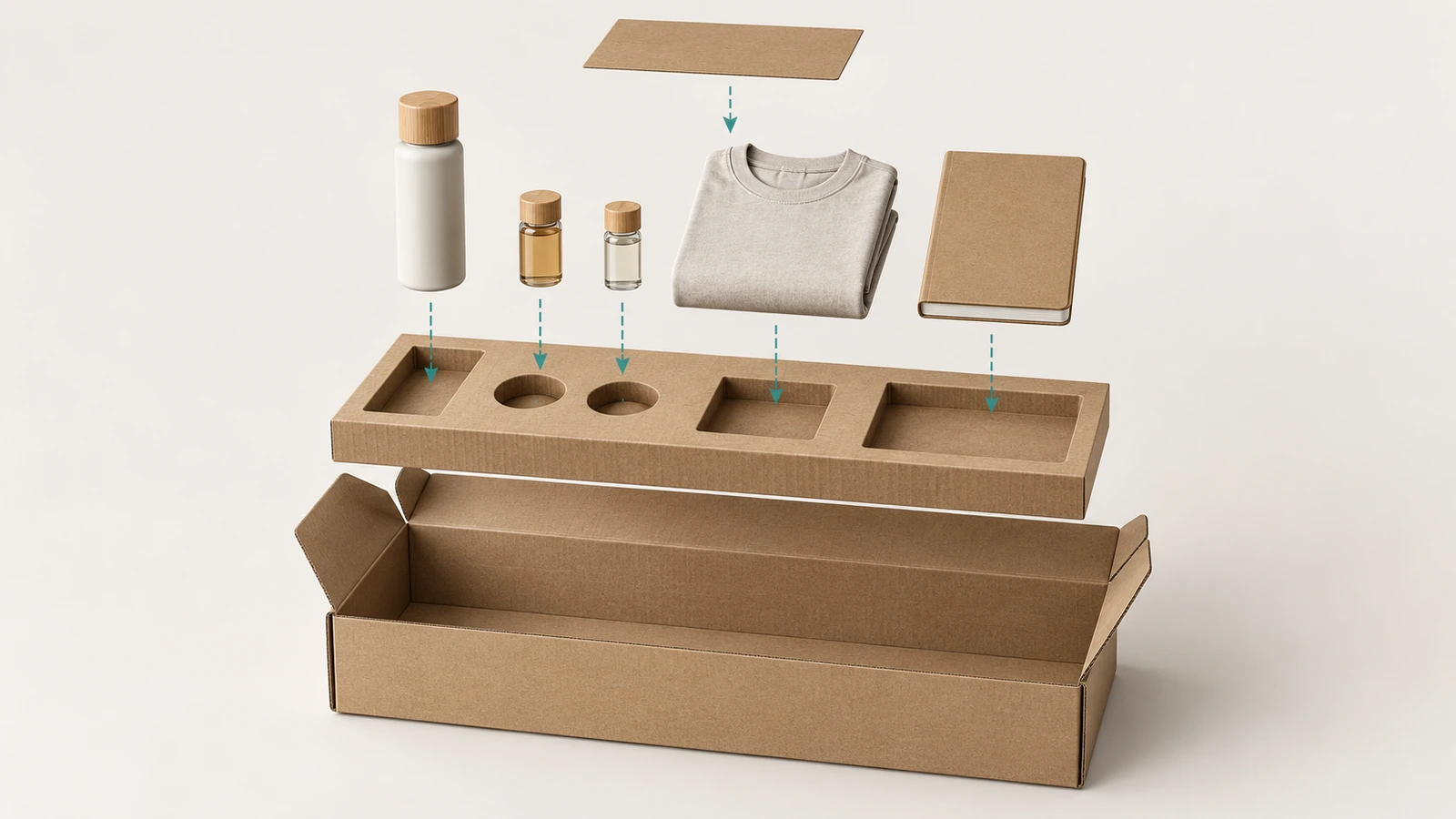
Before anyone sketches a box, list every component with five fields: length, width, height, weight, and fragility class (rigid, semi-rigid, crushable, or breakable). Measure physical samples rather than relying on vendor spec sheets. Retail packaging on a tumbler or a folded garment often adds more depth than the listed product dimension. Mark any item that carries shipping restrictions, such as liquids, aerosols, or devices with lithium batteries, because those items can force a separate compartment or a different carrier service.
Step 2: Separate fixed components from variable ones
Most programs have a stable core and a rotating edge. An onboarding kit might always contain a notebook and a bottle, while the apparel size changes per recipient. A subscription box keeps its shell for a year while the contents change monthly. Design one shell around the largest configuration you expect, then absorb variation inside the box with swappable inserts. One shell size simplifies storage, carrier rate planning, and print runs. A new shell for every version multiplies all three.
Step 3: Identify the anchor item and map the layout
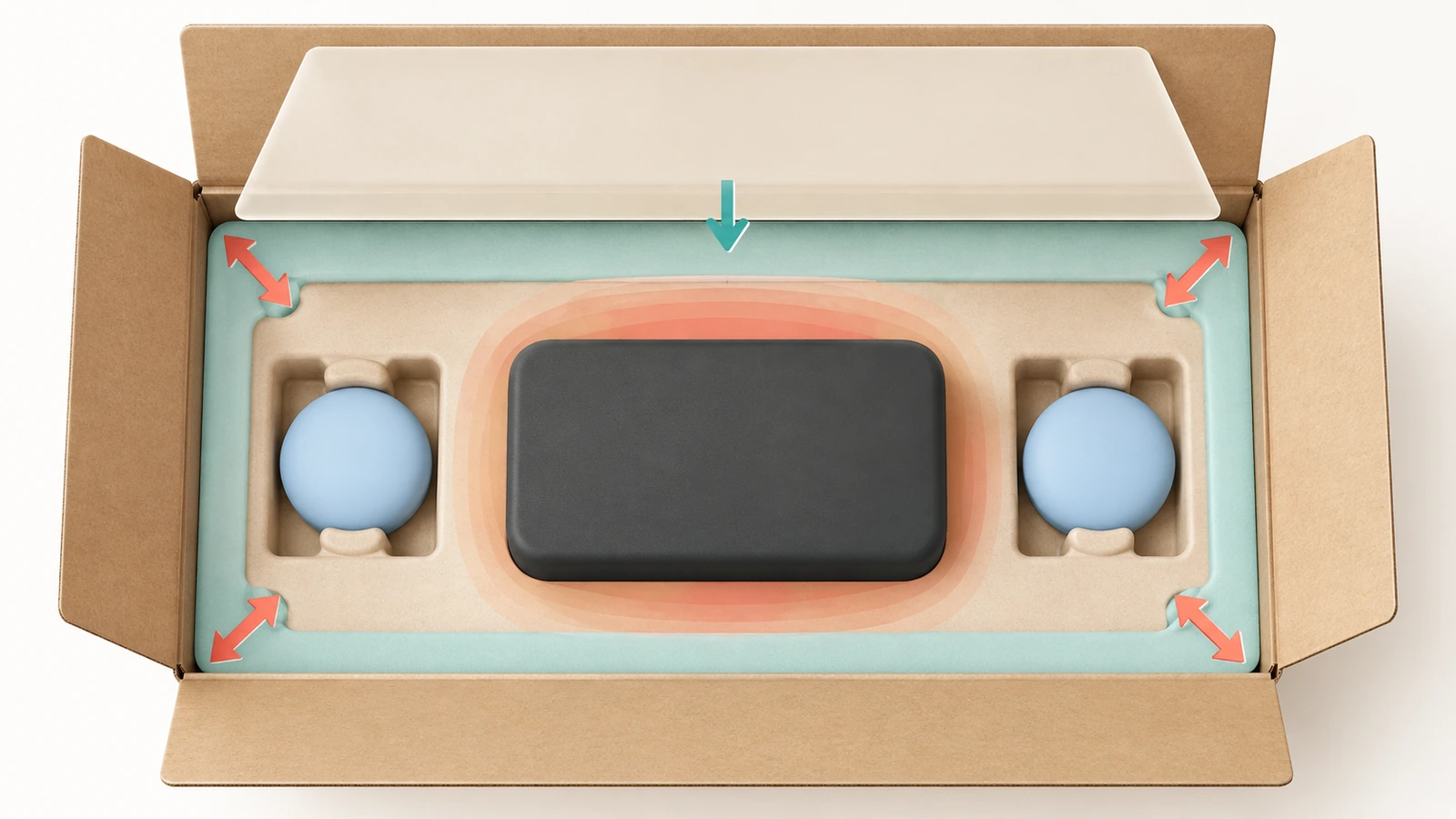
The anchor item is the heaviest or largest component, and it sets the footprint. Place it low and central so the center of gravity stays inside the box footprint when the parcel tips. Keep breakable items away from walls and corners, where drop impacts concentrate. Put flat items such as welcome letters and cards on top, directly under the lid. That keeps them from being crushed and makes them the first thing the recipient sees.
Step 4: Choose an insert architecture
Give every component a defined position. The usual tools are die-cut corrugated inserts with fitted cavities, folded paperboard trays, slotted partitions, and stacked tiers for kits that exceed the footprint. The comparison table below sets out the trade-offs. The governing rule is that loose fill is a last resort. Fill does not hold items in place over a long route, it slows packing, and EU rules now count it as empty space (see Step 8).
Step 5: Engineer the packing sequence
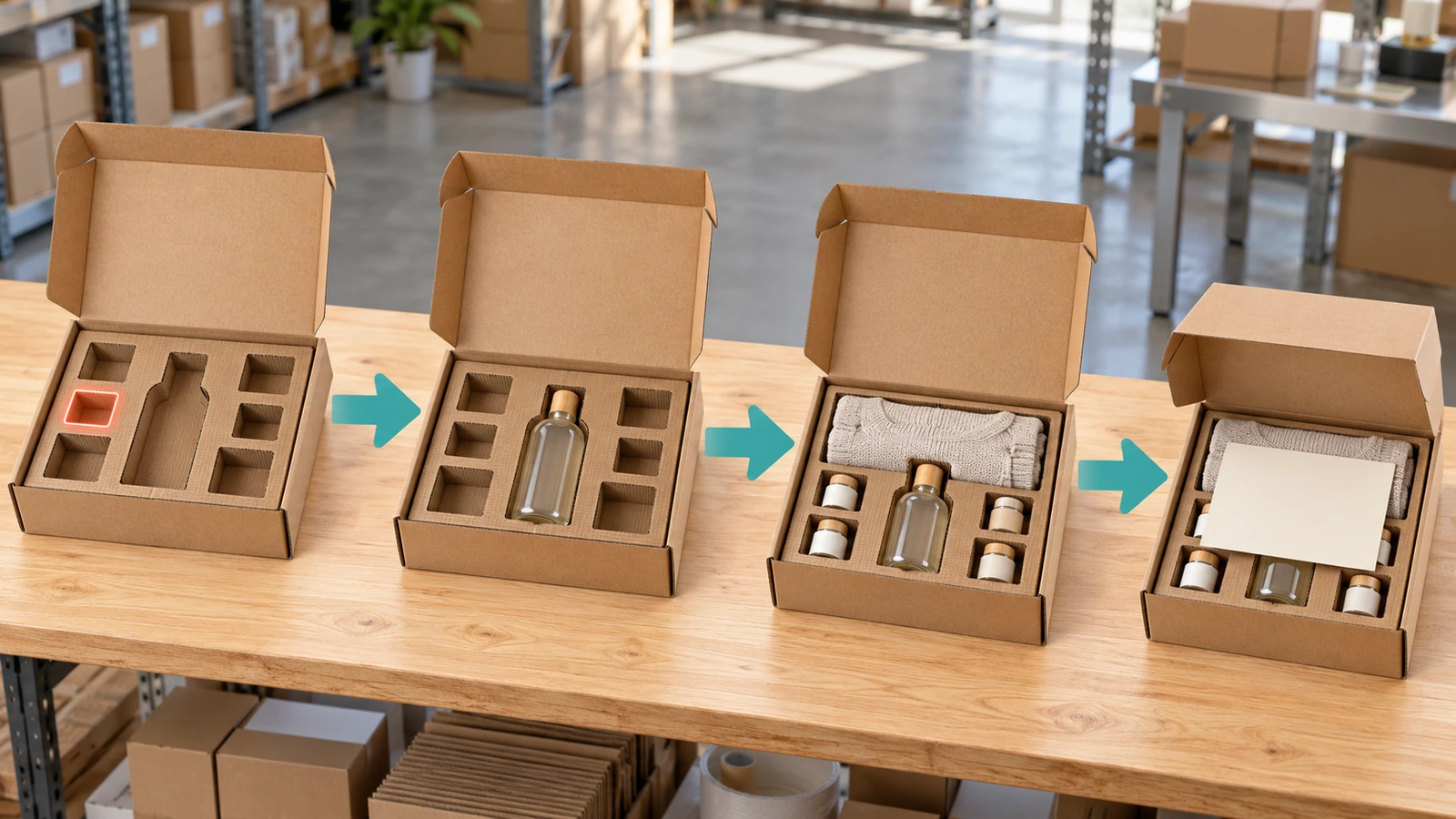
Fulfillment speed and accuracy are set at the design stage. Order the cavities to match the packing line: the bottom tier and anchor item go in first, then mid-layer items, then the card layer. Make each cavity fit exactly one SKU, so that an empty slot is obvious at a glance. That turns the insert into a built-in error check. Many teams print a small pictorial pack-out guide for the line rather than relying on memory, especially when seasonal staff join.
Step 6: Split permanent branding from variable content
Good mailer boxes design for kits puts the brand system on the shell, which is printed once in volume, and puts anything that changes on inserts, sleeves, stickers, or cards. A new quarterly theme then costs you a card reprint instead of a box reprint. Decide on exterior visibility deliberately. Onboarding kits delivered to home addresses can carry bold exterior branding. High-value sample kits or confidential product launches often use a plain or subtle exterior with the full reveal printed inside. Custom mailers with logo designs on the inside lid tend to show up in employee and customer photos, because that is the first surface seen when the box opens.
Step 7: Keep materials recyclable as one stream
A corrugated shell with a corrugated or paperboard insert can usually go into one recycling bin, which makes it easier for recipients to dispose of. U.S. corrugated boxes reached a 96.5% recycling rate in 2018, with 32.1 million of 33.3 million tons generated being recycled, according to the U.S. EPA[4]. If you need coatings for moisture or scuff resistance, ask whether they have been evaluated under the AF&PA and FBA voluntary repulping standard[5], which was updated on 29 May 2025 to replace the 2013 version. Plastic trays and foam inserts break the single-stream story. If your program needs certified fiber sourcing, ask suppliers for FSC chain-of-custody[6] documentation rather than relying on a logo on a sample.
Step 8: Validate the full kit, not just the box
Pack a pilot run with real components, not dummies, and time each packer. Then ship test kits through a distribution simulation. ASTM D4169[7] defines distribution cycles that combine drop, vibration, and compression hazards for a given shipping mode. Board strength is commonly specified by edge crush test (ECT) in pounds per inch. University labs such as Virginia Tech's corrugated packaging lab[8] run this test, and 32 ECT is the common single-wall reference for parcel shipping. Finally, check the empty-space ratio. The EU Packaging and Packaging Waste Regulation, Regulation (EU) 2025/40, caps empty space in e-commerce and transport packaging at 50%, and it counts filling material as empty space. The regulation entered into force on 11 February 2025 and has applied generally since 12 August 2026, as the European Commission[9] notes. Some articles carry their own later dates, so check the specific provisions that affect your program. If your kits ship to EU recipients, a fitted insert does more than look good; it helps keep the kit compliant.
Matching the Kit Structure to the Program Type
The same planning steps produce different structures depending on the program. The four most common B2B uses each have one dominant constraint.
Program
Dominant constraint
Structural answer
Design emphasis
Employee onboarding kits
Size variance (apparel, regional items)
One shell; a soft-goods compartment that tolerates folded garments in any size; fixed cavities for hard goods
Interior welcome message; consistent brand system across hiring waves
Sample kits
Many small, often fragile items
Die-cut cavities sized per vial or swatch; card layer for specs and contact details
Clear order and labeling on inserts so the prospect can compare samples
Subscription boxes
Contents rotate every cycle
Modular inserts swapped per cycle inside a fixed shell
Seasonal themes on cards and sleeves, not on the box
Promotional bundles
Fixed launch or event date
Simple tray or partition that is quick to pack in a short window
Bold exterior when the box itself is part of the campaign
A practical way to generate mailer box ideas for a new program is to start from the dominant constraint in the table, not from the artwork. The artwork works best on a structure that already solves the packing problem.
Insert and Compartment Options Compared
The insert matters more to a kit's outcome than the shell's graphics. This comparison covers the options most often specified for kitting mailers. It assumes a corrugated outer shell in every case.
Insert type
Best for
Item hold
Pack speed
Version flexibility
Recycling with shell
Die-cut corrugated insert (fitted cavities)
Sample kits, fragile or high-value items
High: each item held on several sides
Fast once trained; empty cavities are obvious
Low: new items need a new die
Same fiber stream
Folded paperboard tray
Light items, printed reveal layers
Medium
Fast
Medium: tray graphics can change per run
Same fiber stream
Slotted partitions (dividers)
Bottles, cans, similar-sized items
Medium to high for upright items
Medium: partitions must be assembled
Medium: cell sizes can be adjusted
Same fiber stream
Stacked tiers (two-level insert)
Kits that exceed the footprint
High per tier
Slower: two loading stages
Medium: tiers can be swapped separately
Same fiber stream
Loose paper fill only
Pilot runs, very irregular items
Low: items shift over long routes
Slow and inconsistent
High
Same fiber stream, but counts as empty space under EU rules
Two patterns hold across most programs. Die-cut inserts win when the item list is stable for months. Trays and tiers win when contents rotate. Many subscription programs combine them: a permanent die-cut base for the recurring item, plus a swappable tray on top for the monthly contents.
Material choice also affects the footprint. In one peer-reviewed comparison published in Resources, Conservation and Recycling[10], the corrugated option carried the highest carbon footprint under that study's conditions, largely because of its weight and long transport distances. The practical lesson for kits is to right-size. An insert that lets you drop to a smaller shell removes board weight and shipped volume on every parcel.
FAQ
FAQ: What is the difference between a kitting mailer and a regular mailer box?
A regular mailer is sized around one product. A kitting mailer is sized around a group of products, and it usually includes an insert, partitions, or tiers that assign each item a position. The insert controls weight distribution and contact between items, and it sets the order in which the recipient sees things.
FAQ: Can one mailer size serve several kit versions?
Yes, and in most programs it should. Size the shell for the largest configuration you expect, then handle the differences with swappable inserts or trays. This keeps one print run, one storage footprint, and one carrier rate profile for the whole program.
FAQ: How do I stop small items from shifting inside the kit?
Give each small item its own fitted cavity rather than letting it sit in a shared space. Place flat items in a top layer under the lid, and keep fragile items away from the walls. Loose fill alone rarely holds small items in place over a multi-leg route.
FAQ: Should the insert be made from the same material as the box?
Where possible, yes. A corrugated or paperboard insert inside a corrugated shell lets the recipient recycle everything in one fiber stream. U.S. corrugated boxes had a 96.5% recycling rate in 2018, according to the EPA. If the insert needs a coating, ask whether it has been evaluated for repulpability under the AF&PA and FBA voluntary standard.
FAQ: Should the brand print go on the outside or the inside?
It depends on the program. Bold exterior print suits promotional bundles and onboarding kits, where the box is part of the experience. Confidential or high-value sample kits often keep the exterior plain and put the reveal on the inside lid and inserts. In both cases, keep content that changes off the box and on cards or sleeves.
FAQ: How should a kit be tested before launch?
Pack a pilot with real components, time the pack-out, and run test shipments through an ASTM D4169 distribution cycle that matches your shipping mode. Check board strength by ECT, and if the kits ship into the EU, measure the empty-space ratio against the 50% limit in Regulation (EU) 2025/40.
FAQ: What quantities and lead times should I plan for?
Both depend on the shell size, the insert complexity, the print coverage, and how many kit versions you run. Share your kit bill of materials and program cadence with your supplier to get a quotation based on your actual configuration.
Key Takeaways
Corrugated kit shells and inserts can be recycled together in one stream. — 96.5% of U.S. corrugated boxes were recycled in 2018 (Source)
Fitted inserts help keep EU-bound kits within the empty-space limit, because filling material counts as empty space. — 50% maximum empty-space ratio (Source)
Check any coated insert or shell for repulpability under the current industry standard. — updated 29 May 2025, replacing the 2013 version (Source)
Use standard style codes so buyers and converters describe the same structure. — FEFCO Code, 12th edition, includes a retail and e-commerce series (Source)
Your kit shares the carrier network with a very large volume of corrugated packages. — nearly 40 billion packages from 416 billion sq ft of U.S. board in 2021 (Source)
Conclusion
Kitting mailers work when the structure is decided before the artwork. Start with a measured bill of materials. Keep one shell for every version and let the inserts absorb the variation. Order the cavities so packers load in sequence and spot gaps instantly. Put permanent branding on the box and anything that changes on cards and sleeves. Then confirm the full kit, rather than an empty box, through distribution testing. When you are ready to turn a kit plan into a shell specification, review our custom roll-end tuck-top corrugated mailer boxes and request a sample-based quotation for your configuration.
Hi there! I'm Bruce, proud dad to my amazing son. I'm the founder of Zigpac, a printing and packaging company empowering small and medium-sized businesses with custom solutions. Let's create something great together!



 Blog PDF for offline reading












The information below is required for social login
Sign In
Create New Account