


 Blog PDF for offline reading
Quick answer: Hologram stickers printing is a multi-stage process. An optical master is originated, copied into nickel embossing shims, embossed into film, and metallized. The film is then overprinted, optionally given a tamper-evident VOID layer and serial numbers, and die-cut. Most of the cost, minimum order and lead time is set by whether you need a custom master and how many security layers you stack on top.
If you have asked three suppliers for a hologram stickers printing quote, you have probably received three answers that do not look like they describe the same product. They usually don't. The same word "hologram" covers rainbow vinyl that any desktop shop can cut, stock security foil that thousands of brands share, and custom-originated optical devices whose master never leaves a controlled facility. This guide explains each production stage so you can tell which one you are actually being quoted for, before you pay for tooling you don't need or skip a layer you do.
Why Do Hologram Sticker Quotes Look So Different?
The problem: buyers compare unit prices, but the real cost sits in decisions that happen before the first label is printed. These include who owns the optical master, whether the hologram must line up with printed artwork, and whether every label needs a unique number.
Why it hurts: counterfeiting is not a niche risk. The OECD and EUIPO estimate that fakes made up 2.3% of world trade, about USD 467 billion, in 2021[1]. In 2024, EU customs and enforcement authorities detained around 112 million fake items worth an estimated EUR 3.8 billion[2]. Public buyer reviews of cheap stock "security" stickers repeat the same complaints. The label peels off whole, the residue is too faint to notice, or the serial numbers repeat across packs. A label that looks secure but can be reapplied costs money and also gives false confidence.
The fix: understand the production chain. Once you know what each stage adds, you can decide which stages your product actually needs and ask suppliers to quote them separately.
What Is a Holographic Sticker, Really?
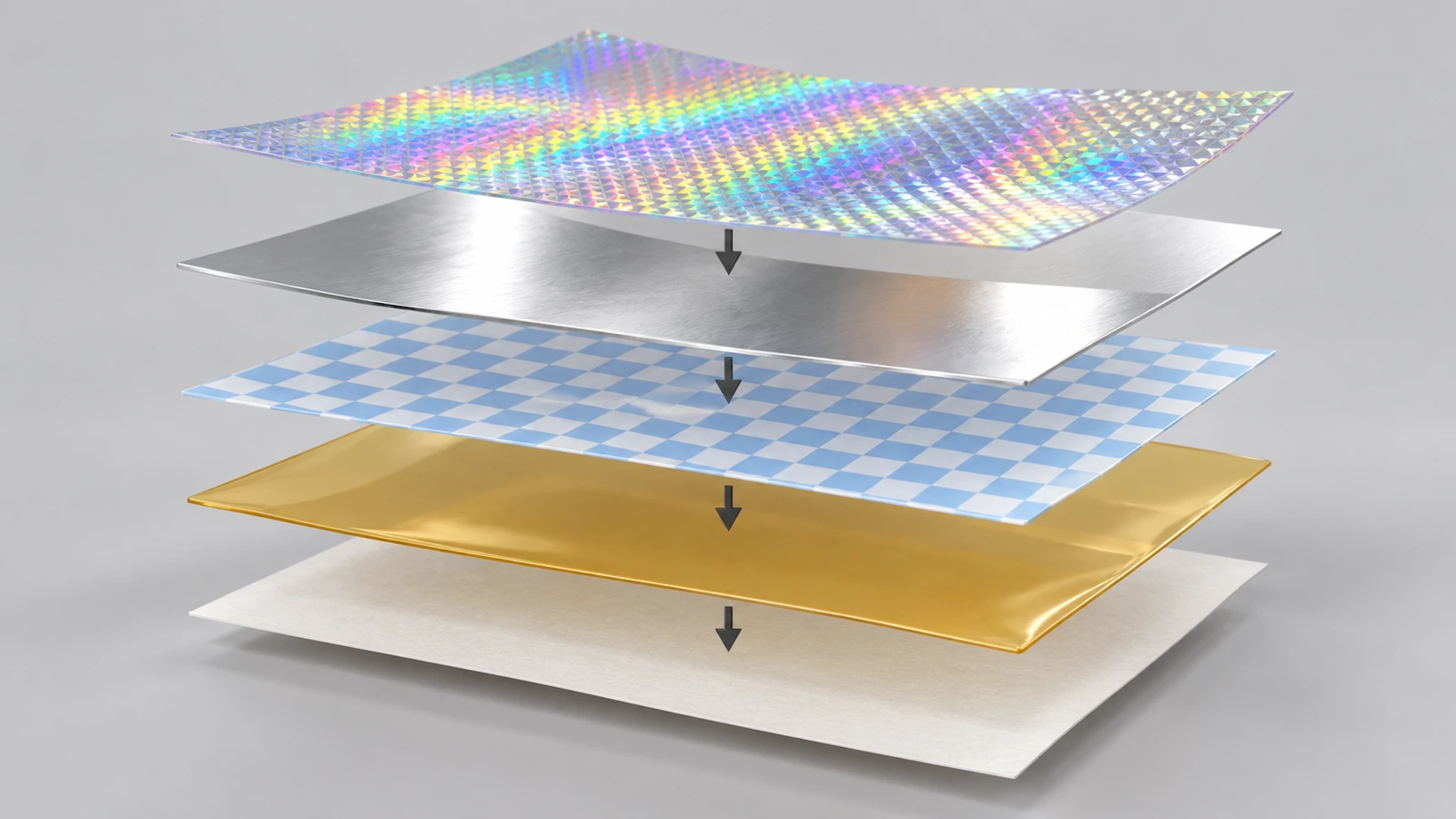
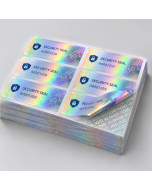
A holographic sticker is any self-adhesive label whose surface shows a diffractive, angle-dependent image or color shift. Commercially, the term covers three different constructions, and the distinction matters more than the name.
- Decorative holographic film. This is a metallized film with a generic rainbow or pattern texture, printed over with ordinary inks. It looks premium, but anyone can buy the same film, and the label usually peels off cleanly.
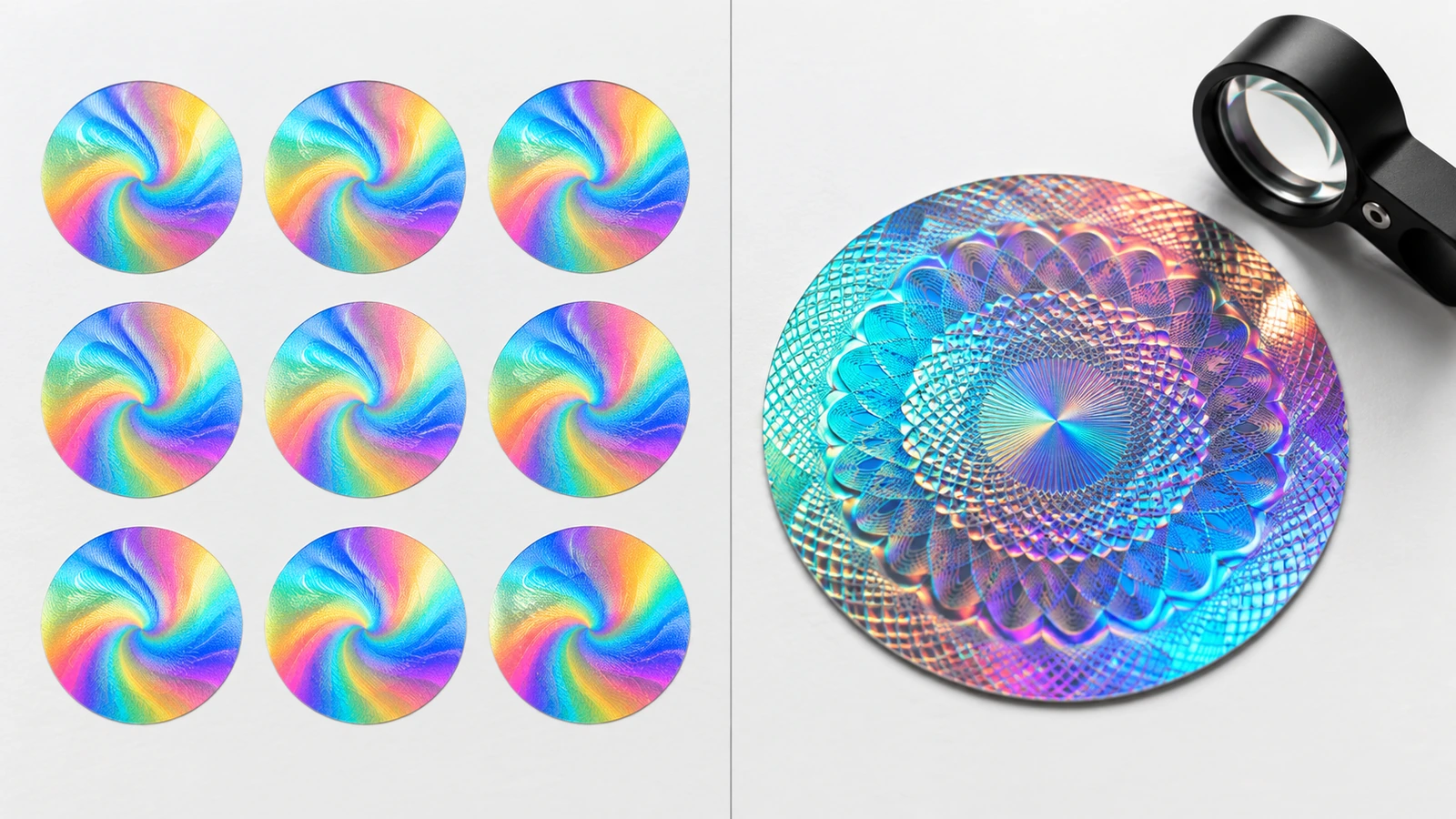
- Security hologram. This is a diffractive microstructure embossed from a master made for one brand or one program. It can include 2D/3D depth, kinetic effects, microtext and hidden images. Its job is authentication: "is this the original?"
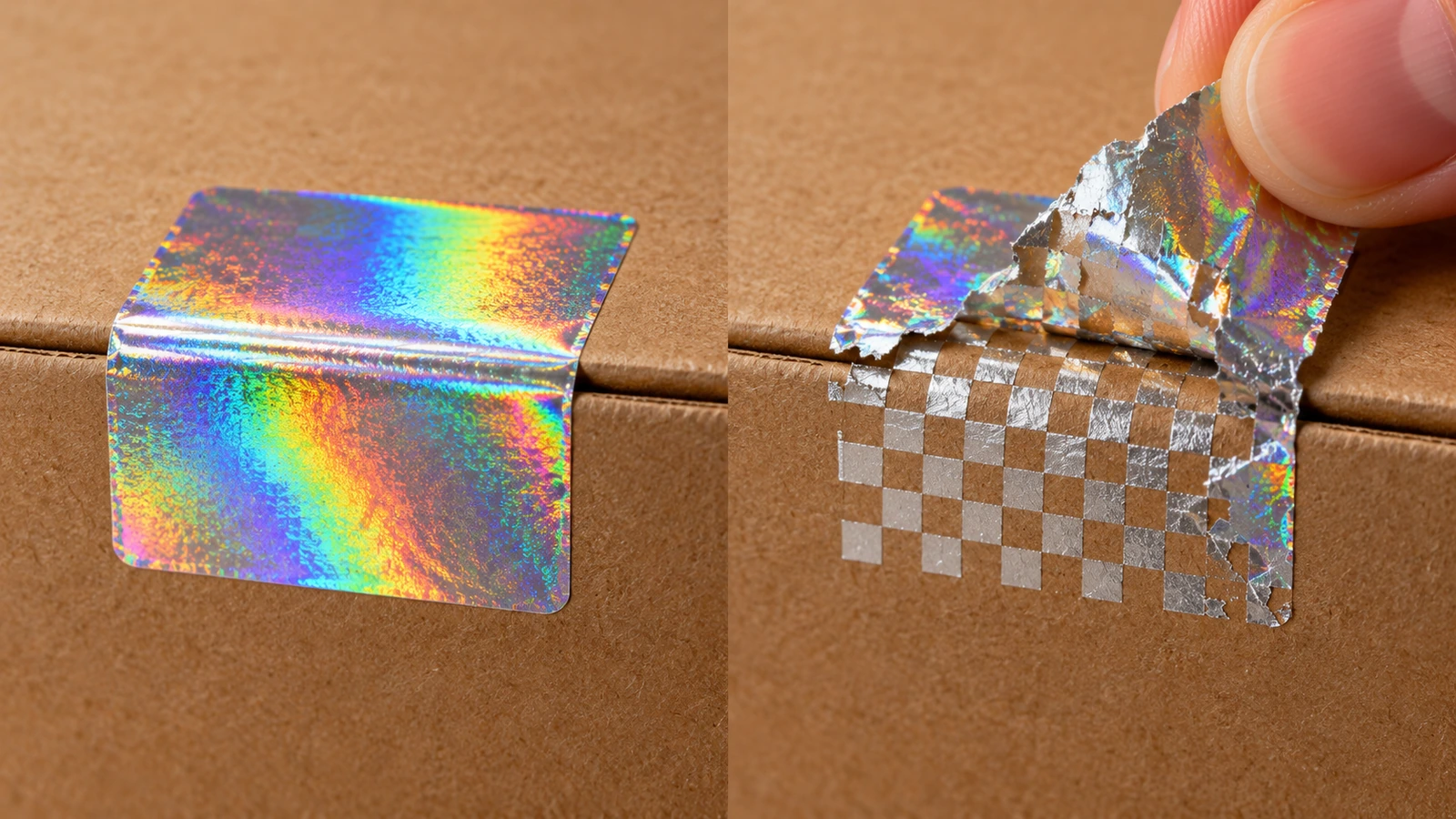
- Tamper-evident (VOID) hologram. This is a security or stock hologram combined with a patterned release layer. When someone peels it, the label breaks and leaves a message or pattern behind. Its job is integrity: "has this been opened?"
The EUIPO's anti-counterfeiting technology guide notes that traditional holograms can be applied to paper, plastic, fabrics and tamper-evident materials such as destructible labels. It also notes that they cannot be reproduced simply by color printing, scanning or photographing, although reliable checking requires a genuine reference to compare against EUIPO technology guide[3]. For VOID constructions, the same guide explains that the label deposits part of its color onto the product as "void", a custom text or a logo. Once peeled, the label's integrity cannot be restored. Even if someone wipes the message off the product, it shows in negative when the label is put back EUIPO void labels[4].
How Does Hologram Stickers Printing Work, Step by Step?
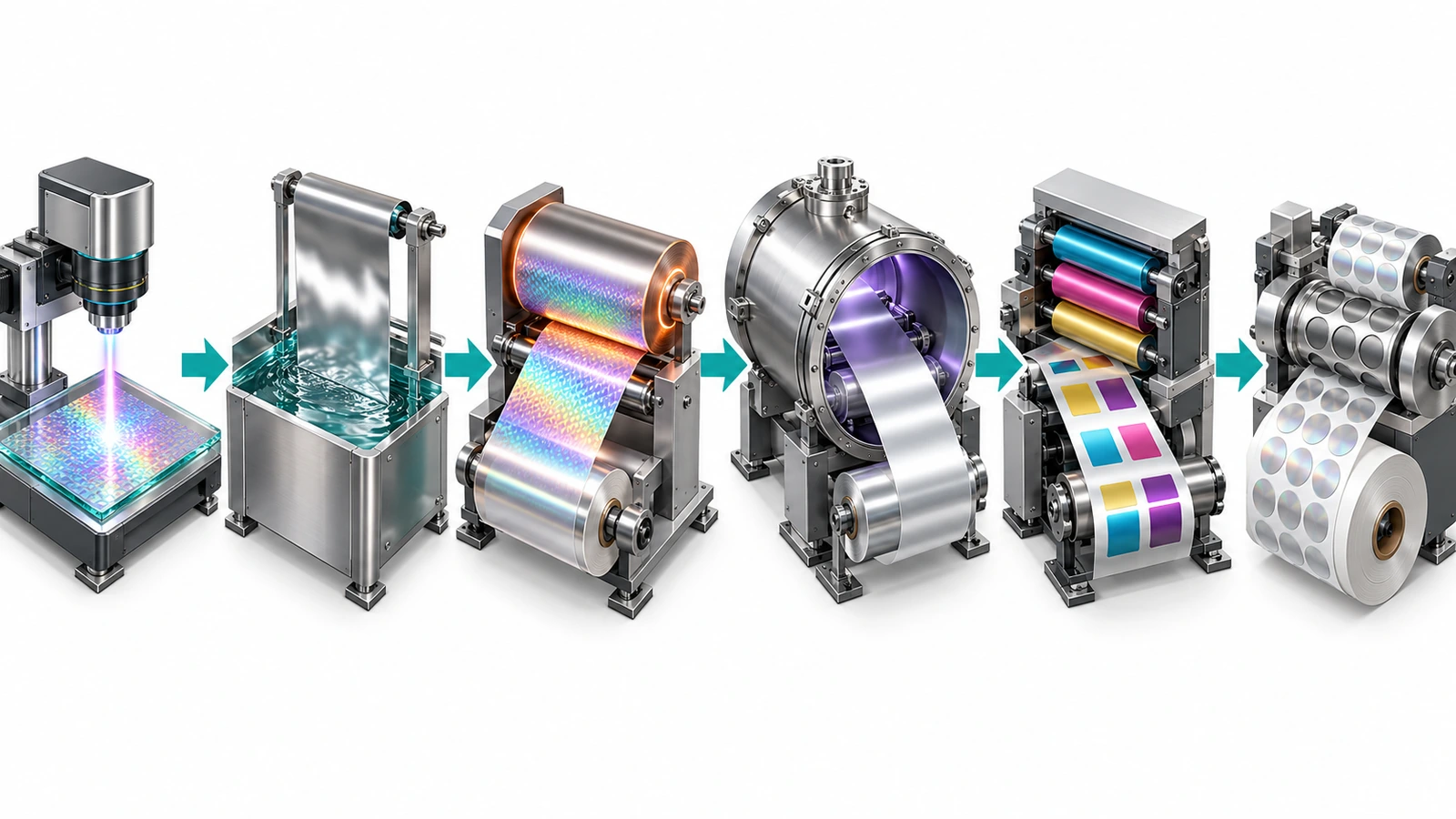
The sequence below describes a custom security hologram with optional tamper evidence and serialization. Decorative labels skip steps 2 to 4 because they start from purchased film. Each step lists the buyer decision it creates.
Step 1: Define the threat before the artwork
ISO 22383:2020 frames authentication as a lifecycle problem. It gives performance criteria and an evaluation method for authentication solutions[5] but deliberately does not prescribe a technology. In practice, this means writing down who might copy or tamper with your product, where in the supply chain this could happen, and who will check the label: a consumer, a returns clerk, or a forensic lab. That answer decides whether you need a custom master at all.
Step 2: Originate the optical master
The master is the security asset. It is created with dot-matrix, lithographic or electron-beam origination and encodes the diffractive structures: depth layers, color switches, microtext, and covert images visible only under a laser or magnifier. Origination is a one-time cost and the largest fixed item in a custom program. Ask two questions here. First, who owns and stores the master? Second, can the image be registered? The International Optical Technologies Association (formerly IHMA) runs the Security Image Register[6]. It was expanded from the Hologram Image Register in January 2024, is operated by the ICC's Counterfeiting Intelligence Bureau, and helps prevent two programs from using the same image.
Step 3: Electroform nickel shims
The master is too delicate to run on a press, so it is copied by electroforming into nickel shims. These shims are then "recombined" (step-and-repeat) into a production shim that matches the embossing machine's width. Shims wear out, and a larger label size or a different layout can require a new recombination. That is why changing the hologram footprint usually costs more than changing the printed artwork.
Step 4: Emboss and metallize the film
The shim presses the microstructure into a coated polyester film under heat and pressure, or into a UV-curable coating (UV casting). The embossed relief is invisible until it is coated. Vacuum metallization with aluminum makes it bright and opaque. A transparent high-refractive-index coating keeps it see-through, which is used when the hologram sits over printed data. Selective demetallization can open clear windows for a registered effect. Because embossing and metallizing run in rolls, minimum economic quantity is tied to film length rather than label count. This is one reason custom-hologram MOQs behave differently from digital sticker MOQs.
Step 5: Add the tamper-evident layer (if required)
For VOID constructions, a release coating is printed in a pattern (text, checkerboard, honeycomb or brand mark) before the adhesive is applied. When someone peels the label, the bond fails along that pattern by design. Whether the pattern stays on the surface, on the label, or on both is a transfer-type choice. That choice is covered in detail on our custom VOID hologram labels page, so we won't repeat it here. Note that tamper evidence comes from the adhesive structure, not from the hologram. A hologram alone can be peeled and reused.
Step 6: Overprint the artwork
Brand graphics are printed over or around the hologram by flexo, offset, screen or digital processes. A white underbase is often printed where colors must stay solid instead of turning translucent over the metal. The key cost decision is registration. A "wallpaper" hologram repeats continuously and the artwork can land anywhere. A registered hologram must line up with specific printed elements, which needs register marks and tighter press control. Public complaints such as "the hologram was barely visible" or "the rainbow ran the opposite direction to the picture" usually come from approving a flat image instead of a physical proof. Ask to see the effect under the lighting and viewing angle your customers will use.
Step 7: Serialize with variable data
Sequential numbers, barcodes and unique QR codes are added inline by thermal transfer, inkjet or laser marking. Serialization makes each label individually traceable, which is the gap a hologram cannot fill on its own. The EU's falsified-medicines rules illustrate the logic. Delegated Regulation (EU) 2016/161[7] requires a unique identifier and an anti-tampering device as two separate safety features. Insist on a written uniqueness rule (no number reused across orders) and a number log delivered with the shipment.
Step 8: Die-cut, inspect and control waste
Labels are kiss-cut on the liner, sometimes with security slits so they tear rather than lift. They are then inspected and wound or sheeted. In security work, misprints and overruns must be counted and destroyed, because a genuine but uncontrolled label is harder to detect than a fake. ISO 14298:2021 is the management standard for security printing processes[8]. It replaced the 2013 edition and covers controls over customer requirements, materials, originals and waste, rather than optical quality.
Stock Foil vs. Custom Origination: How the Options Compare
The table compares the five constructions buyers most often confuse. Levels are relative. Actual figures depend on size, quantity and supplier, and should come from a written quote.
| Construction | What is custom | One-time tooling | Main MOQ driver | Main lead-time driver | Copy resistance | Opening evidence |
|---|---|---|---|---|---|---|
| Decorative rainbow film + print | Artwork only | Cutting die (often none for digital) | Press setup | Print queue | Low: film is widely available | None: peels cleanly |
| Stock security foil + custom overprint | Artwork, colors | Plates/die | Stock foil roll availability | Print queue | Low–medium: image is shared | Only if a VOID layer is added |
| Custom-originated hologram | Optical image, microtext, covert features | Master + shims | Embossing and metallizing film run | Origination and proof approval | High: exclusive, registrable image | Only if a VOID layer is added |
| Custom hologram + VOID release layer | Above + release pattern or message | Master + shims + pattern | Film run + coating setup | Origination + adhesion testing on your surface | High | Yes: irreversible pattern |
| Custom hologram + VOID + serialization | Above + unique numbers or codes | Above + data setup | Film run + data file | Above + data verification | High + per-unit traceability | Yes, linked to a unique ID |
What Drives Cost, MOQ and Lead Time?
Once the stages are clear, the price structure of hologram stickers printing becomes predictable. Fixed costs come from origination, shims, cutting dies, release-pattern setup and variable-data programming, and you pay them once per design. Variable costs come from film area, metallization, ink, adhesive and inspection, and they scale with quantity and label size. The EUIPO describes void-label costs as fairly low, but varying with customisation. That is accurate: the customisation, not the sticker, is what you are mainly paying for.
Four questions settle most of the quote before a supplier gives you a number:
- Do you need an exclusive image? If not, stock security foil removes origination cost and time. If counterfeiting is your real threat, a shared image offers little protection.
- Must the hologram register with the artwork? Registration adds press control and waste. Wallpaper holograms are cheaper and faster.
- Do you need proof of opening? If so, budget for adhesion testing on your actual pack surface. Plastics, coatings and curved edges behave differently.
- Do you need per-unit traceability? If so, define the number format, uniqueness rule and data handover before artwork is frozen.
Regulation rarely forces the choice for you. For US over-the-counter drugs, 21 CFR 211.132[9] requires packaging with indicators or barriers that give visible evidence of tampering, plus an identifying characteristic such as a pattern, name, registered trademark, logo or picture. It does not require a hologram. A custom hologram is one way to provide that identifying characteristic. Likewise, NIST's FIPS 140-3[10], published on March 22, 2019, sets requirements for cryptographic modules, not for labels. A tamper seal may form part of a module's physical security, but the module is what gets validated. For safe claim wording and warranty language, see the guidance on our tamper-evident hologram label page.
FAQ
FAQ: What is a holographic sticker, and is it the same as a security hologram?
Not necessarily. A holographic sticker is any label with a diffractive, color-shifting surface. Many are decorative film that anyone can buy. A security hologram is embossed from a master made for one owner, often with microtext or covert features, so it can serve as an authentication feature.
FAQ: Can someone copy my hologram with a scanner or high-end printer?
Not directly. The image is a physical microstructure, so color printing, scanning or photographing cannot reproduce the diffractive effect. A determined counterfeiter can, however, attempt a look-alike origination. That is why master custody, image registration and a genuine reference sample for inspectors all matter.
FAQ: Do I need a new master every time my packaging artwork changes?
Usually not. Overprinted graphics, colors and serial numbers can change without touching the master. A new master or shim is needed only when the optical image itself, its size, or its layout across the web changes.
FAQ: Is there a law that requires hologram stickers on products?
No general US or EU law requires holograms on consumer goods. Specific rules, such as 21 CFR 211.132 for OTC drugs or EU 2016/161 for prescription medicines, require tamper evidence or unique identifiers, and a hologram can be one way to meet part of those requirements.
FAQ: How can I tell whether a supplier runs real security hologram stickers printing?
Ask whether its certified scope covers security printing under ISO 14298. Ask who stores the master and shims, whether your image can be registered with the IOTA Security Image Register, how misprints are destroyed, and how serial-number uniqueness is guaranteed. A shiny sample alone proves none of these.
FAQ: Does a VOID hologram stop all tampering?
No. It makes opening visible and hard to hide, but it does not stop someone from replacing contents and applying a different label. Pairing it with an exclusive image and unique serial numbers closes that gap.
Key Takeaways
- Counterfeiting is measurable, not hypothetical. — 2.3% of world trade, about USD 467 billion in 2021 (Source)
- Enforcement pressure is rising. — around 112 million fake items worth EUR 3.8 billion detained in the EU in 2024 (Source)
- The master, not the sticker, is the security asset. — image registration expanded into the Security Image Register in January 2024 (Source)
- Security printing has its own management standard. — ISO 14298:2021 replaced the 2013 edition (Source)
- Identity and integrity are separate features. — EU 2016/161 requires 2 safety features: a unique identifier and an anti-tampering device (Source)
- US OTC drug rules require tamper evidence, not holograms. — 21 CFR 211.132 (Source)
Conclusion
Hologram stickers printing is not one process but a chain: origination, shims, embossing, metallization, an optional tamper layer, overprinting, serialization and controlled finishing. Each link adds either cost or security, and the right label includes only the links your threat model needs. Decide whether you need an exclusive image, proof of opening, and per-unit traceability. Then ask suppliers to quote those items separately, so you can compare offers on equal terms. When you are ready to turn that brief into samples and a quote, start with our custom VOID hologram security labels.
Sources
- OECD/EUIPO, Mapping Global Trade in Fakes 2025 (published 2025-05-07) ↩
- European Commission, Taxation and Customs Union: EU detains 112 million counterfeit items worth EUR 3.8 billion in 2024 (2025-10-01) ↩
- EUIPO, Anti-Counterfeiting and Anti-Piracy Technology Guide: Holograms ↩
- EUIPO, Anti-Counterfeiting and Anti-Piracy Technology Guide: Void Labels ↩
- ISO 22383:2020, Guidelines for the selection and performance evaluation of authentication solutions for material goods ↩
- International Optical Technologies Association, Security Image Register ↩
- EUR-Lex, Commission Delegated Regulation (EU) 2016/161 ↩
- ISO 14298:2021, Graphic technology: Management of security printing processes ↩
- eCFR, 21 CFR 211.132: Tamper-evident packaging requirements for over-the-counter human drug products ↩
- NIST, FIPS 140-3: Security Requirements for Cryptographic Modules (2019-03-22) ↩












The information below is required for social login
Sign In
Create New Account