


 Blog PDF for offline reading
Quick answer: High quality custom trucker hats pair a buckram-backed twill or UV-stable foam front with tight polyester mesh, taped seams, a plastic-core brim, a sewn-flat sweatband and a snap that seats cleanly. Write each part into a spec, approve a physical sample, and inspect the bulk lot against it using agreed AQL levels.
Why Do Custom Trucker Hats Disappoint After Delivery?
Most failed cap orders look fine in the mockup and fail later, on someone's head. Buyers who search for high quality custom trucker hats usually describe the same problems. A front panel looks "ten years old" after two sweaty outdoor shifts. A heat-pressed logo starts peeling within weeks. Three black hats from the same order fit smaller than the navy ones. A lump of fabric in the middle of the brim leaves a dent in the wearer's forehead. None of these problems shows up in a digital proof, because they come from materials and construction, not artwork.
The stakes are higher than the unit price suggests. Caps are the largest product type in headwear, accounting for 37.9% of global headwear revenue in 2025[1], and trucker caps are named among the most purchased styles. Your employees, team members and customers already own retail caps. They compare your branded hat against those caps, and a flimsy one goes into a drawer instead of out in public.
This guide gives business buyers a part-by-part benchmark: crown foam and mesh grade, panel and seam construction, brim and sweatband materials, closure hardware, stitch density and finishing. It ends with a sample and bulk-lot inspection checklist that includes acceptance criteria you can paste into a purchase order.
What Makes a Trucker Hat "High Quality"?
For a business order, quality means that every hat in the lot matches a written specification, not that one sample looked good. A trucker cap is a structured front panel, or a pair of panels, joined to breathable mesh rear panels, with a brim, an inner sweatband and an adjustable closure. The product guide on custom trucker caps covers the basic definition and ordering. This article focuses on how to grade each component.
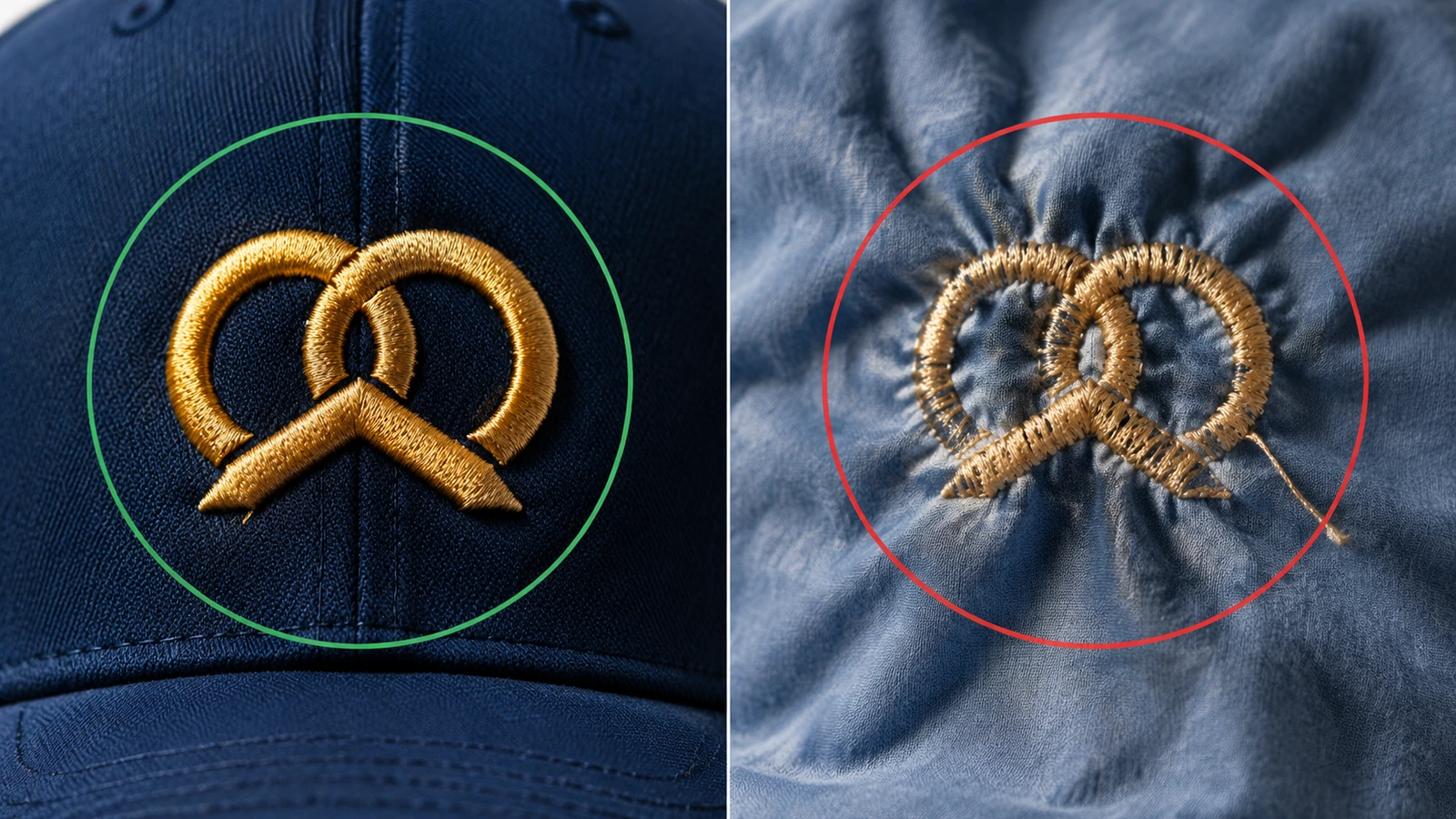
Grade the cap in two layers. The blank is the hat itself: fabric, foam, mesh, brim, seams and hardware. The decoration is embroidery, patch or print. A premium decoration cannot rescue a weak blank. Dense embroidery on an unsupported front puckers, and a leather patch on a soft, collapsing crown sags. A strong blank can also be ruined by a decoration it was not built for. Embroidery on soft foam sinks in, and thin outlines, gradients and tiny text lose definition once the needle compresses the foam. Quality comes from matching the two layers, which is why the checklist later in this guide inspects them separately.
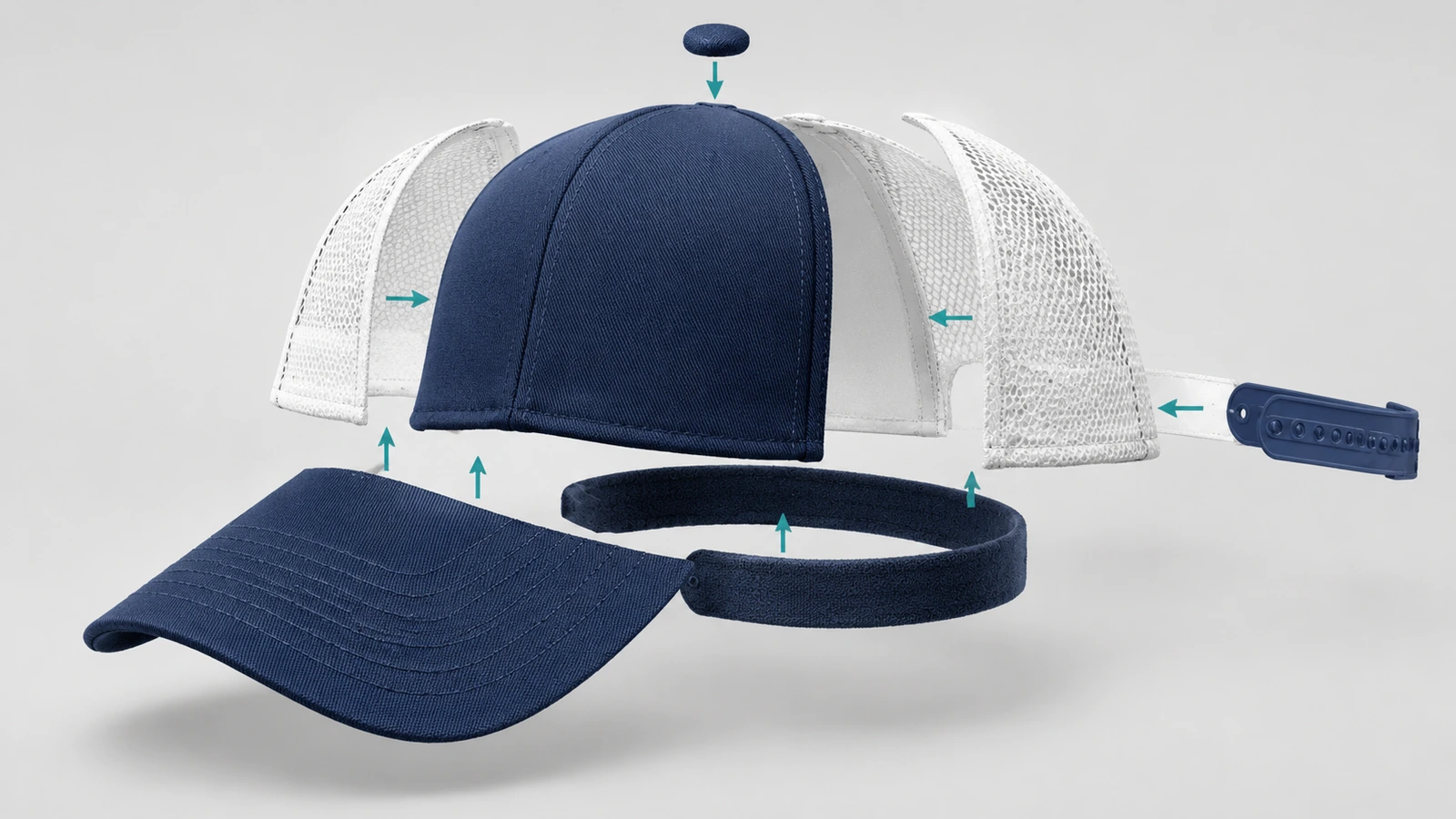
How Do You Judge High Quality Custom Trucker Hats Part by Part?
1. Crown front: structured twill vs. foam
The front panel carries the logo and the shape, so grade it first. Two constructions dominate.
- Structured twill front. The industry's reference structured blank uses a 60% cotton / 40% polyester twill front over 100% polyester mesh. Many value blanks flip that ratio to roughly 65% polyester / 35% cotton. More polyester gives better colorfastness. More cotton gives a softer hand but fades faster in sun and sweat. The front should be fused to a buckram stiffener. Press the center of the panel with your thumb: it should spring back without creasing.
- Foam front. This is a polyester or nylon foam laminate, commonly 3–5 mm thick. It suits screen print, heat transfer and large graphics. Low-grade foam yellows under UV and loses its loft, so ask in writing for UV-stabilized foam. Embroidery is the weak spot on foam, as noted above.
Buyers who need fine detail and repeated washing should default to twill with buckram. Foam belongs on graphic-heavy event hats where a retro look matters more than daily-wear life.
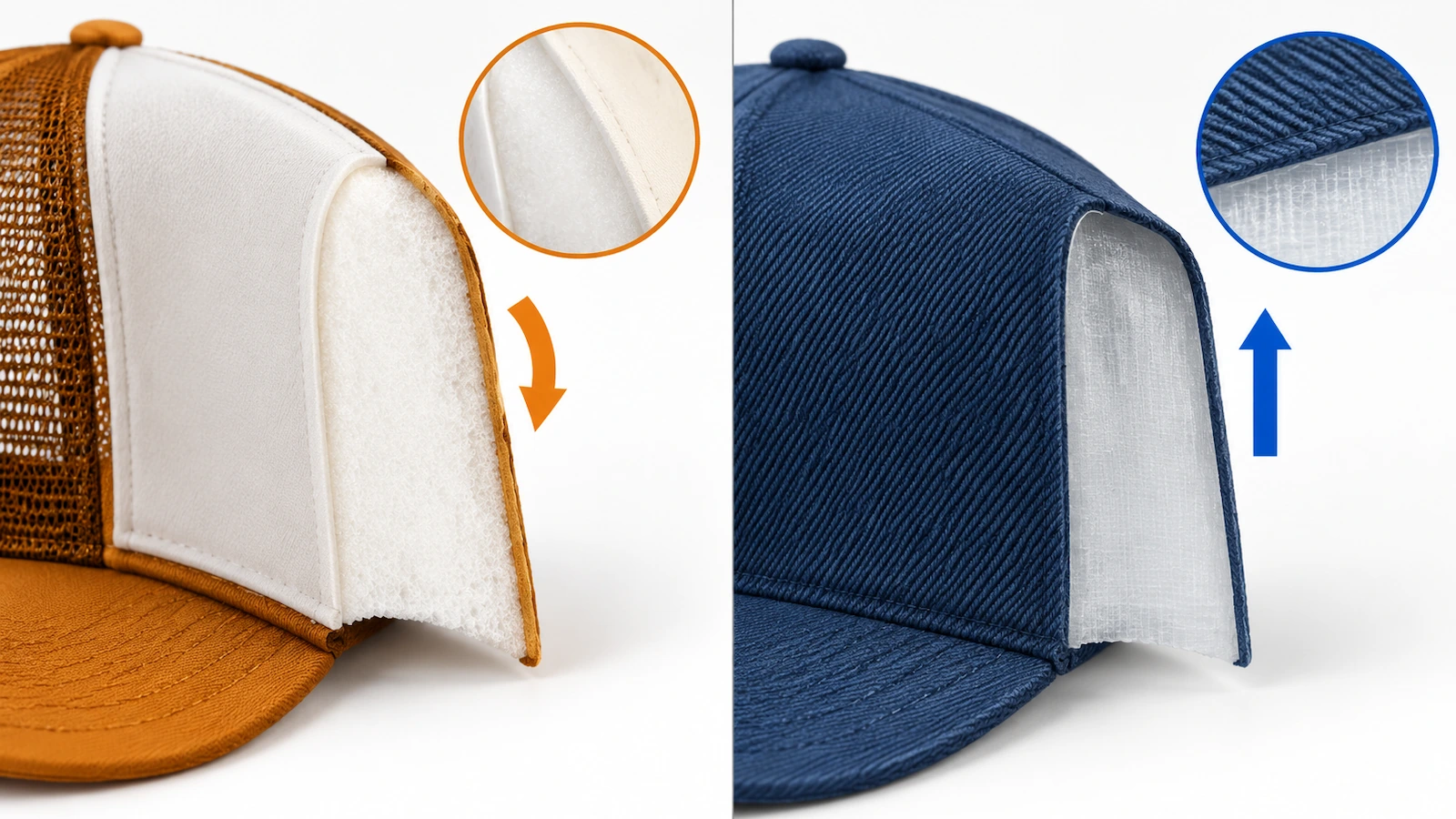
2. Mesh grade
Mesh is where cheap hats show their cost first. Buyers describe low-grade mesh as stiff, or so weak that "one little tug" could tear it. Polyester mesh is the durable benchmark. Nylon mesh is lighter and very breathable but slightly less tough. PVC-type mesh feels stiff and is the least sustainable option. To check mesh, stretch a corner gently and look for snapped strands and uneven hole size near the seams. Confirm that the mesh color matches across every colorway in the order. Mesh is unbacked, so it should carry only small flat embroidery. Dense fills, puff embroidery and heavy patches belong on the front.
3. Panel and seam construction
Choose the panel count to suit the artwork.
- Six-panel: a center seam runs through the embroidery area. This works well for classic mid-size logos, but text that crosses the seam can sink into the seam ridge and distort.
- Five-panel: a single seamless front panel is better for wide patches and large graphics.
Inside the hat, look for seams covered with seam tape and no raw edges. Stitch lines should be straight and free of skipped stitches. The top button should sit centered where the panels meet. A lopsided crown is a construction defect, not a styling choice, so record crown symmetry as a measurable check. Ask the supplier to confirm crown height and profile (low, mid or high) on the spec sheet. Profile changes how the logo sits and how the hat fits.
4. Brim
The brim should have a plastic core, not paperboard, so it survives rain and can be shaped. Check the topstitch rows: they should be evenly spaced, parallel and unbroken across the full width. Then turn the hat over and run a finger along the brim-to-crown joint. A thick fold of fabric at center front is the source of the "dent in my forehead" complaints, and you can catch it on the first sample. Pre-curved and flat brims are both legitimate. The requirement is that every hat in the lot has the same curve.
5. Sweatband
The sweatband decides comfort over a full workday. Common materials are cotton, terry, mesh and moisture-wicking polyester. Whatever you choose, it should be sewn flat with no puckers and no bulky overlap at the front seam. It should also be firmly attached along its whole length, because a band that folds inward after the first wash signals weak edge stitching.
Care-instruction labels are not federally mandated for hats. The Care Labeling Rule excludes articles used exclusively to cover the head[2]. Many buyers still add a voluntary care card, because it heads off "it shrank" complaints.
6. Closure hardware
A plastic snapback is standard and works for most adult heads. Reviewers do rank it as less premium than a leather strap with a metal buckle. Grade the hardware itself:
- Snap tabs should be molded cleanly with no flash on the edges.
- Every post should engage every hole.
- The strap should not crack when flexed.
- Rivets or stitching that anchor the closure should not pull out of the mesh.
If your crew includes very large or very small heads, ask for the adjustment range of your exact blank. "One size" is a range, not a guarantee. The bulk-lot check below verifies that the range holds across colors.
7. Stitch count, density and digitizing
Stitch count is the most useful number on an embroidery proof. A buckram-fused structured front is commonly reported to hold about 10,000 stitches without puckering when the backing and hooping are correct. Decorator ceilings on cap fronts run around 15,000 stitches. Flat cap embroidery is typically limited to about 8 thread colors.
Density that is too high stiffens the panel and puckers the twill. Density that is too low lets the fabric show through satin columns. Ask to see the digitized file's stitch count and a stitch-out on the actual blank, not on flat fabric, because cap curvature changes how stitches lie.
Small lettering needs extra spacing. One verified buyer complained that a final "i" merged into the "d" next to it. Fluorescent or off-chart thread colors are another common cause of a "wrong green" result. Pick colors from the decorator's thread chart. 3D puff works only for bold shapes, about three inches across or less on a structured high-crown front, and it is a poor fit for curved, seam-split or foam panels.
8. Premium finishing details that make a unique trucker hat
Finishing separates a promo giveaway from a unique trucker hat that people keep wearing. Specify the details deliberately:
- Printed or contrast seam tape inside the crown.
- A contrasting under-brim color.
- A woven inner label.
- A small flat-embroidered side or back mark.
- Patches with finished edges: merrowed for woven patches, cleanly cut and fully stitched for leather and PVC.
A patch that is heat-pressed only, with no perimeter stitching, is a common source of lifting corners. Leather patches should also be checked for consistent tone across the lot, because hides vary.
Demand is shifting toward this kind of detail. After the Y2K revival, Depop searches for "trucker hat" rose 90% from the start of 2024[3]. In Australia, where cap makers turn out about four million hats a year[4], one operator notes that what customers want customized on the cap has changed. If you claim recycled or organic content, ask for the GRS or GOTS certificate behind the claim before you print it on a hangtag.
9. Turn the benchmarks into a written spec
Write every choice above into a one-page spec sheet. It should cover:
- Front fabric and stiffener
- Foam type and UV stabilization
- Mesh fiber
- Panel count and profile
- Brim core and curve
- Sweatband material
- Closure type
- Decoration method, position, stitch count and thread chart codes
- Packing method, so crowns are not crushed in transit
For performance claims such as colorfastness or shrinkage, name a test method. NIST's apparel compliance guide lists ASTM International and AATCC among the voluntary standards bodies[5]. A claim backed by a lab report number holds up, while "won't fade" does not. Ordering steps and decoration budgets are covered in the custom trucker caps ordering guide.
Which Construction Choices Signal Promo Grade vs. Premium Grade?
Use this table to read a sample quickly. The right-hand column shows how to verify each point by hand, without a lab.
| Component | Promo-grade signal | Premium benchmark | How to verify |
|---|---|---|---|
| Front panel | Thin foam; soft twill with no stiffener | Buckram-fused poly/cotton twill, or UV-stabilized 3–5 mm foam | Thumb-press test; compare against a sample left in sunlight |
| Mesh | Stiff, shiny, uneven holes | Polyester mesh with uniform holes and clean edges | Gentle stretch at seam corners |
| Seams | Raw edges; skipped stitches; off-center button | Taped interior seams; straight stitch lines; centered button | Turn the hat inside out under a bright light |
| Brim | Paperboard core; wavy topstitching | Plastic core; evenly spaced parallel stitch rows | Flex test; count and compare rows across the sample |
| Sweatband | Bulky front overlap; loose edges | Sewn flat; absorbent or wicking material | Finger-run along the brim joint |
| Closure | Flashing on plastic; posts that miss holes | Clean-molded snap that engages fully, or a leather strap with metal buckle | Close every setting once |
| Embroidery | Puckering; loose threads; text merged together | Stitch count appropriate to the panel; clean satin columns; spaced lettering | Compare to proof under daylight; check the reverse side |
| Patch | Glue-only edges; printed "patch" sold as woven | Perimeter-stitched; finished edges; method named on the proof | Lift a corner gently with a fingernail |
Print is not automatically low grade. It is the right method for photographic art and gradients. It does need its own checks, though. Buyers report heat-transfer vinyl cracking after only a few washes, and "transparent" PNG areas sometimes print as a solid white box. If a design must be printed, run the tape-pull and wash checks in the next section on the sample before approving bulk.
Sample and Bulk-Lot QC Checklist with Acceptance Criteria
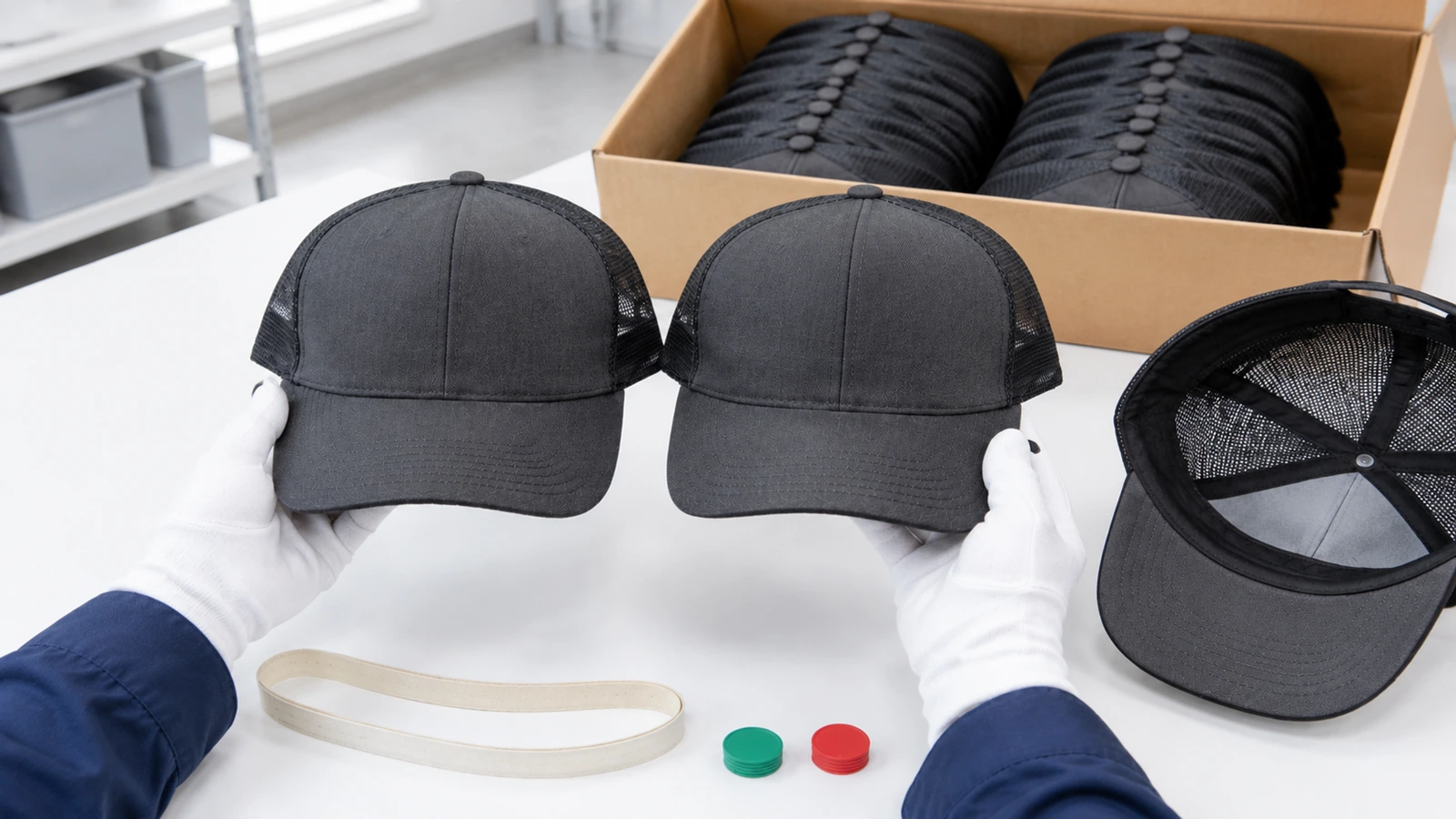
Run QC in two gates. Gate 1 is the pre-production sample: one sewn sample per colorway on the exact blank. Approve it, then keep one hat sealed as the "golden sample" that bulk is measured against. Gate 2 is the bulk lot. A common apparel convention is sampling to ANSI/ASQ Z1.4 (equivalent to ISO 2859-1) at general inspection level II, with AQL 0 for critical defects, 2.5 for major and 4.0 for minor. Agree on these levels in writing before production starts, not after a problem appears.
| Check | Gate | Method | Accept if | Defect class if failed |
|---|---|---|---|---|
| Logo position | Sample + bulk | Measure from the brim seam and center seam against the proof | Within the numeric tolerance written on the spec sheet | Major |
| Thread and patch color | Sample + bulk | Daylight comparison to the golden sample and thread chart codes | No visible shift; codes match the proof | Major |
| Embroidery finish | Sample + bulk | Inspect the front and reverse side | No puckering, loose threads or merged letters; stitch count matches the proof | Major (loose threads: minor) |
| Decoration method | Sample | Compare against the wording on the proof | Woven, embroidered, leather, PVC or printed exactly as approved | Critical |
| Print or patch adhesion | Sample | Tape-pull check modeled on ASTM D3359-style adhesion testing; corner lift test | No ink lifts onto the tape; no corner lift | Major |
| Wash survival | Sample | Cold hand-wash and air-dry one hat, repeated per your wear plan | No peeling, bleeding, shrinkage or sweatband fold-in | Major |
| Crown shape | Bulk | Set on a flat surface; compare left and right panels | Symmetric; no dents; button centered | Major |
| Mesh integrity | Bulk | Visual check plus gentle stretch | No holes, snags or broken strands | Major |
| Seams and brim | Bulk | Inside-out inspection; flex the brim | Taped seams; even stitch rows; no fabric lump at center front | Minor (lump: major) |
| Closure | Bulk | Close at the smallest, middle and largest settings | Engages fully at every setting; no cracks | Major |
| Fit consistency | Bulk | Measure the adjustment range on hats drawn from each color lot | Same range as the golden sample across all colors | Major |
| Hazards | Bulk | Visual and touch check | No broken needles, sharp burrs or contamination | Critical |
| Packing | Bulk | Open random cartons | Crowns supported; no crushing; correct counts per carton | Minor |
Measure fit by color for a specific reason: buyers have reported black hats arriving smaller than other colors of the same style, with different label tags, which suggests mixed production lots.
Add a short paperwork check before shipment:
- Fiber claims. Headwear generally sits outside the textile labeling rules, but under FTC guidance any fiber representation brings the disclosure requirements back[6]. Any "100% cotton" claim on a hangtag must be accurate.
- Origin wording. Check it against 16 CFR 303.33[7].
- Youth sizes. Hats made for children 12 and under need a CPSC tracking label[8] and a certificate under 16 CFR Part 1110[9].
The full labeling picture is summarized on the custom trucker caps page.
FAQ
FAQ: Is a foam front lower quality than a cotton twill front?
Not by default. Foam is a different tool. UV-stabilized foam of roughly 3–5 mm suits bold prints and a retro look. Buckram-backed twill suits detailed embroidery and repeated washing. Foam becomes low quality when it is thin, not UV-stabilized, or paired with fine embroidery that sinks into it.
FAQ: Is a digital proof enough, or do I need a physical sample?
A digital proof confirms artwork, size and placement. It cannot show stitch density on a curved panel, how thread lies across a center seam, or how a patch edge is finished. For a first order, a new blank or a complex logo, approve a sewn sample on the exact blank and keep it as the golden sample for bulk inspection.
FAQ: How many stitches are too many for a trucker hat front?
It depends on the panel. A buckram-fused structured front is commonly reported to hold around 10,000 stitches without puckering when backing and hooping are correct, and decorator limits sit near 15,000. Unbacked mesh should carry only small flat embroidery. If a design pushes past the limit, simplify the fill or switch to a stitched patch.
FAQ: Does a leather or PVC patch make a hat premium?
Only when it is finished well. Look for perimeter stitching rather than glue alone, consistent leather tone across the lot, clean edges, and a proof that names the exact patch type. A printed graphic sewn onto a hat is not a woven or embroidered patch, and confusion between the two is a frequent complaint.
FAQ: How do I make sure the whole team gets the same fit?
Record the adjustment range of the golden sample, then measure hats drawn from every color lot during bulk inspection. Treat any difference between colors as a major defect, because a mixed-lot blank can change crown depth and closure range even within one style number.
Key Takeaways
- Your cap competes with the retail caps people already own. — Caps held 37.9% of global headwear revenue in 2025 (Source)
- Distinctive, detailed trucker hats are back in demand. — Depop "trucker hat" searches rose 90% from the start of 2024 (Source)
- Name a test method for every performance claim. — NISTIR 8115r1 (2021) lists ASTM and AATCC as voluntary standards bodies (Source)
- Care cards for hats are voluntary but worth adding. — 16 CFR 423.1 excludes head coverings from mandatory care labels (Source)
- Keep youth-size caps on a separate QC track. — Products for children 12 and under need tracking labels (Source)
- Customers increasingly expect the cap itself to be customized, not just stamped with a logo. — About 4 million trucker caps a year are produced for the Australian market alone (Source)
Conclusion
High quality custom trucker hats come from decisions you can write down and check by hand:
- A front panel matched to the decoration
- Durable polyester mesh
- Taped seams and a plastic-core brim
- A flat-sewn sweatband and a clean-seating closure
- A stitch count the panel can hold
Approve a sewn sample, seal it as the golden sample, and inspect the bulk lot against it using agreed defect classes. When your spec sheet is ready, use the custom trucker caps guide to choose a mesh-back blank and decoration, then request a quote and sample for your exact quantity and timeline.
Sources
- Grand View Research, Headwear Market Size, Share & Trends Report, 2026–2033. https://www.grandviewresearch.com/industry-analysis/headwear-market-report ↩
- eCFR, 16 CFR Part 423, Care Labeling of Textile Wearing Apparel. https://www.ecfr.gov/current/title-16/chapter-I/subchapter-D/part-423 ↩
- New York Post, "Gen Z is giving this Y2K accessory a surprising comeback," 2024-10-24. https://nypost.com/2024/10/24/lifestyle/gen-z-is-giving-this-y2k-accessory-a-surprising-comeback-thanks-to-celebs-like-kylie-jenner-and-bella-hadid/ ↩
- The Land, "Trucker caps: the hat craze that sees four million produced annually," 2025-09-09. https://www.theland.com.au/story/9049964/trucker-caps-australia-hat-craze-that-sees-four-million-produced-annually/ ↩
- NIST, Guide to United States Apparel and Household Textiles Compliance Requirements (NISTIR 8115r1), 2021. https://www.nist.gov/publications/guide-united-states-apparel-and-household-textiles-compliance-requirements-0 ↩
- Federal Trade Commission, Threading Your Way Through the Labeling Requirements Under the Textile and Wool Acts. https://www.ftc.gov/business-guidance/resources/threading-your-way-through-labeling-requirements-under-textile-wool-acts ↩
- eCFR, 16 CFR 303.33, Country where textile fiber products are processed or manufactured. https://www.ecfr.gov/current/title-16/chapter-I/subchapter-C/part-303/section-303.33 ↩
- U.S. Consumer Product Safety Commission, Tracking Label FAQ. https://www.cpsc.gov/FAQ/Tracking-Label ↩
- eCFR, 16 CFR Part 1110, Certificates of Compliance. https://www.ecfr.gov/current/title-16/chapter-II/subchapter-B/part-1110 ↩












The information below is required for social login
Sign In
Create New Account