We use cookies to enable our websites to remember information, to help some website functionalities to work properly, to understand how you interact with and use our websites and to display you content and ads that are relevant and engaging for you.
By clicking Accept All you consent to the use of these cookie.
The store will not work correctly when cookies are disabled.
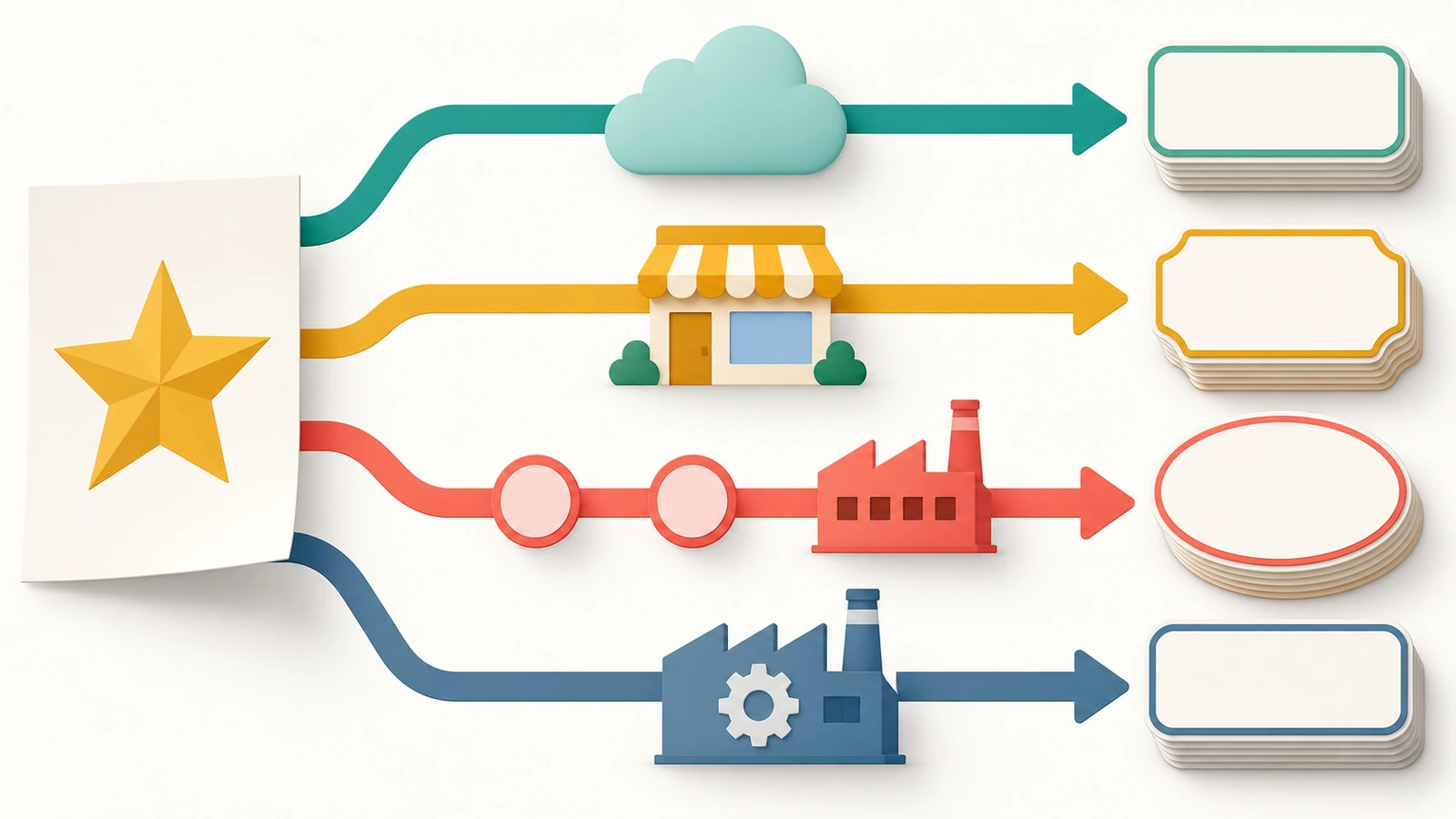
Quick answer: Where to order custom stickers depends on your volume, material and tolerance for spec risk. Online print-on-demand shops suit small runs of standard vinyl or paper. Local printers suit fast, hands-on proofing. Trading agents suit buyers who want one contact for many SKUs. Factory-direct manufacturers suit repeat orders and specialty materials such as PU imitation leather, provided you send a written spec and a test plan.
Why the Channel Decision Matters More Than the Price Quote
Most teams researching where to order custom stickers start with a unit price. The channel you buy through has a bigger effect on cost, because it decides who controls the material, who signs off the proof, who owns a failed batch and who answers when a label lifts after three weeks on a customer's bag.
The failure pattern repeats across buyer forums and review sites. A team orders quality stickers and labels from whichever storefront ranked first. The sample looks right, but production arrives on a different face stock. Edges lift on curved or creased surfaces, and leather conditioner dissolves the adhesive. A faux-leather label gets marketed as "leather." None of these problems shows up on a quote. Each one comes from a gap between what the buyer specified and what the channel was set up to control.
This guide compares the four channels most brand and procurement teams use to order custom labels. It sets out where each one is reliable and where it breaks, and covers what to put in writing before you choose.
What Counts as a Sourcing Channel for Custom Stickers?
A sourcing channel is the commercial route between your artwork and the finished label. The route decides how many parties touch your order before it ships. Each extra handoff adds margin, but it also adds a point where the spec can be misread.
Online print-on-demand shops sell through a web configurator. You pick a shape, size, finish and quantity from preset menus, upload a file and approve an automated proof. Production runs on standardized materials and gang-run layouts.
Local printers are regional shops with digital, flexo or screen equipment. You can visit them, check a press proof in person and make changes on short notice. The range of materials is limited to what the shop stocks.
Trading agents (sourcing agents, trading companies and promotional distributors) take your requirement and place it with one or more factories they do not own. Their value is consolidation: one invoice and one contact across many product types.
Factory-direct manufacturers make the label in-house. They control material purchasing, tooling, printing or embossing, die-cutting and inspection, and they quote from your specification rather than from a menu.
None of these channels is "better" in the abstract. Each one is tuned for a different combination of volume, customization depth and the buyer's in-house expertise.
How to Decide Where to Order Custom Stickers in Five Steps
Step 1: Define the material and the surface before you shop
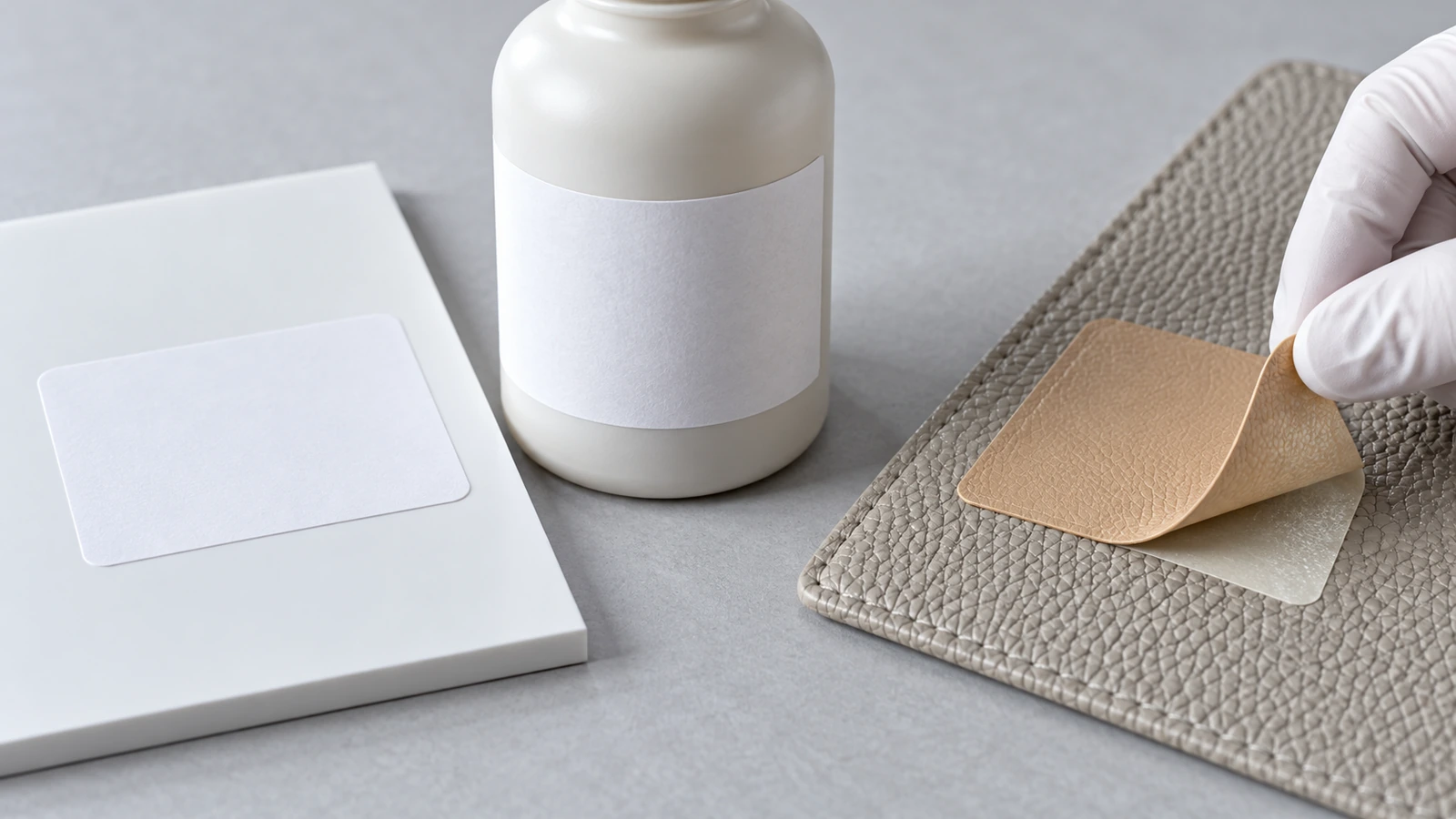
Write down what the label is made of and what it will stick to. Paper on a flat carton is one problem. Vinyl on a curved bottle is another. Adhesive-backed imitation leather on a coated bag panel is a third. Online shops only offer the materials on their menu. Local printers offer what they have in stock. Only manufacturers, and the agents who place orders with them, can source or develop a face stock and adhesive system for a specific surface. If your surface is textured, flexible, oily or curved, that alone narrows your options.
Step 2: Estimate annual volume and reorder rhythm, not just the first order
A first run of personalized stickers for business is often small. If you expect to reorder the same design every quarter, though, consistency between batches matters more than the setup cost of the first run. Online shops and local printers price well for one-off, small and varied runs. Factory-direct pricing usually improves once tooling (embossing dies and cutting dies) is paid for and reused.
Step 3: Decide how much proofing control you need
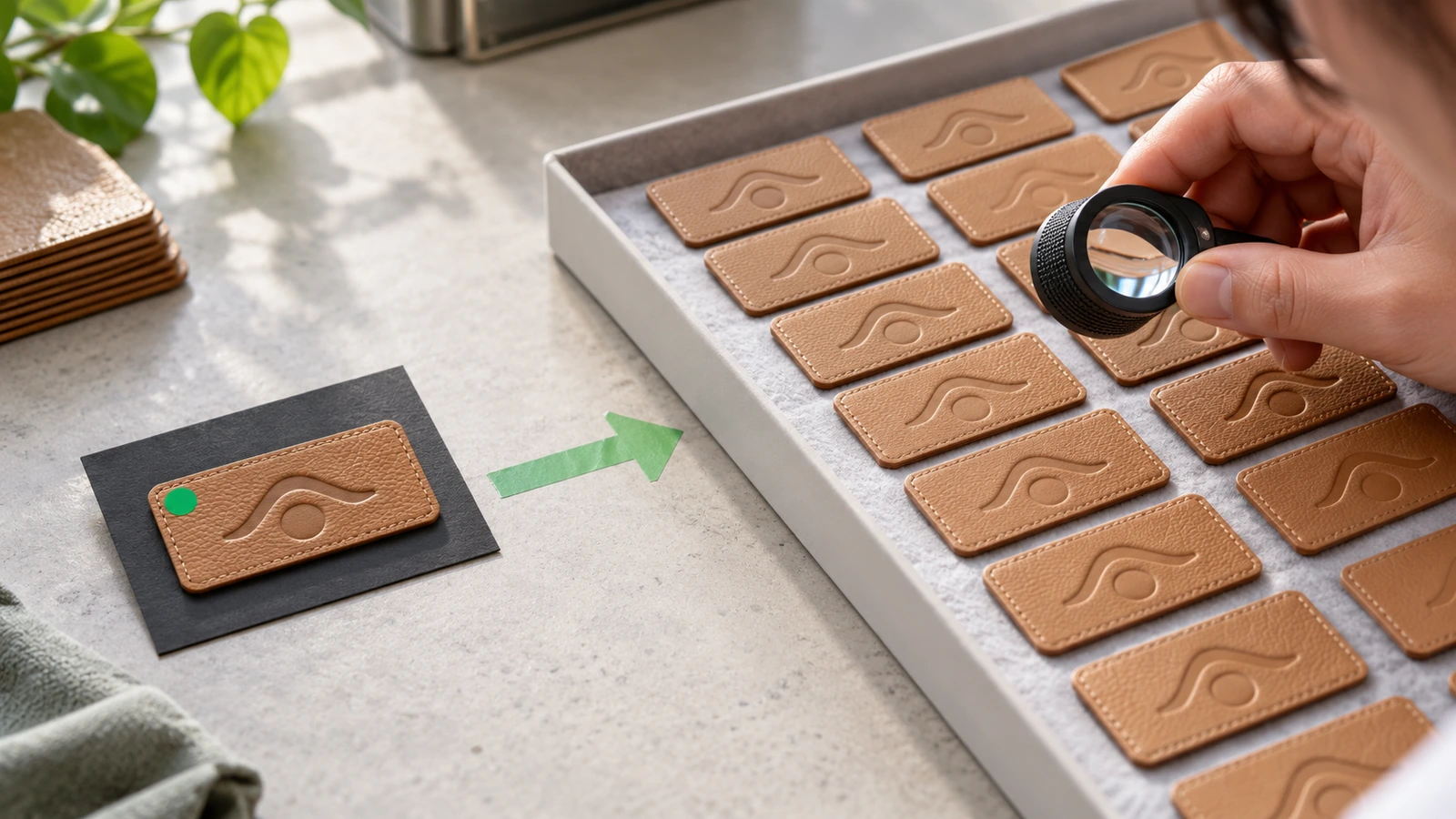
Automated web proofs check layout. They do not check color under your lighting, embossing depth or how the label feels in the hand. If any of those matter, you need a physical pre-production sample that you approve and keep as the "golden sample" for comparison. Local printers and manufacturers can usually provide one. With agents, ask whether the sample comes from the same factory and the same material lot as the bulk order.
Step 4: Assign compliance responsibility in writing
Material naming, country-of-origin marking and children's-product rules stay with the brand that sells the product, whichever channel prints the label. Decide who drafts the material wording on the label and who keeps the test reports. Put that in the purchase order, not in an email thread.
Step 5: Run a sample against a measurable test plan
Replace "durable" with methods. For adhesive labels, a peel-adhesion test such as ASTM D3330 on your actual substrate tells you more than a supplier's verbal assurance. For leather and coated leather finishes, ISO 11644:2022 measures finish adhesion with a 90° peel ISO 11644[1]. Labels that will be laundered need wash testing to ISO 6330, plus colorfastness to ISO 105-C06. Physical properties of leather materials can be checked against the ASTM leather standards family ASTM leather test methods[2]. A channel that cannot tell you which tests were run on your batch should be treated as a channel that ran none.
Channel Comparison: MOQ, Cost, Materials, Lead Time, QC and Communication
The table compares the four channels on the six factors procurement teams weigh most. Ratings are relative to each other. Actual minimums, prices and lead times vary by supplier and specification, so confirm them in a written quote.
Factor
Online print-on-demand
Local printer
Trading agent
Factory-direct manufacturer
Minimum order
Lowest; often very small runs
Low to moderate
Set by the factory behind the agent
Moderate; depends on tooling and material
Unit cost at volume
Highest per piece as volume grows
Moderate to high
Factory price plus agent margin
Lowest once tooling is reused
Material options
Fixed menu (paper, vinyl, clear, holographic)
Limited to shop stock
Broad, but you may not know which plant makes it
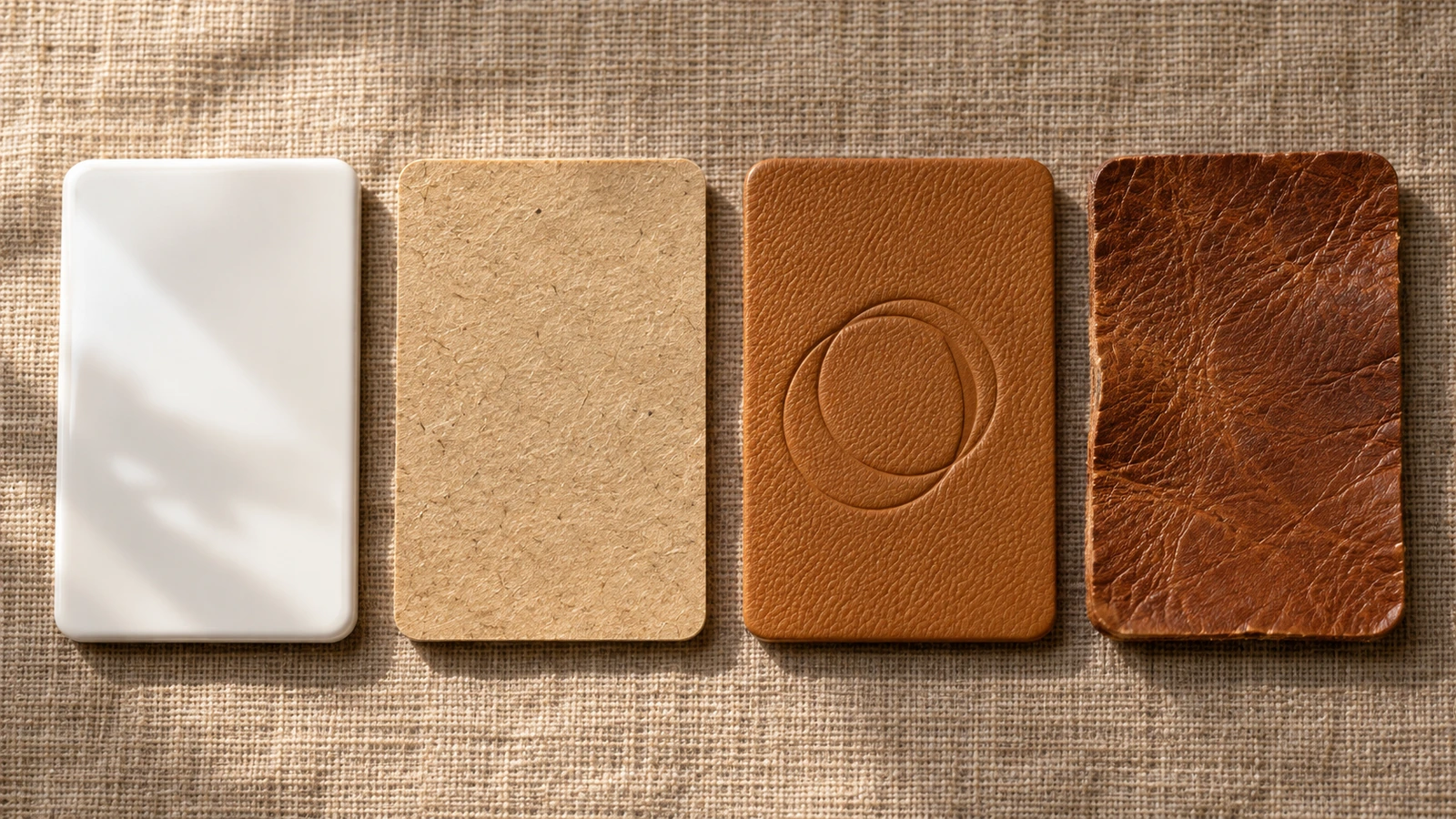
Broadest, including embossed and PU imitation leather
Lead time
Short for standard specs
Shortest for local pickup
Variable; adds a coordination layer
Longer for first orders with new tooling; stable on reorders
Quality control
Automated checks, layout-focused
Visual, in person
Depends on the agent's inspection practice
In-house inspection against your golden sample
Communication risk
Low complexity, little room for custom requests
Lowest; face-to-face
Highest; specs pass through a middle party
Moderate; time zones and language need clear written specs
Where online print-on-demand works and where it breaks
Configurator shops are hard to beat for event stickers, packaging seals and test runs, where the material on the menu is the material you want. They break when the job needs something outside the menu, such as a different adhesive for a low-energy surface, a tactile finish, or color matched to a physical swatch rather than a screen value.
Where local printers work and where they break
A local shop gives you a press check, same-week changes and accountability you can drive to. The limit is capability. Embossing, foil, specialty face stocks and large volumes often go beyond a regional shop's equipment, and some local printers quietly subcontract that work, which turns them into agents.
Where trading agents work and where they break
Agents earn their margin when you are sourcing many unrelated items, such as stickers, bags, boxes and merchandise, and you lack staff to manage several factories. The risk is spec drift. Your requirements are retold to a factory you have never audited, and the sample plant and the production plant may differ. Ask the agent to name the factory on the sample approval and to forward the original inspection records.
Where factory-direct manufacturers work and where they break
Ordering direct removes the middle layer, so the people who quote, produce and inspect are the same people you talk to. That matters most for specialty materials and repeat programs. It breaks down when the buyer's spec is vague. A factory builds what is written, so an RFQ that says "nice leather sticker" will be quoted on the cheapest material that fits that description.
When Specialty Materials Change the Answer
Leather-look labels show clearly why the channel matters. The research behind this guide found the same recurring complaints:
adhesive lifting at bends and creases;
conditioners emulsifying sticker glue;
low-grade PU going brittle after heat exposure;
removal pulling away a leather surface's finish.
These are material-and-adhesive engineering problems, not artwork problems. They are rarely solved by picking from a web menu.
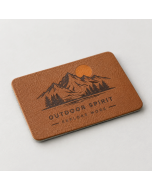
If your brand needs an adhesive-backed imitation leather logo label, you need a channel that will specify the face material, the adhesive and the target surface together, and then sample against that surface. That usually points to a factory-direct manufacturer. Our product page covers the specification, production and RFQ details for adhesive-backed PU leather logo labels, so they are not repeated here.
One rule of thumb for any specialty material: if a supplier cannot tell you what the face stock is made of, the label cannot be described accurately on your product. That leads to compliance.
Compliance Responsibilities Do Not Transfer With the Order
Whatever channel you choose, the selling brand stays responsible for what the label says and what it is made of. Four rules come up most often for teams selling into the United States and the EU.
Material naming. The FTC's Guides for Select Leather and Imitation Leather Products say it is deceptive to use the unqualified term "leather" for a product that is not substantially made of leather FTC Leather Guides[3]. Material that looks like leather but is not should be disclosed with wording such as "imitation leather" or "not leather," according to 16 CFR Part 24 16 CFR Part 24[4]. The same part restricts absolute claims such as "waterproof" or "scratchproof." The UK-based International Council of Tanners' code of practice adds an industry definition: material that has been broken down into fibers and re-bonded is not leather ICT labelling code[5]. Brands that make origin claims about the hides behind genuine leather can point to voluntary programs such as the Leather and Hide Council of America's traceability program L&HCA traceability[6].
Country of origin. Under 19 CFR 134.11, imported articles or their containers must be marked legibly and permanently with the English name of the country of origin, unless an exception applies 19 CFR 134.11[7]. When you buy through an agent, confirm who makes sure this marking is right.
Children's products. For products designed primarily for children aged 12 and under, adhesive stickers and hangtags are not treated as permanent tracking labels on textiles. Tracking information belongs on a durable, typically sewn-in, label CPSIA tracking labels[8]. Accessible components are also subject to the 100 ppm total lead limit 16 CFR 1252.1[9].
EU environmental claims. Since 27 September 2026, Directive (EU) 2024/825 bans sustainability labels that are not based on a certification scheme or set up by public authorities. Unsupported "eco leather" wording on a label is therefore a liability in EU markets. Hides and leather were exempted from the EU Deforestation Regulation in July 2026, with a formal review due in 2030 Euractiv EUDR report[10]. That exemption does not mean any claim about the supply chain has been verified.
FAQ
FAQ: Is it cheaper to order custom labels from a factory than from an online shop?
Usually only at volume and on repeat orders. Online shops spread setup across many customers' jobs on shared runs, so small quantities are cheap. Factories charge for dedicated tooling up front and recover that cost over larger and repeated runs. Compare total landed cost, including freight, duties and the cost of a failed batch, not just the unit price.
FAQ: How do I know whether a supplier is a manufacturer or a trading agent?
Ask which processes are done in-house (material lamination, printing or embossing, die-cutting, inspection) and request inspection records from the line that will run your order. Agents are a legitimate channel. The risk comes from not knowing which kind of supplier you are dealing with, because that hides who is accountable when a batch fails.
FAQ: What should I send to get comparable quotes from different channels?
Send the same written spec to every supplier: face material, adhesive or attachment method, target surface, dimensions, finish, color reference, quantity, reorder frequency and the tests you expect. Quotes based on different assumptions cannot be compared. For leather-look labels, the RFQ checklist on our product page lists the fields that matter.
FAQ: Can I call a PU sticker a "leather sticker" on my product page?
Not without qualification in the US. Under 16 CFR Part 24, material that looks like leather but is not should be disclosed as imitation or simulated leather. "Vegan leather" alone does not replace a material disclosure.
FAQ: Which channel is best for a brand's first order of quality stickers and labels?
For a standard material on a flat surface, an online shop or local printer is the lowest-risk way to test a design. For a specialty material, a textured or curved surface, or a label meant to run as a repeat program, go straight to physical sampling with a manufacturer. That avoids having to re-qualify a second supplier later.
Key Takeaways
The channel decides who controls the material, so choose it on spec risk, not unit price. — 4 channels compared on 6 factors in the table above (Source)
Imitation leather must be disclosed as non-leather on US products. — 16 CFR Part 24 (Source)
Replace "durable" with a named test before approving bulk. — ISO 11644:2022 uses a 90° peel to measure finish adhesion (Source)
Adhesive stickers cannot serve as permanent tracking labels on children's textiles. — applies to products for children aged 12 and under (Source)
Origin marking stays the importer's job whichever channel prints the label. — 19 CFR 134.11 (Source)
Conclusion: Match the Channel to the Risk You Cannot Afford
The right place to order custom stickers is the channel whose controls match your weakest point:
For a simple design and a small run, use a configurator shop.
For a design that needs a press check this week, use a local printer.
For many unrelated SKUs and no sourcing staff, use an agent who names the factory.
For a specialty material, a demanding surface or a repeat brand program, work with a manufacturer from a written spec, a physical golden sample and a test plan.
If your program involves leather-look logo labels, request a sample and a quote built from your surface, volume and wording requirements. Start with our custom leather sticker labels page and send your spec. We will reply with a comparable, itemized quotation instead of a menu price.
Hi there! I'm Bruce, proud dad to my amazing son. I'm the founder of Zigpac, a printing and packaging company empowering small and medium-sized businesses with custom solutions. Let's create something great together!



 Blog PDF for offline reading












The information below is required for social login
Sign In
Create New Account