We use cookies to enable our websites to remember information, to help some website functionalities to work properly, to understand how you interact with and use our websites and to display you content and ads that are relevant and engaging for you.
By clicking Accept All you consent to the use of these cookie.
The store will not work correctly when cookies are disabled.
Quick answer: A keychain mold is a one-time tooling charge for each design and each molded side. Its cost depends on five features of your artwork: the number of relief layers, the number of separate color cells, the outline size, the number of cavities cut into one mold plate, and the depth of the 3D sculpting. The fee is spread across every piece you order, and an unchanged reorder normally does not pay it again if the mold is kept on file. To get an exact figure, send your artwork and ask for an itemized quote.
If you searched "how much does a keychain mold cost," you probably have a quote in front of you. One line on it is labeled mold, tooling, or setup, and it looks large next to the unit price. You may also have noticed that two suppliers quoted very different fees for the same artwork. This guide explains what that line pays for, which design decisions raise or lower it, and how the fee spreads across first orders and reorders.
Why the mold line on a keychain quote is confusing
The mold fee is the only cost on a molded keychain quote that does not scale with quantity, and it is usually given as a single number with no explanation. Without a breakdown, you cannot tell what a higher fee buys. It might pay for a second molded side, a deeper 3D sculpt, or extra cavities that lower your unit labor. It might also just reflect a supplier who prices tooling differently.
The confusion gets more expensive in two situations. The first is a "no mold fee" offer. Waiving the fee does not remove the work of cutting a mold. It moves that cost into the unit price or into a higher minimum quantity, so you can only compare offers by their total cost. The second is a reorder where someone has "slightly" adjusted the outline or moved a raised word. That small change can retire the old tool and trigger a new fee.
Skipping the mold is rarely realistic. Independent artists discussing how creators make these items point out that molded rubber keychains are not a practical DIY product[1]. Nearly everyone outsources them to a factory that cuts a dedicated tool. The useful question is not how to avoid the fee but how to make sure you pay for the right tool, and only once.
What the keychain mold fee actually pays for
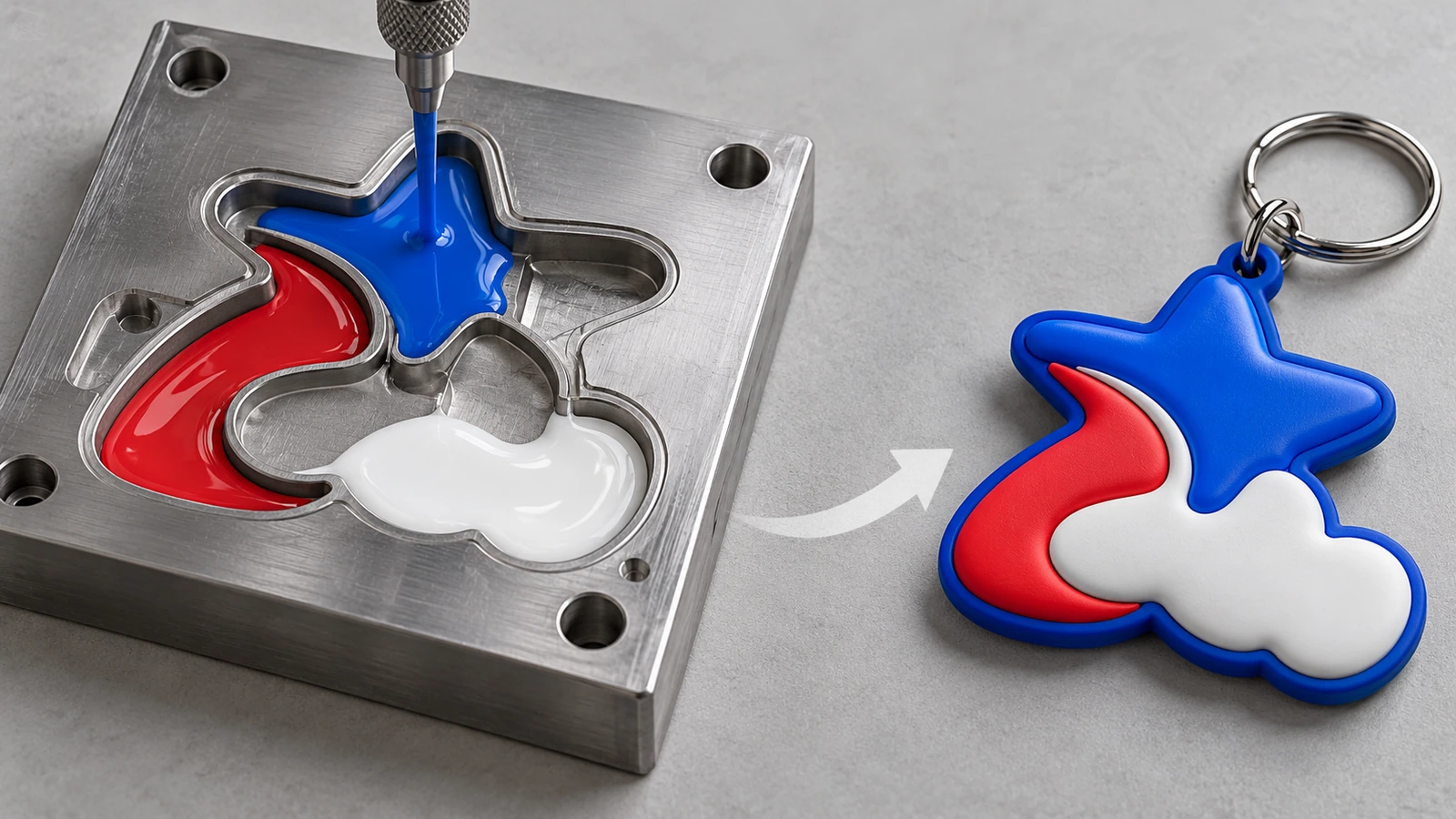
A molded soft PVC keychain is made by filling a metal mold with liquid PVC, one color at a time, and then heat-curing it into a flexible part. If you need a refresher on the product itself, our page on custom 3D rubber keychains covers construction. This section deals only with the tool.
The mold is a metal plate, usually CNC-machined or engraved. Its surface is a negative of your design. Each recessed pocket is a cell that holds one color, and thin raised walls between cells keep the colors from bleeding into each other. The mold fee typically pays for four things:
Tool-path preparation: turning your vector artwork into cutting data. For true 3D designs this includes a digital sculpt of every curved surface.
Machining time: often the largest component. It grows with cut area, number of depth levels, and fine detail.
The mold material itself: a larger outline or more cavities means a larger metal block.
First-off checks: some suppliers include trial pours used to confirm the tool before production.
Suppliers use the terms "mold fee," "tooling charge," and "setup fee" loosely. Some setup fees also include artwork preparation or a physical sample, so ask which of these the line covers before you compare quotes.
How much does a keychain mold cost for your design? The five drivers
Every mold quote is a function of the same five variables. If you know how your artwork scores on each one, you can predict whether your fee will be at the low or high end of a supplier's range before you ask. These steps are about cost only. For guidance on legibility and detail, see the design notes on the 3D rubber keychain product page.
Step 1: Count the relief layers
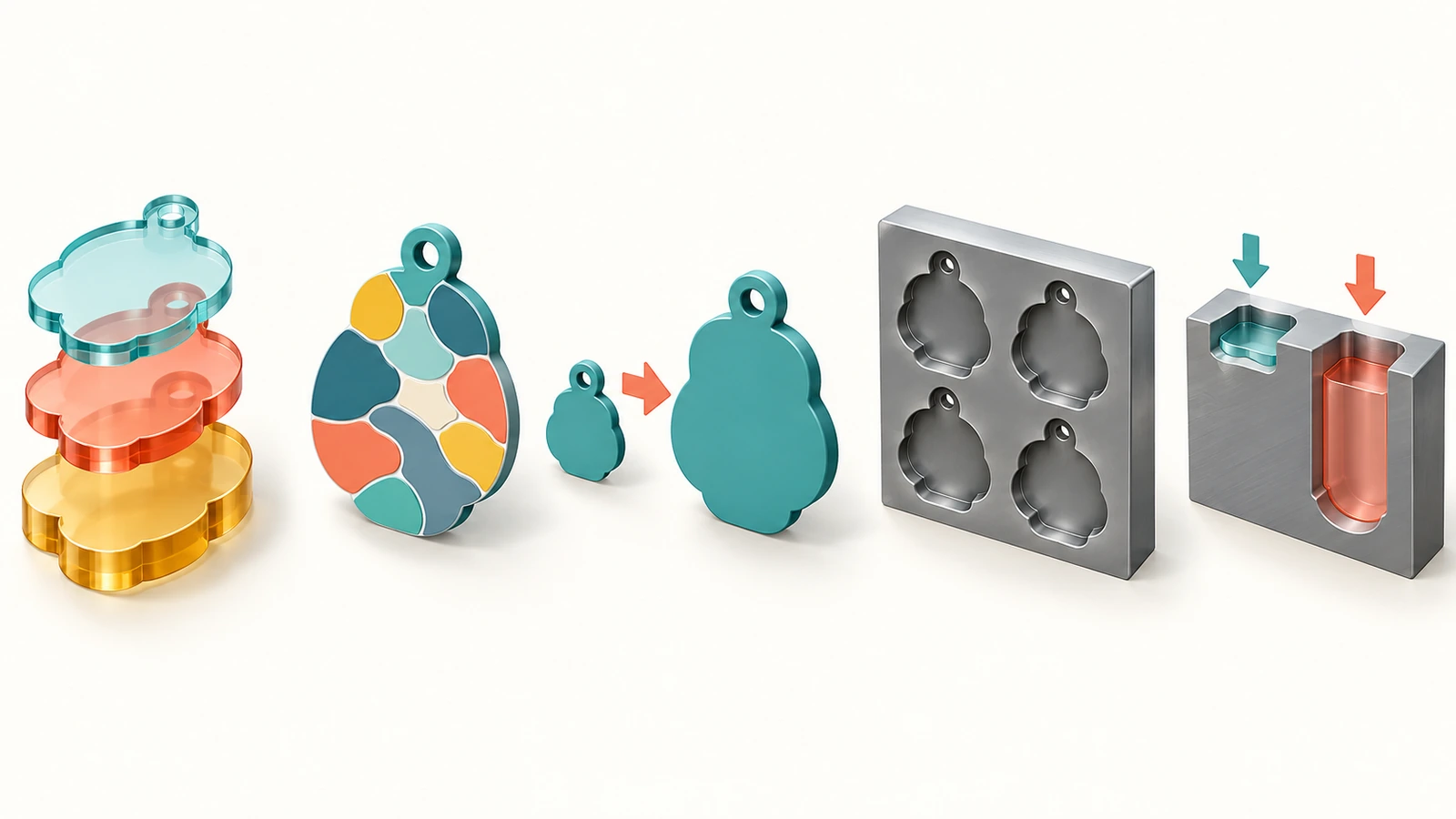
A flat 2D keychain has recessed color cells but a mostly uniform top surface. A layered design adds raised steps, such as a logo sitting above a background plate. Each step is another depth level the cutter must machine. A sculpted 3D design is different again. It has continuous curved surfaces, like a mascot's cheeks, so it needs a digital sculpt and finer, slower finishing passes. This is the main reason a 3D design of the same outline usually costs more to tool than a 2D one.
Step 2: Count color cells, not just colors
This is where most confusion about "keychain tooling cost per color" comes from. In dispensed soft PVC, each color does not get its own separate mold. What the mold must provide is a walled cell for every separate color island. A design that uses three colors spread across twelve separate islands needs twelve cells and all the walls between them. A design that uses five colors in five clean blocks may be simpler to cut.
Color count mainly affects the unit price, because every additional color is another fill step on every piece. When you ask whether color is billed per color, find out whether it is charged in the tooling fee, the unit price, or both.
Step 3: Measure the outline at final size
A larger outline needs a larger metal block and more cutting time. It also leaves room for more detail, which adds cutting time again. Shrinking a design to cut cost has its own downside, because fine lines and small text can stop reading clearly at small sizes. Settle the final dimension before you request the mold quote, since a tool cut at one size cannot be rescaled.
Step 4: Match cavity count to your volume
A cavity is one copy of your design cut into the mold plate. A single-cavity tool is the cheapest to make but produces one piece per fill cycle. A multi-cavity tool costs more up front because it needs a larger plate and repeated machining. In return it produces several pieces per cycle, which can lower the unit labor on large runs. For a small first order, extra cavities are usually money spent too early. For a design you expect to reorder at volume, ask the supplier to quote both options.
Step 5: Decide relief depth and how many sides are molded
Deeper relief means more material removed from the mold and more careful finishing, especially on steep walls. A double-sided molded keychain usually needs two matching mold halves that line up precisely, so expect the tooling to be closer to two tools than one. If the back only needs a simple flat finish or a printed element, ask whether a single-sided mold with a plain back would meet the brief at a lower fee.
How the mold fee spreads across order quantities
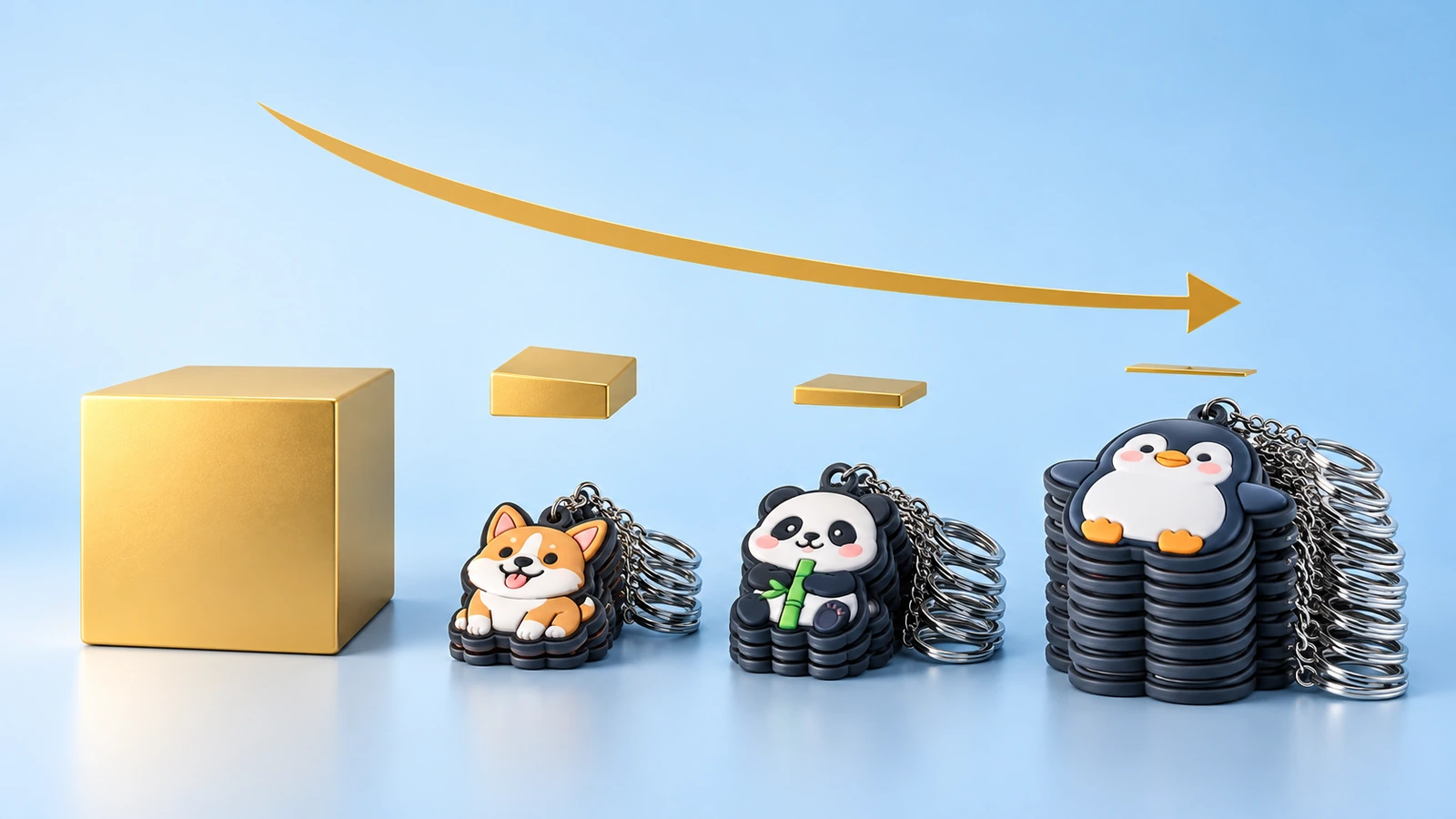
Because the fee is fixed, its share of each piece's cost is simply the fee divided by the number of pieces it is spread over. Doubling the quantity halves that share. Ordering ten times as many pieces cuts it to a tenth. The table uses a mold fee of F and a first-order quantity of Q, so you can substitute the figures from your own quote.
Scenario
Pieces the fee is spread over
Mold share per piece
New mold fee paid?
First order
Q
F ÷ Q
Yes
Larger first order
2Q
F ÷ 2Q (half)
Yes
First order plus one unchanged reorder of the same size
2Q over the life of the tool
F ÷ 2Q (lifetime)
No, on the reorder
First order plus four unchanged reorders
5Q over the life of the tool
F ÷ 5Q (lifetime)
No, on the reorders
Reorder with a changed outline
New Q
New F ÷ Q
Yes, a new tool
The lifetime rows matter most for promotional buyers. A design you will reorder for every event should be judged on its lifetime cost per piece, not its first-order cost. That can justify a fully sculpted 3D tool, or even a multi-cavity tool, if you expect several reorders. A one-off event piece is the opposite case. There, a flatter design with fewer relief levels keeps the fixed cost proportionate to a single run.
When a quote says the mold fee is waived, rebuild the same table using total cost, which is unit price multiplied by quantity. If the waived quote's total is higher at your quantity, the fee has simply been absorbed into the unit price. On reorders, that absorbed amount is charged again on every piece, whereas a separately billed fee is paid once.
Are keychain molds reusable for reorders?
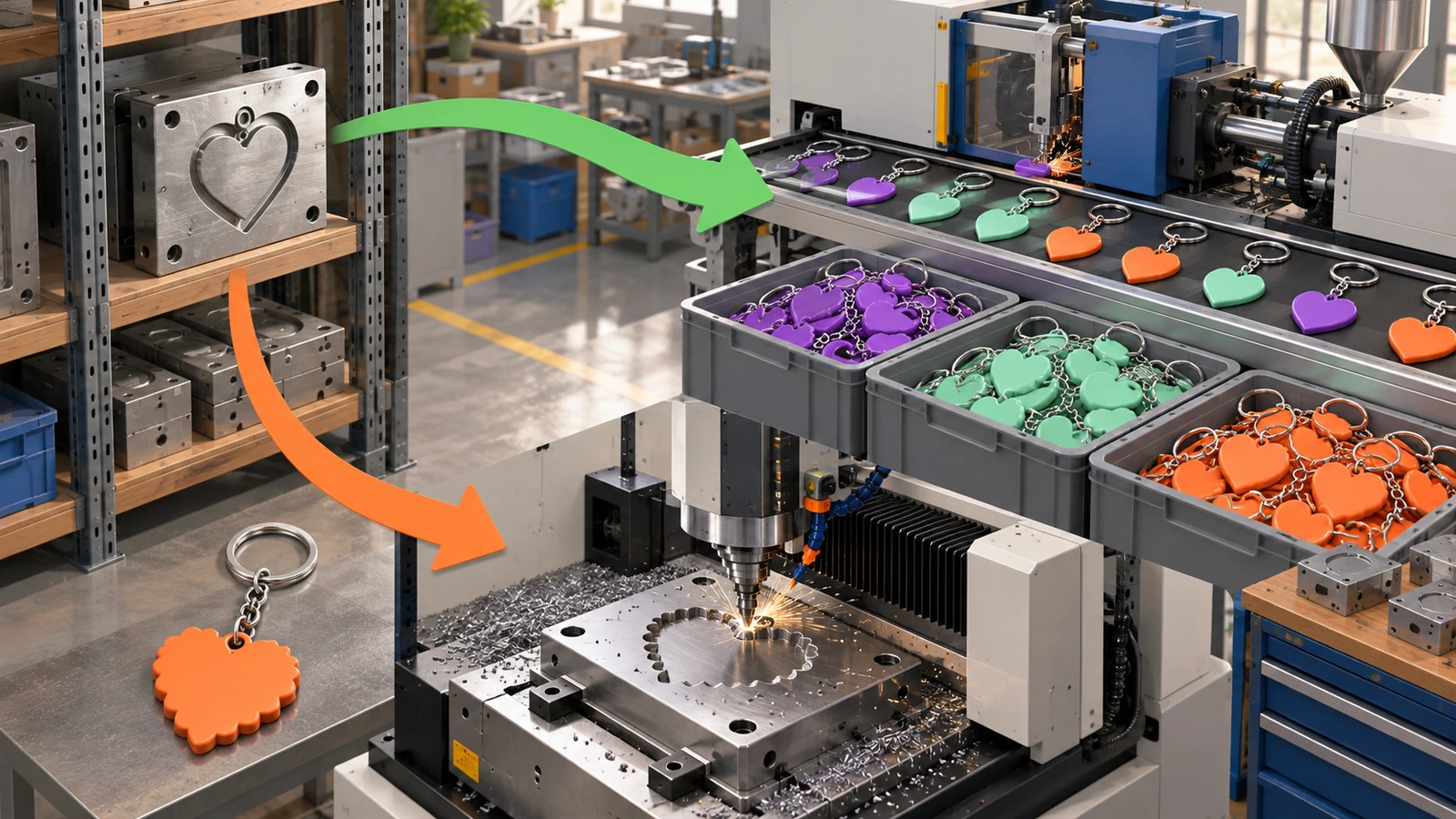
Yes. A metal mold is a durable asset, and an unchanged design can be poured from it again, as long as the factory has kept the tool. That condition is the part buyers forget to confirm. Before the first order, get written answers to three questions. How long will the mold be retained without activity? Will the supplier notify you before it is scrapped? Does the fee give you ownership of the tool, or only the right to reorder from it?
Whether a reorder reuses the mold depends on what you change. These changes keep the existing tool:
Changing the color assigned to existing cells, for example a seasonal colorway.
Changing hardware that attaches through an existing hole.
Changing packaging.
These changes usually require a new or recut tool:
Changing the outline.
Moving or resizing raised text.
Adding a new color island.
Making the relief deeper.
Running several colorways from one outline is the most efficient way to get more variety out of a single mold fee.
What a reusable mold does not carry forward is material quality. Compound is mixed fresh for every batch, and the published failure modes are batch failures, not tool failures. An independent buyer's guide describes low-grade rubber that hardens, fades and cracks[2] with frequent use. Surface tackiness has a known chemical cause, which is plasticizer migrating out of the PVC. Peer-reviewed work found that a bio-based polyester rubber plasticizer made PVC almost nonmigratory at 30 phr[3]. That is a formulation question to raise on every reorder.
Compliance also applies batch by batch, and the limits have tightened. Since 29 November 2024, the EU has restricted lead in PVC articles to below 0.1% by weight[4]. In the US, children's toys and child care articles fall under the CPSC's phthalate restrictions[5]. California's Proposition 65 has produced settlements over DEHP in keychain products[6]. The UK's product safety regulator reported anime keyrings containing 36.8% DEHP[7]. Testing of unofficial collectible figures found lead in 8 of 42 items[8].
Hardware needs the same attention. The CPSC once recalled about 192,000 key chains[9] because of lead in their metal charms. If your brief describes a part as food-grade, the US reference for repeat-use rubber articles is 21 CFR 177.2600[10]. In short, a paid-off mold makes reorders cheaper, but each batch still needs current test documentation.
Which design changes move the mold fee, and which move the unit price
Use this table when you weigh a design revision. It shows where each change lands in the quote, so you can decide whether it is worth paying for.
Design decision
Effect on mold fee
Effect on unit price
Reuse on reorder
Add a raised relief layer
Higher (extra depth level)
Slight
Yes, if unchanged
Move from layered 2D to sculpted 3D
Highest increase (digital sculpt plus finishing)
Moderate
Yes, if unchanged
Add a color using existing cells
Usually none
Higher (extra fill step)
Yes
Add a new separate color island
Higher (new cell and walls)
Higher
No, needs a recut
Enlarge the outline
Higher (bigger block, more cutting)
Higher (more material)
No, needs a new tool
Mold the back as well as the front
Much higher (matching second half)
Higher
Yes, if unchanged
Add cavities to the plate
Higher up front
Lower labor at volume
Yes
Swap hardware on an existing hole
None
Varies by hardware
Yes
Recolor the same outline (new colorway)
None
Unchanged or slight
Yes
Two patterns stand out. Outline and cell structure are what the mold is built around, so they are the expensive things to change later. Color assignments and hardware are cheap to change. That makes it worth spending review time on the outline before tooling and leaving room for color variety in later runs.
FAQ
FAQ: Do I pay a separate mold fee for every color?
Usually not, for dispensed soft PVC. The mold provides walled cells, and colors are filled into them one at a time. Extra colors mostly raise the unit price because each color adds a fill step. A new separate color island can raise the tooling fee because it needs a new cell. Ask the supplier to state which way they bill color.
FAQ: Why does a 3D design cost more to tool than a 2D design of the same size?
Flat and layered designs are cut at a few fixed depths. A sculpted 3D design has continuous curved surfaces, so it needs a digital sculpt and slower finishing passes, and a double-sided version needs a second matching mold half. That extra preparation and machining time is what raises the fee.
FAQ: Can I avoid the mold fee completely?
You can avoid seeing it as a separate line, but someone still has to cut the tool. "No mold fee" offers recover the cost through a higher unit price or a higher minimum quantity. Compare total order cost, and remember that a fee absorbed into the unit price is charged again on every reorder.
FAQ: Who owns the mold after I pay for it?
It depends on the supplier's terms. Some treat the fee as buying the tool, and others as buying the right to reorder from a tool they keep. Get the ownership terms, the retention period, and the notice policy before scrapping in writing before the first order.
FAQ: Will changing my logo slightly require a new mold?
If the change moves the outline, the raised areas, or the cell walls, then yes. The tool is a physical negative of those shapes. Color-only changes and hardware swaps generally reuse the existing mold.
FAQ: Does reusing a mold mean the reorder is automatically compliant?
No. Compliance depends on the PVC compound and the hardware in each batch, not on the mold. Ask for current test documentation that matches your target market's rules on lead and phthalates for every production run.
Key takeaways
The mold share per piece is the fee divided by quantity, so ten times the pieces means one-tenth the share — 1/10 per piece at 10× volume (Source)
Judge reorder-heavy designs by lifetime cost, since an unchanged reorder adds pieces without adding tooling — F ÷ 5Q after four unchanged reorders (Source)
A reused mold does not reuse compliance; EU lead limits in PVC apply to every batch — below 0.1% by weight since 29 Nov 2024 (Source)
Batch test reports matter because regulators still find heavily plasticized keyrings — 36.8% DEHP in one UK report (Source)
Hardware is part of the risk, not just the molded body — about 192,000 key chains recalled over lead in charms (Source)
Sticky surfaces are a formulation issue that can be specified, not a mold defect — almost nonmigratory at 30 phr bio-based plasticizer (Source)
Conclusion
The honest answer to "how much does a keychain mold cost" is that the figure comes from your artwork. Relief layers, color cells, outline size, cavity count, and relief depth set the tooling fee. Your first-order quantity and expected reorders set how much of that fee each piece carries. Fix the outline and cell structure before tooling, leave color variety for later colorways, and confirm the mold retention terms in writing.
For an exact figure, send your artwork through our custom 3D rubber keychain page and ask for an itemized quote. It should separate the mold fee, unit price, cavity count, and sides molded, and state the reorder terms.
Footnotes
r/ArtistLounge, "Assuming that they're made at home, how do people…" (community discussion, 2023). reddit.com↩
Tech Magazines, "How to Distinguish Between High-Quality and Low-Quality Rubber Keyrings" (2025-04-08). techmagazines.net↩
Frontiers in Materials, low-molecular-weight bio-based polyester rubber as a PVC plasticizer, doi:10.3389/fmats.2024.1406469 (2024-07-29). frontiersin.org↩
Commission Regulation (EU) 2023/923 amending REACH Annex XVII, entry 63 (lead in PVC), OJ L 123 (2023-05-08). eur-lex.europa.eu↩
U.S. Consumer Product Safety Commission, Business Guidance: Phthalates. cpsc.gov↩
California Office of the Attorney General, Proposition 65 settlement 2021-00238S0360 (2021). oag.ca.gov↩
UK Office for Product Safety and Standards, Product Safety Report: Anime Keyrings (2212-0056). gov.uk↩
Journal Online, "Warning out on unofficial Labubu toys containing toxic lead." journal.com.ph↩
U.S. Consumer Product Safety Commission, "Key Chains Recalled by Dollar General Due to Risk of Lead Exposure" (Recall 08-009, October 2007). cpsc.gov↩
Electronic Code of Federal Regulations, 21 CFR 177.2600, Rubber articles intended for repeated use. ecfr.gov↩
Hi there! I'm Bruce, proud dad to my amazing son. I'm the founder of Zigpac, a printing and packaging company empowering small and medium-sized businesses with custom solutions. Let's create something great together!



 Blog PDF for offline reading













The information below is required for social login
Sign In
Create New Account