


 Blog PDF for offline reading
Quick answer: The most effective personalized sustainable wooden keychains examples combine one personalization style with one eco message you can prove. Use a wooden keychain with name for staff recognition, a logo silhouette for event giveaways, and a limited illustrated shape for retail merch. Print only the sustainability claims you can document.
Most galleries of personalized sustainable wooden keychains examples show attractive pieces. They rarely explain why a design worked or which campaign it was made for. This guide sorts nine proven formats by promotional goal. For each one, it covers what gets personalized, which sustainability message fits, and what tends to go wrong in daily use.
Why "pretty examples" are not enough for business buyers
Wood is still a small share of the key accessory market, but it is the fastest-growing share. Independent market research puts wood at a 9.8% share of the global key chain pendant market in 2025. The same research projects a 7.4% CAGR through 2034, ahead of metal, plastic and leather, driven by demand for natural, biodegradable materials (key chain pendant market research[1]). Growth like that attracts copycat designs. Copycat designs make it harder to stand out.
The budget at stake is also large. An Oxford Economics study for the Promotional Products Association International estimates that the U.S. spent $174 billion on branded merchandise in 2025, including $50 billion on promotional products (PPAI global economic impact study[2]). A keychain with the wrong style ends up in a drawer. A vague "eco-friendly" line can turn a goodwill gift into a greenwashing question.
Buyer feedback shows the same two failure points again and again:
- Personalization that does not read well: tiny engraving, and fine details lost on wood.
- Durability that does not match the green story: scratches, rings separating from the fob, and cracks around the hole.
One 2026 marketplace trend analysis found that 36.8% of reviewers praised craftsmanship, while 33.3% mentioned susceptibility to scratches. The examples below are chosen to avoid both problems.
What makes a wooden keychain "personalized" and "sustainable"?
Personalization means one element changes in a way that the recipient notices. The element can change per person, such as a name or start date. It can also change per group, such as a team icon, a property address or an event date. A keychain that carries only your logo is branded, not personalized. That difference matters, because a recipient keeps an object that refers to them far longer than one that refers only to you.
Sustainability has four layers:
- Where the wood came from
- How it is finished
- How it is packed
- Whether the piece lasts long enough to replace a disposable alternative
Durability is the most overlooked of the four. A keychain that breaks in three months has a worse footprint than a metal one used for years. That is why every example below includes a "watch-out" note.
Most of the examples suit layered plywood, which is used in our laser-cut and engraved plywood keychains. Layering the veneers in alternating grain directions limits splitting along a single grain line. This is a known weak point of thin solid hardwood near the ring hole.
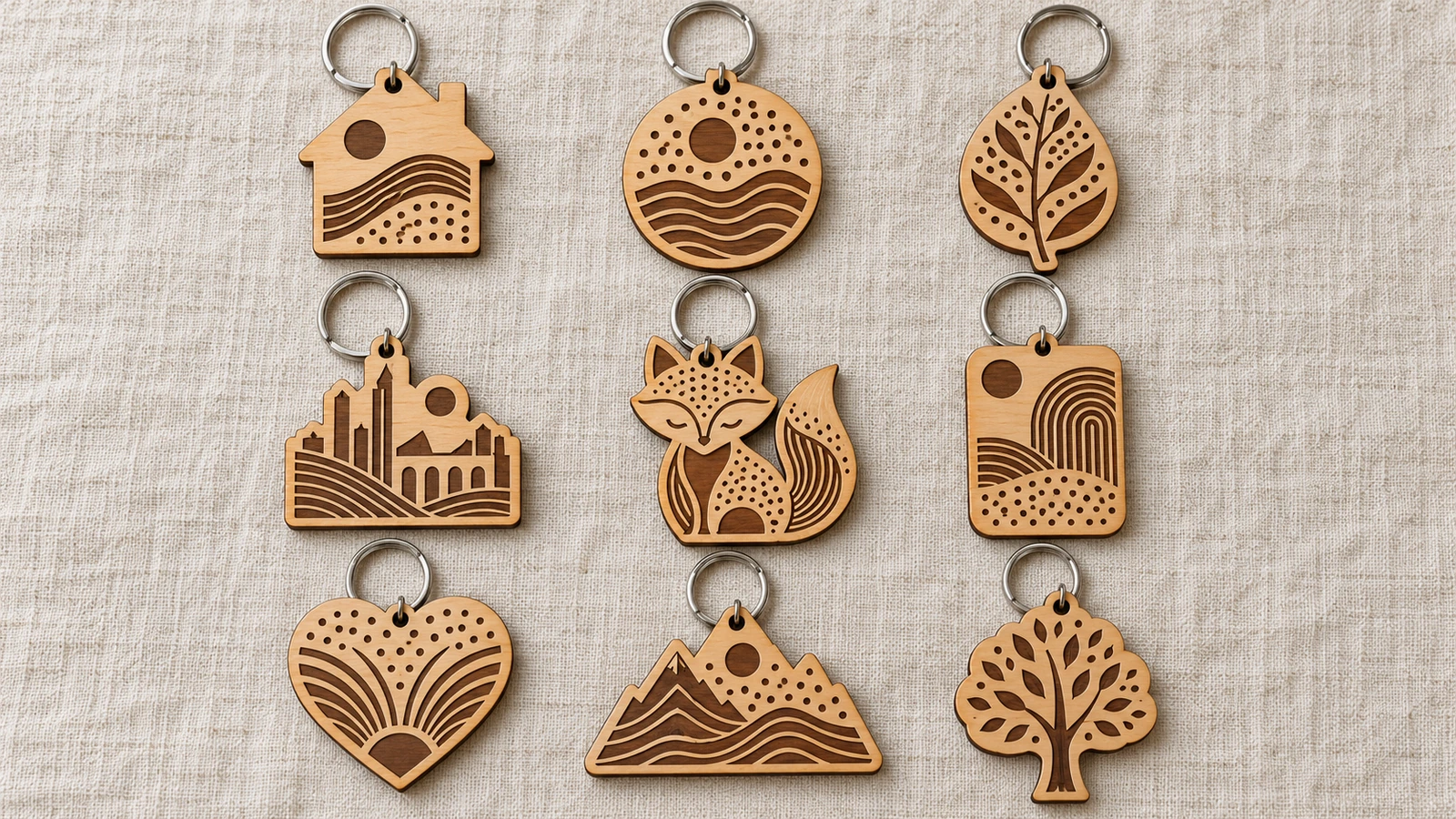
Personalized sustainable wooden keychains examples by promotional goal
Each example below lists the goal, what gets personalized, the eco message that fits, and the main risk.
1. Name-engraved staff appreciation tag
Goal: recognition and retention.
Personalization: a wooden keychain with name, plus a milestone such as a year or team name.
Eco message: a short, factual material origin line on the card, not on the wood.
The recipient's own name is the only element they will check closely, so it needs the most legible layout. Keep the name to a single line and use a clean typeface. Put any extra text on the reverse or on the backing card.
Watch-out: this is the example most likely to be carried every day, so ring attachment and finish matter most here.
2. New-hire onboarding token
Goal: belonging in week one.
Personalization: the first name plus a department icon cut into the outline.
Eco message: "Made from responsibly sourced wood". Use this only if your supplier can document the sourcing.
Shared icons across departments make the set feel like a system, not a one-off gift. That system makes reorders for future hires easy.
Watch-out: keep the icons bold. Fine linework is the detail most often lost when engraved on wood.
3. Trade-show or conference giveaway
Goal: booth traffic and brand recall.
Personalization: group-level, such as an event name and year. If your supplier engraves both sides, add a web address on the back.
Eco message: a natural-material alternative to the plastic giveaway on the next stand.
A logo silhouette cut-out reads from across an aisle better than an engraved rectangle does.
Watch-out: buyers sometimes find large novelty shapes "too big" for a keyring. Shape impact has to be balanced against pocket comfort.
4. Real estate closing gift
Goal: a referral reminder that stays on the client's keys.
Personalization: a house outline with the street name or move-in date.
Eco message: warmth and natural material rather than an environmental statistic.
Agents in the research feedback said deeply engraved wood felt "more prestigious" than metal tags at closings. The likely reason is that the keychain arrives with the new keys and is used from day one.
Watch-out: house keys are heavy. Ask how the ring is secured.
5. Corporate event or wedding favor
Goal: a keepsake that people associate with the occasion.
Personalization: initials and a date. Optionally, add the guest's name for place-card duty.
Eco message: plastic-free favor packaging, which reviewers notice and mention unprompted.
Doubling as a place card gives the piece a job at the event. It also makes it far less likely to be left on the table.
Watch-out: per-guest names mean one proof list. Build in time to check spelling.
6. Hospitality and rental key tag
Goal: function first, with brand second.
Personalization: the property or room identifier and a simple local motif.
Eco message: "Built to be reused", backed by a finish that tolerates handling.
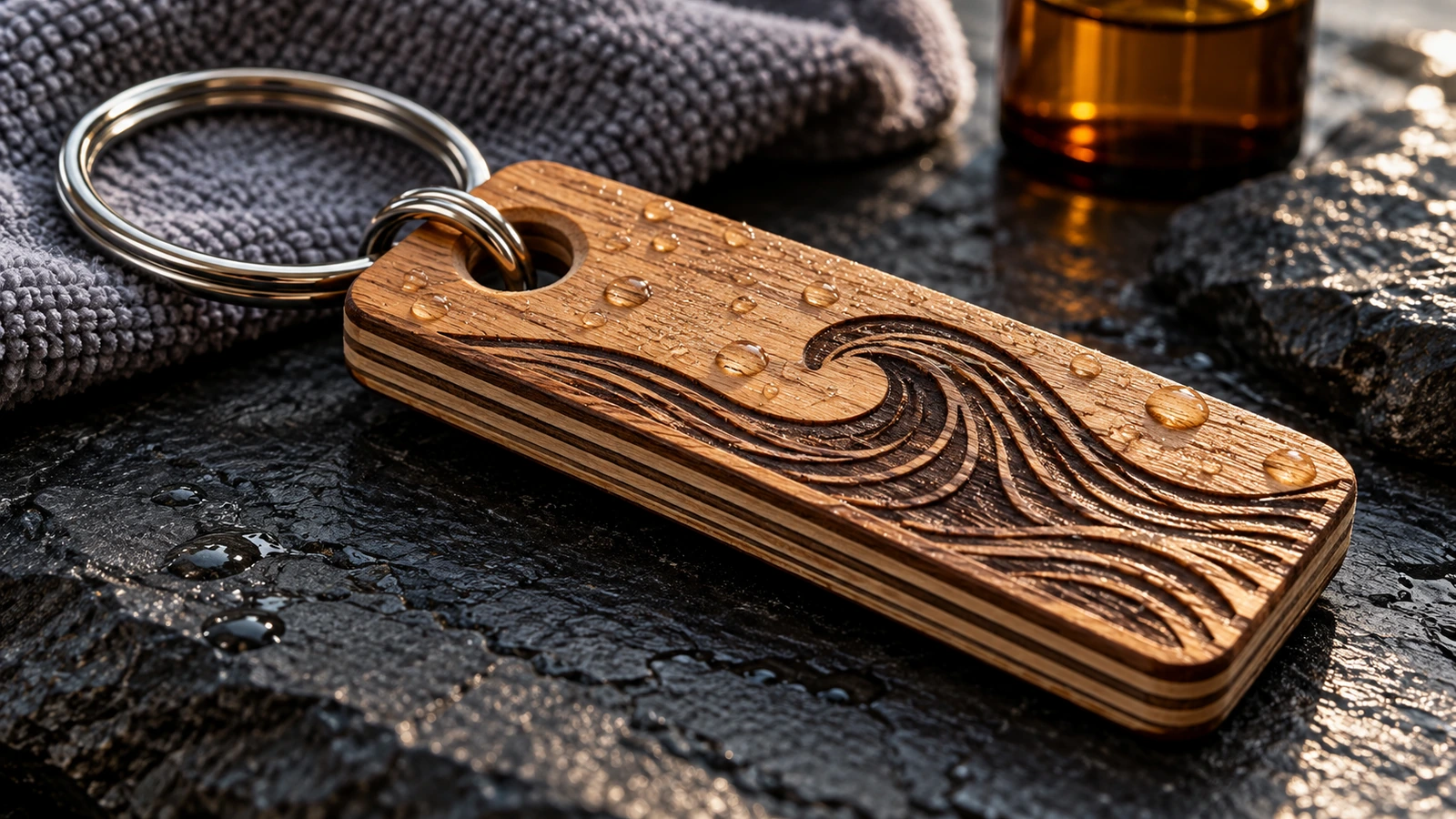
This is the harshest use case in the gallery: many hands, frequent drops and occasional wet counters. Specify a sealed finish rather than raw wood.
Watch-out: wood is water-resistant when sealed, not waterproof.
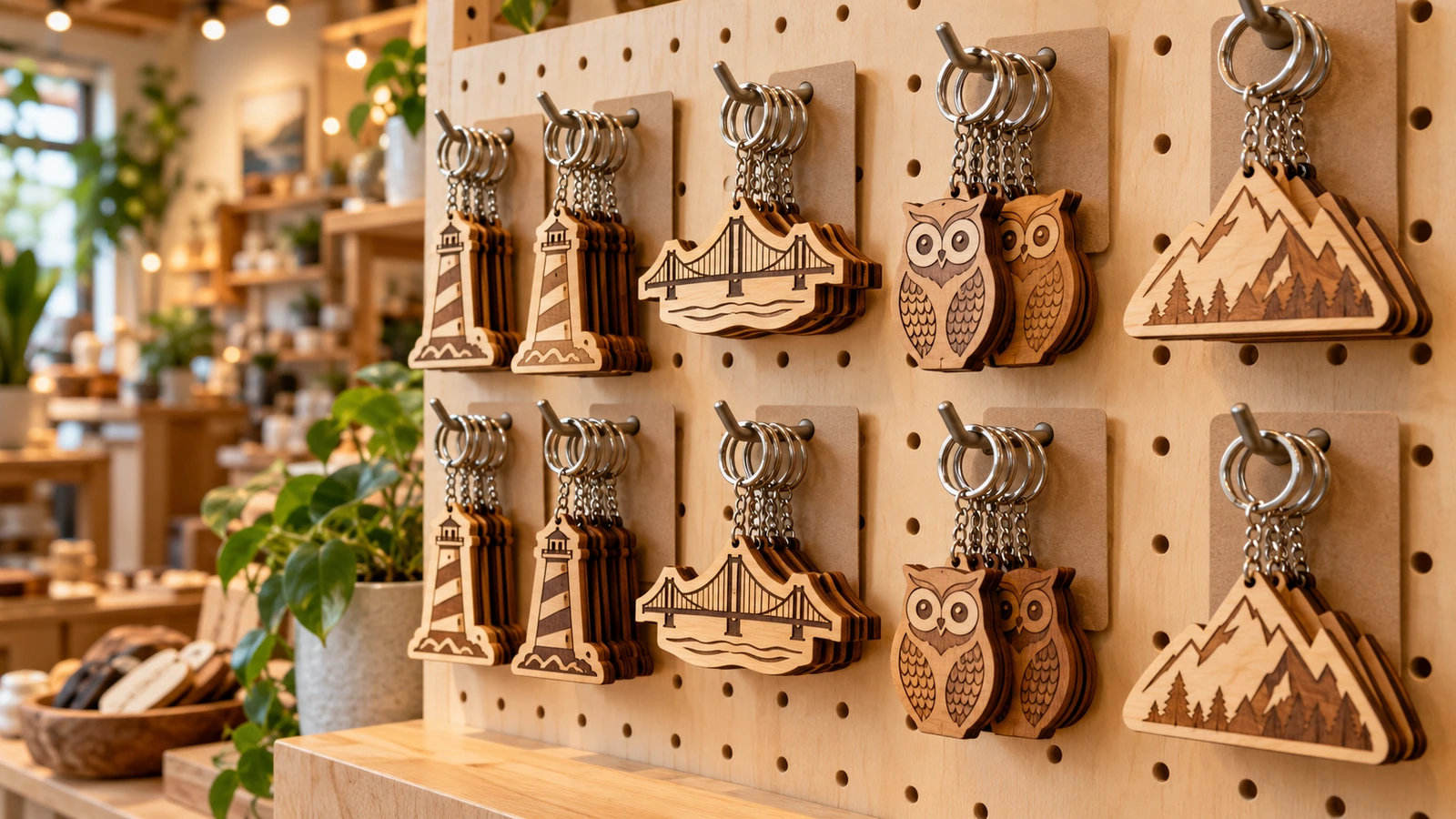
7. Branded retail merch series
Goal: margin and collectability.
Personalization: a limited illustrated shape, such as a landmark, mascot or seasonal motif, released as a numbered or rotating series.
Eco message: on-pack, and only with licensed certification marks if you use them.
Retail buyers judge the piece against acrylic charms on the same peg. The natural grain and the tactile engraving are the differentiators.
Watch-out: natural colour variation between pieces. Tell shoppers it is a feature, so it does not read as a defect.
8. Creator or fan-community merch
Goal: limited drops for an audience that already exists.
Personalization: character or emblem silhouettes, sometimes with the creator's mark.
Eco message: fans in the research data explicitly said they were "glad they're eco friendly". That makes it a genuine purchase reason in this segment.
Watch-out: complex multi-layer designs can cost more than first estimated. Confirm feasibility before you announce a price to your community.
9. Nonprofit, park or campus fundraiser
Goal: donor appreciation and place attachment.
Personalization: the coordinates of a trail, building or planting site, or a donor's name.
Eco message: the strongest fit in this gallery. The object can point to the place it supports.
Coordinates are a quietly powerful variable. One gift-giver described buying matching keychains with the coordinates of where their parents met. The father, who was "super hard to shop for", actually put it on his keys.
Watch-out: long number strings need generous spacing to stay readable.
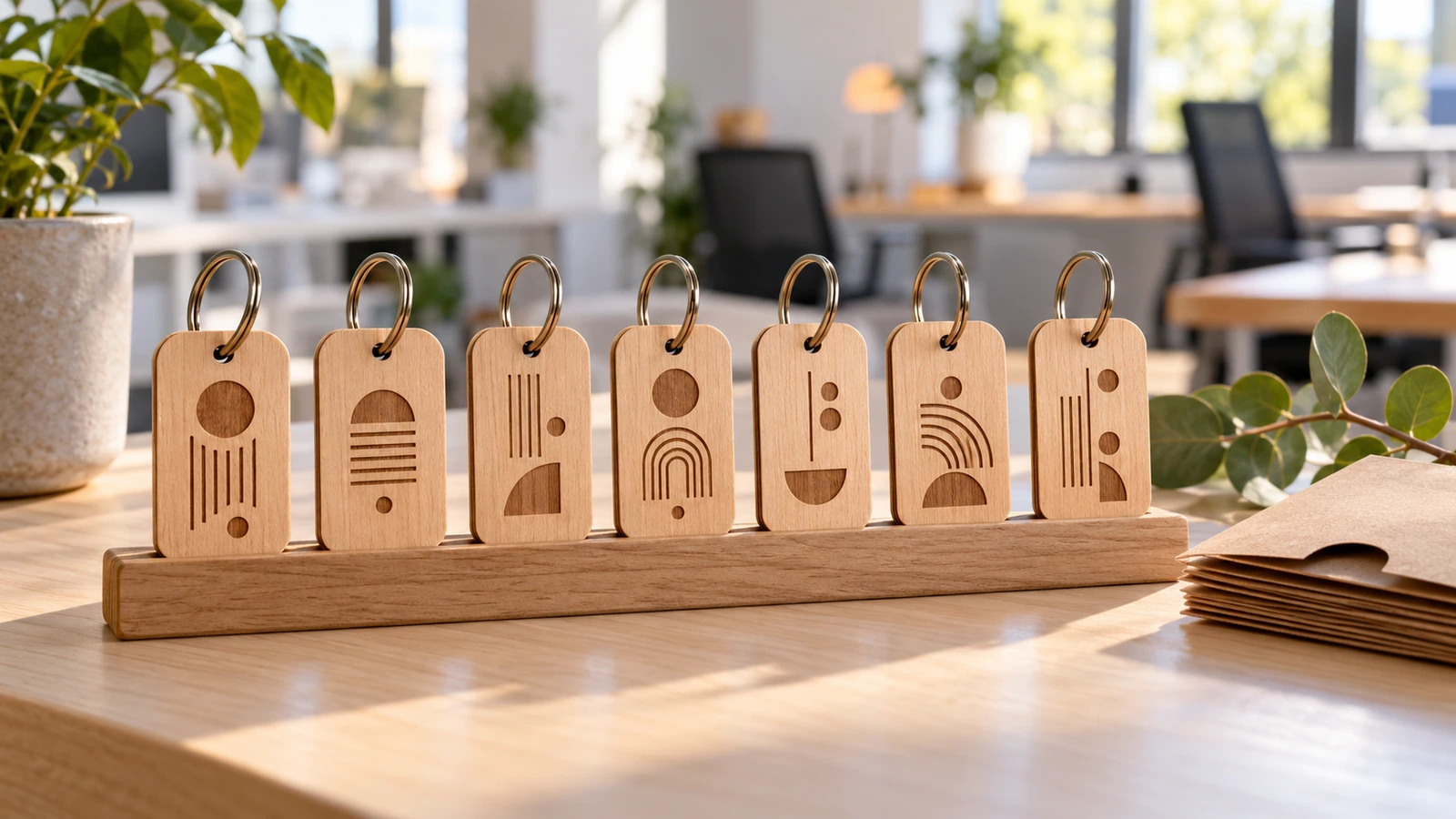
How to match an example to your campaign in five steps
- Name the retention target. Decide whether the piece must survive daily key use (examples 1, 4, 6) or mainly needs to be remembered (examples 3, 5). Daily-carry pieces justify investing in the finish and hardware. Event pieces justify investing in shape.
- Choose one personalization variable. Per-person variables (name, start date) raise perceived value but add proof work for every unit. Per-group variables (event, property, team) keep artwork simple and make reorders easy.
- Pick one sustainability message and its evidence. A single claim you can prove is more persuasive than three vague ones. Use the claims table in the next section.
- Plan for wear. USDA Forest Products Laboratory guidance explains how penetrating oils, waxes and sealers protect wood against moisture and handling (USDA guidance on finishing wood[3]). Its research on water-repellent treatments explains why a sealed piece resists swelling better than raw wood (water-repellent finish research[4]). Ask your supplier which finish suits your use case.
- Brief once, clearly. Readable sizing, artwork preparation and sampling are covered step by step on the custom wooden keychains page. Use that checklist instead of reinventing it.
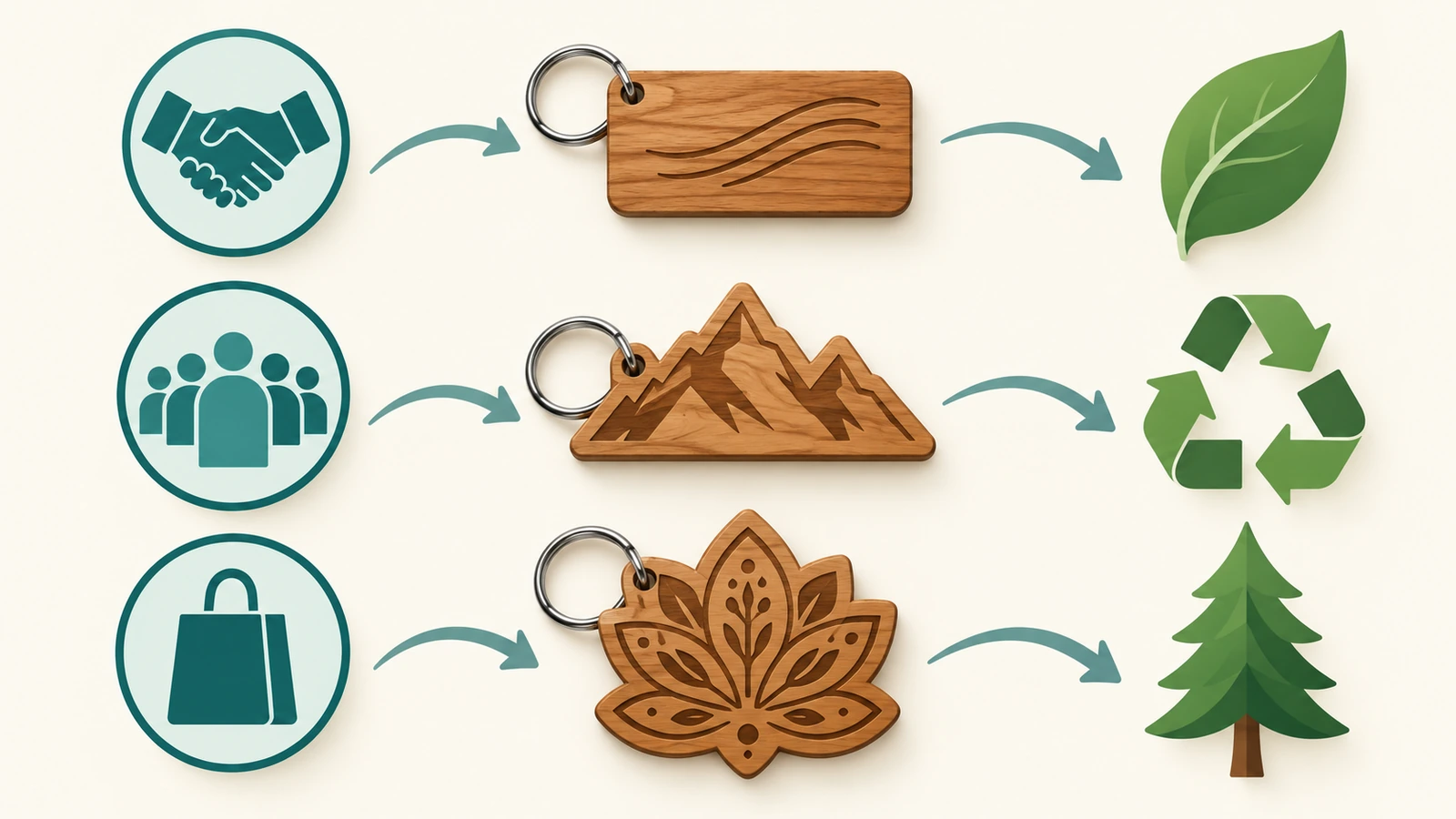
Which sustainability messages hold up under scrutiny?
The fastest way to undermine an eco-positioned gift is to print a claim that you cannot back up. Industry figures show why buyers care. ASI reported record promotional products sales of $26.6 billion in 2024, with the sustainable products category estimated at about $3.69 billion (ASI annual sales report[5]). Procurement teams that buy in this category increasingly ask for evidence.
| Message you want to use | What it needs behind it | Best-fit examples |
|---|---|---|
| "FSC-certified" or an FSC logo on pack | A certified supply chain and permission to use the trademark. Promotional use of FSC marks is governed by a dedicated licence (FSC promotional licence[6]) | 7, 9 |
| "Deforestation-free" for EU recipients | Under Regulation (EU) 2023/1115, wood must come from land not deforested after 31 December 2020. Obligations apply to medium and large operators from 30 December 2026 and to micro and small operators from 30 June 2027 (EU Deforestation Regulation[7]) | 3, 7 |
| "Legally and responsibly sourced" for U.S. imports | Wooden handicrafts are a USDA APHIS commodity class with specific import requirements, and wood products may require a Lacey Act declaration recording the plant genus, species and country of harvest (APHIS wooden handicraft requirements[8]) | 1, 2, 4 |
| "Natural material" for children's events | The CPSC has determined that unfinished, untreated wood does not exceed the toy-standard heavy element limits. Paints and finishes fall outside that determination (16 CFR Part 1251[9]) | 5, 9 |
| "Plastic-free gift" | Plastic-free packaging and inserts, not just a wooden fob | 5, 6, 8 |
The documentation itself is covered in the sourcing and compliance section of the product page. The rule for the message is simple: put the provable claim on the card, and let the wood speak for itself on the keychain.
Side-by-side comparison of the nine examples
| Example | Personalization variable | Fitting eco message | Primary goal | Main risk to plan around |
|---|---|---|---|---|
| Staff appreciation tag | Individual name + milestone | Material origin on card | Retention | Ring separation under daily use |
| Onboarding token | First name + department icon | Responsibly sourced wood | Belonging | Fine icon detail lost |
| Trade-show giveaway | Event name/year | Plastic alternative | Recall, traffic | Oversized shapes |
| Closing gift | Address or move-in date | Natural warmth | Referrals | Heavy key load |
| Event/wedding favor | Initials, date, guest name | Plastic-free packaging | Keepsake | Spelling errors in long lists |
| Hospitality key tag | Property/room identifier | Reusable by design | Function | Moisture and drops |
| Retail merch series | Illustrated limited shape | Licensed certification marks | Margin | Grain variation read as defect |
| Creator/fan merch | Character silhouette | Eco as purchase reason | Limited drops | Cost of complex designs |
| Fundraiser keepsake | Coordinates or donor name | Link to the supported place | Donor appreciation | Long number strings |
FAQ
FAQ: Is a wooden keychain with name better than a logo-only design for staff gifts?
For recognition, yes. A logo-only keychain says something about the company. A name says something about the person, and that is what drives daily carry. Keep the logo small or move it to the reverse. Give the name the main surface.
FAQ: Are wooden keychains durable enough for daily key use?
Sealed wood handles daily pocket use well. Unsealed wood and weak ring attachments are the usual failure points. Plan the finish and the attachment method for the heaviest use case in your campaign, and confirm them at sampling.
FAQ: Can I call a wooden keychain eco-friendly without certification?
You can describe it factually, for example "made from wood" or "plastic-free packaging". Certification claims and certification logos need a documented chain of custody and permission to use the mark. When in doubt, state the specific, verifiable fact instead of a broad label.
FAQ: Do wooden keychains for EU recipients fall under the deforestation regulation?
Wood products are within the scope of Regulation (EU) 2023/1115. The obligations fall on the operators who place products on the EU market, starting 30 December 2026 for medium and large companies. If you distribute in the EU, ask your supply chain early which due diligence information it can provide.
FAQ: Which personalization style works best for event giveaways?
Group-level personalization works best, meaning the event name and year with a bold silhouette. Per-person names rarely pay off for large crowds. A distinctive outline is visible from a distance and does not slow down the proofing process.
FAQ: How do I get pricing or timelines for one of these examples?
Pricing and timelines depend on design, quantity and finish, so we quote each project individually. Share your chosen example and goal through the custom wooden keychains page to request a quote and sample.
Key takeaways
- Wood is the fastest-growing keychain material, so differentiation now comes from fit, not novelty — 9.8% share in 2025, 7.4% projected CAGR to 2034 (Source)
- Promotional budgets are large enough that style mismatches are expensive — $50 billion U.S. spend on promotional products in 2025 (Source)
- Sustainable merch is a measurable buying category, so buyers expect evidence — about $3.69 billion in 2024 sales (Source)
- EU-bound wooden merch needs deforestation-free traceability — cut-off date 31 December 2020; obligations from 30 December 2026 (Source)
- Finishes, not raw wood, determine durability outdoors and in pockets — USDA research covers oils, waxes and water repellents as moisture barriers (Source)
Conclusion: pick the goal first, then the example
The nine examples above follow one pattern. Start with what the keychain must achieve: recognition, recall, referrals, revenue or donor goodwill. Then choose the single personalization variable and the single provable eco message that support that goal. A wooden keychain with name wins on emotional value. Silhouettes win on visibility. Illustrated series win on collectability.
When you have chosen your example, take it to the laser-cut plywood keychain product page. There you can turn it into a sample-ready brief and request a quote.
Footnotes
- DataIntelo, "Key Chain Pendant Market Research Report 2034" (2025 base year). https://dataintelo.com/report/global-key-chain-pendant-market ↩
- PPAI / Oxford Economics, "Global Economic Impact Study" (2025 data, published 2026). https://www.ppai.org/media-hub/global-economic-impact-study-reveals-branded-merchs-472-billion-footprint/ ↩
- USDA Forest Service Research, Forest Products Laboratory publication on finishing wood. https://research.fs.usda.gov/treesearch/62269 ↩
- USDA Forest Service Research, publication on water-repellent finishes for wood. https://research.fs.usda.gov/treesearch/5990 ↩
- ASI, "ASI Reports Record $26.6 Billion in Annual Sales for Promo Products Industry" (2024 data, published 2025). https://asicentral.com/press-releases/asi-reports-record-26-6-billion-in-annual-sales-for-promo-products-industry/ ↩
- Forest Stewardship Council, "Promotional Licence". https://fsc.org/en/promotional-licence ↩
- EUR-Lex, Regulation (EU) 2023/1115 on deforestation-free products, consolidated text. https://eur-lex.europa.eu/legal-content/EN/TXT/PDF/?uri=CELEX:02023R1115-20251226 ↩
- USDA APHIS ACIR, commodity import requirements for wooden handicrafts, including Lacey Act declaration information. https://acir.aphis.usda.gov/s/acir-document-detail?rowId=a0jSJ00000W117nYAB&Document_Type=Commodity%20Import%20Requirements ↩
- eCFR, 16 CFR Part 1251, determination regarding heavy elements limits for unfinished and untreated wood. https://www.ecfr.gov/current/title-16/chapter-II/subchapter-B/part-1251 ↩












The information below is required for social login
Sign In
Create New Account