We use cookies to enable our websites to remember information, to help some website functionalities to work properly, to understand how you interact with and use our websites and to display you content and ads that are relevant and engaging for you.
By clicking Accept All you consent to the use of these cookie.
The store will not work correctly when cookies are disabled.
Quick answer: Choose soft PVC when your design needs crisp multi-color detail, close brand-color matching and a lower unit cost. Choose silicone when heat, sunlight, odor or a softer, grippier feel matter more. For PVC, ask for phthalate test reports on the actual compound. For silicone, confirm cure quality and how well printed details stay on the surface.
Comparing PVC vs silicone keychains on a supplier quote usually tells you very little. Both get called "rubber," both are flexible, and both are molded into a custom shape around your logo. The two materials behave differently once the order ships, though. One may hold a five-color logo with sharp edges but soften on a hot car dashboard. The other may survive summer heat untouched while turning a fine wordmark into a soft blur. This guide covers the seven areas where business buyers see the difference: detail sharpness, color matching, feel, durability, odor and heat, compliance documentation, and unit-cost drivers.
The stakes are higher than a few cents per piece. Personalized accessories, collectible keychains among them, were named Counselor's 2025 Product of the Year[1] by the Advertising Specialty Institute. A keychain that fades, goes sticky or prompts a compliance question from a retailer undoes the brand impression it was bought to create. Choosing the material before you request a quote is the cheapest way to avoid those problems.
What "Rubber" Actually Means in PVC vs Silicone Keychains
Most products sold as "custom rubber keychains" contain no natural rubber at all. They are made from soft PVC, also called PVC plastisol. This is polyvinyl chloride resin dispersed in a liquid plasticizer, tinted with pigment, dispensed color by color into a mold cavity, and heated until it fuses into a flexible solid. The plasticizer makes PVC soft, so the type of plasticizer used largely decides how the finished piece smells, ages and performs in a lab test.
Silicone keychains are made from a polysiloxane elastomer. Pigmented silicone is placed into a heated mold, usually by compression molding, where it cures through chemical crosslinking. Silicone is flexible by nature and needs no plasticizer. That single chemical difference explains most of what follows: silicone tolerates heat and aging better, while PVC flows more precisely into fine color cells and costs less to process.
Some listings say only "rubber" without naming the polymer, and that vagueness is itself a signal. If a quote does not state the material and the plasticizer type, ask before comparing prices. Otherwise you may be comparing a phthalate-free compound against a cheaper blend that will never pass a test report.
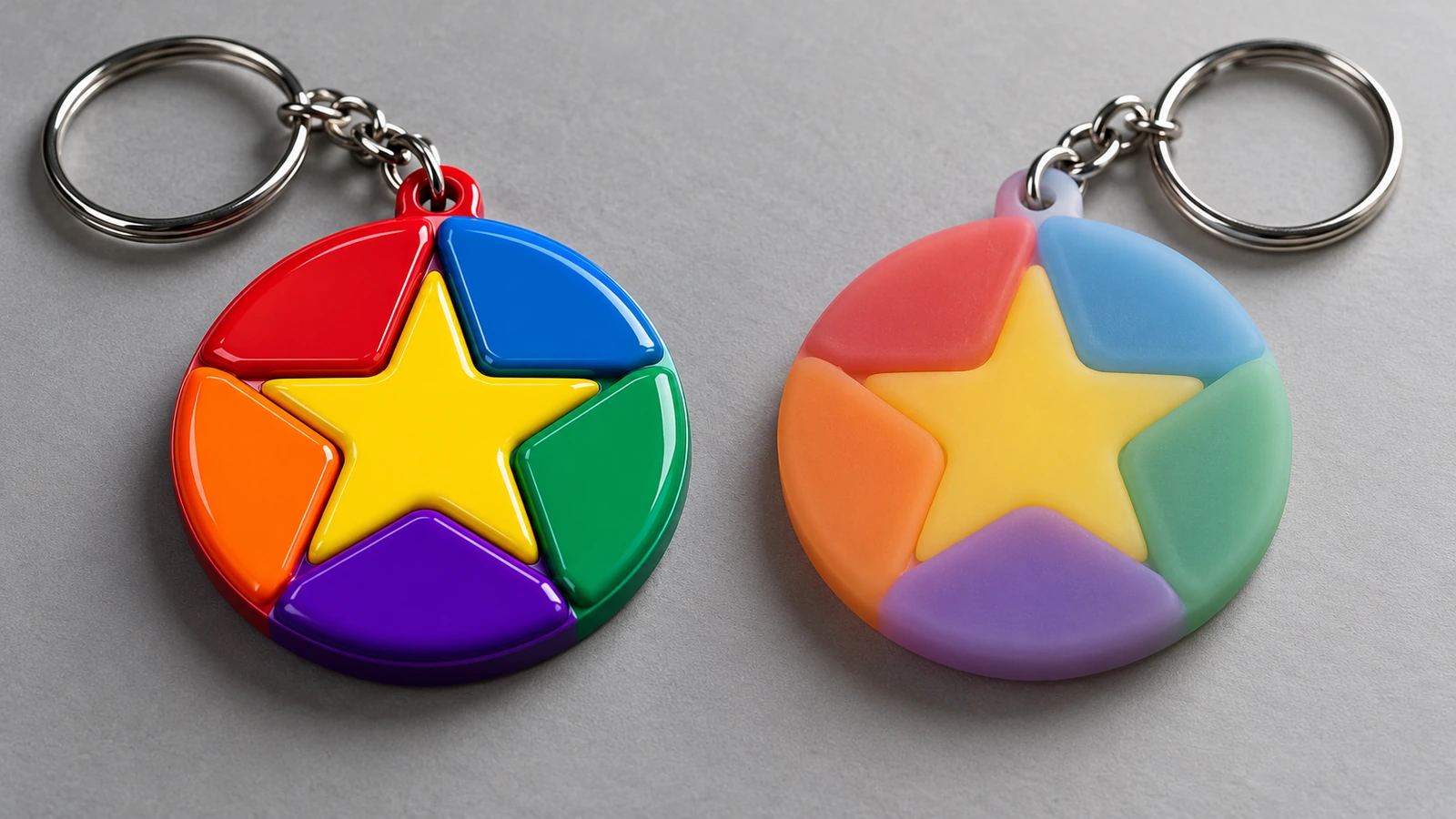
Left: soft PVC with glossy, wall-separated color areas. Right: silicone with a matte, slightly translucent surface and softer color transitions.
How to Choose Between Soft PVC and Silicone in Six Checks
Work through these checks in order. The first one that clearly favors a material usually settles the decision, and the later checks confirm it.
Check 1: How fine is your artwork? (detail sharpness)
Soft PVC is dispensed as a liquid into separate cells formed by raised outline walls in the mold. Each color sits in its own pocket, so edges stay defined even when five or six colors sit close together. This is why PVC is usually the default for multi-color logos, character art and small lettering.
Silicone is pressed and cured under heat, and color separation depends more on mold design and on how pigmented silicone flows during compression. In practice silicone suits bold shapes, single-color debossed or embossed logos, and color-filled debossing. Thin strokes and tightly packed color areas tend to look softer. Printing fine detail onto silicone is also harder. Silicone's low surface energy means ordinary inks bond poorly, so printed elements need silicone-based inks to resist rubbing. If your design depends on a thin wordmark or a tagline, PVC is usually the safer choice. To check whether a design stays readable at its finished size, see the custom rubber keychains guide for 2D molded soft PVC, which covers that review step.
Check 2: Does color have to match a brand standard exactly? (color matching)
PVC is opaque and is often finished glossy or satin, so pigment matched to a brand reference reads clearly and with strong saturation. Silicone has a natural slight translucency and a matte surface. The same target color can look softer or more muted, and bright opaque colors take more pigment to reach. Neither material reproduces gradients well, because both are molded as flat color fills.
Ask for a physical color sample in the actual material, not a screen proof. A swatch that matches on paper can shift noticeably once it is molded in translucent silicone.
Check 3: What should it feel like in the hand? (feel)
Soft PVC feels smooth and slightly firm, with a clean surface that makes colors pop. Silicone feels softer and grippier, which many recipients read as "premium." It also tends to pick up lint and dust from pockets and bags. For a keychain that will live in a coat pocket, that can be a visible downside. If the brand story is about comfort or softness, silicone's feel can justify its premium. If the story is about the logo itself, PVC's surface does more for you.
Check 4: Where will it live? (durability, heat and odor)
This check most often reverses a buyer's first instinct.
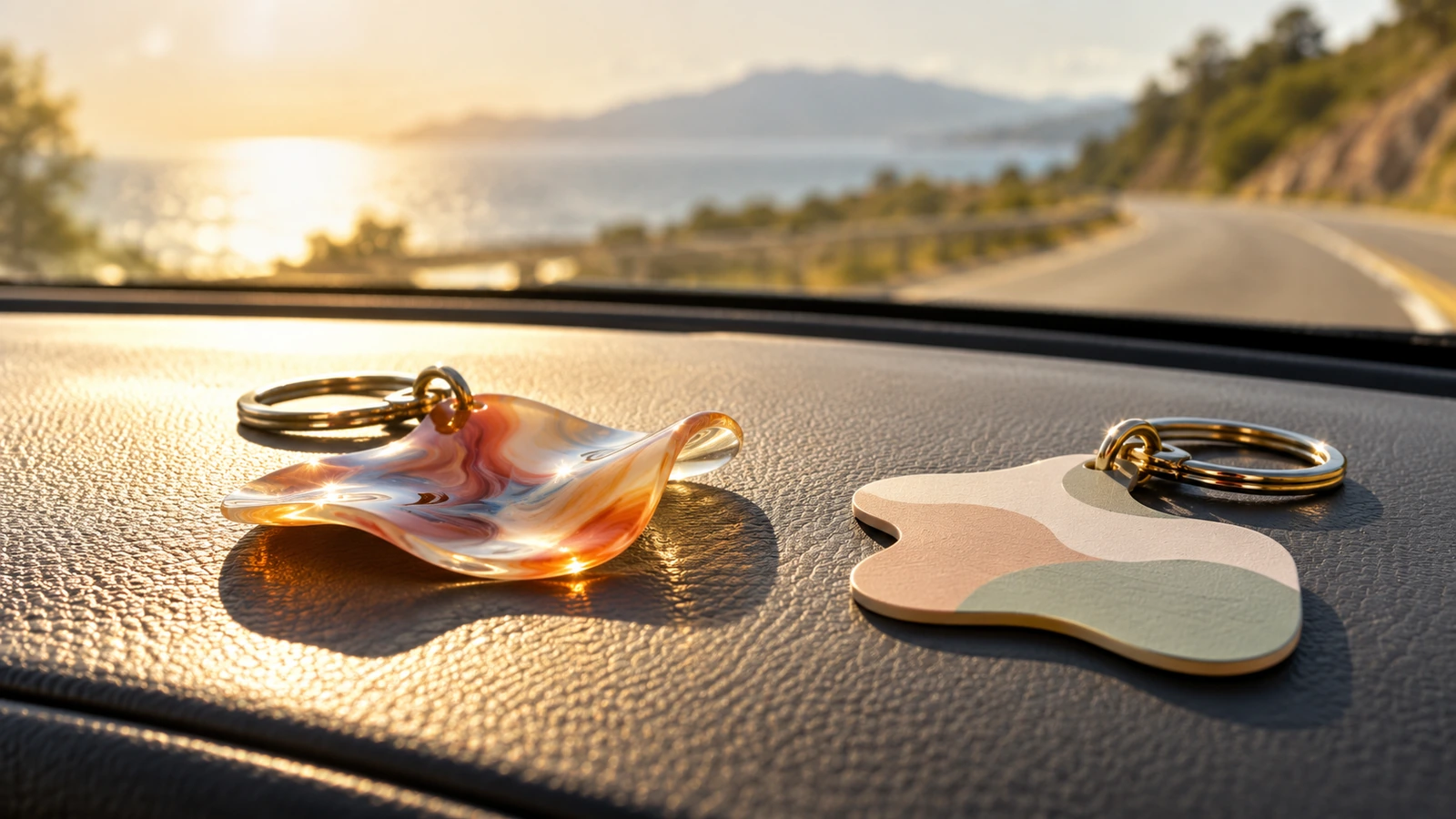
Heat: Fused PVC is thermoplastic, so it softens as temperature rises. A keychain left on a summer dashboard or hanging from a car mirror can deform, feel tacky or stick to surfaces. Cured silicone is a thermoset and does not soften this way, which makes it the stronger choice for automotive, outdoor and travel use.
Aging: Over long use, plasticizer can migrate out of lower-grade PVC. The piece may stiffen, crack or leave a slightly sticky surface. Silicone contains no plasticizer, so it does not age this way.
Tearing: Silicone is not tougher in every respect. Standard silicone grades tear relatively easily once a notch starts, and the key-ring hole is exactly that kind of stress point. Ask whether a thicker ring area or a reinforced attachment is planned. Buyer reviews of both materials often single out the connector between the logo plate and the ring as the first part to fail.
Odor: New PVC can carry a faint plasticizer smell, which stands out when hundreds of pieces are opened together at an event. Properly post-cured silicone is close to odorless. Under-cured silicone can retain a curing odor, so a smelly silicone sample tells you about process quality, not about the material itself.
Heat exposure is where silicone's crosslinked structure shows its advantage over thermoplastic soft PVC.
Check 5: What documentation will your buyers or retailers ask for? (compliance)
The compliance questions differ by material, so request different documents for each.
For soft PVC, the central question is phthalates. Some older PVC compounds use phthalate plasticizers such as DEHP. Under the Consumer Product Safety Improvement Act, children's toys and child care articles may not contain more than 0.1% of any of the eight phthalates restricted by the CPSC[4]. In California, DEHP and several other phthalates are listed under Proposition 65[5], and keychains have been the subject of enforcement. One example is a 2021 Proposition 65 settlement[6] over novelty keychains containing DEHP. The risk is not hypothetical. An independent investigation by Environmental Defence[7] found high levels of harmful phthalates in every plastic product it tested. When you order PVC, ask for a third-party test report on the actual compound, not a generic certificate, and ask which plasticizer replaces the phthalates.
For silicone, phthalates are not the issue, because there is no plasticizer. The questions shift to curing system and process quality, such as platinum-cured or peroxide-cured and whether the parts were post-cured. Suppliers sometimes also promote food-contact grades. Food-contact rules are tightening; China's GB 4806.16-2025 standard for food-contact silicone rubber[8] takes effect on September 2, 2026. A keychain is not a food-contact item, though. Pay for a food-grade compound only if your marketing will actually make that claim.
For both materials, check the hardware and the audience. Split rings, chains and clasps are metal, and lead in accessory metal has triggered recalls, including a 2008 CPSC recall of charm key chains[9]. If the keychain is designed mainly for children aged 12 or under, children's product rules apply whatever the material. That means the lead limits set under the Consumer Product Safety Improvement Act and, for toys, the CPSC toy safety requirements[10], including third-party testing. The evidence our soft PVC product provides is covered on the soft PVC rubber keychain product page, so it is not repeated here.
Check 6: Which cost model fits your quantity?
Silicone usually costs more per piece than soft PVC at the same size and complexity, but the gap is not fixed. It depends on the drivers described in the cost section below. A practical approach is to request quotes for both materials on an identical specification: same outline, same dimensions, same color count and same attachment. That way the price difference reflects the material and not a hidden change in scope.
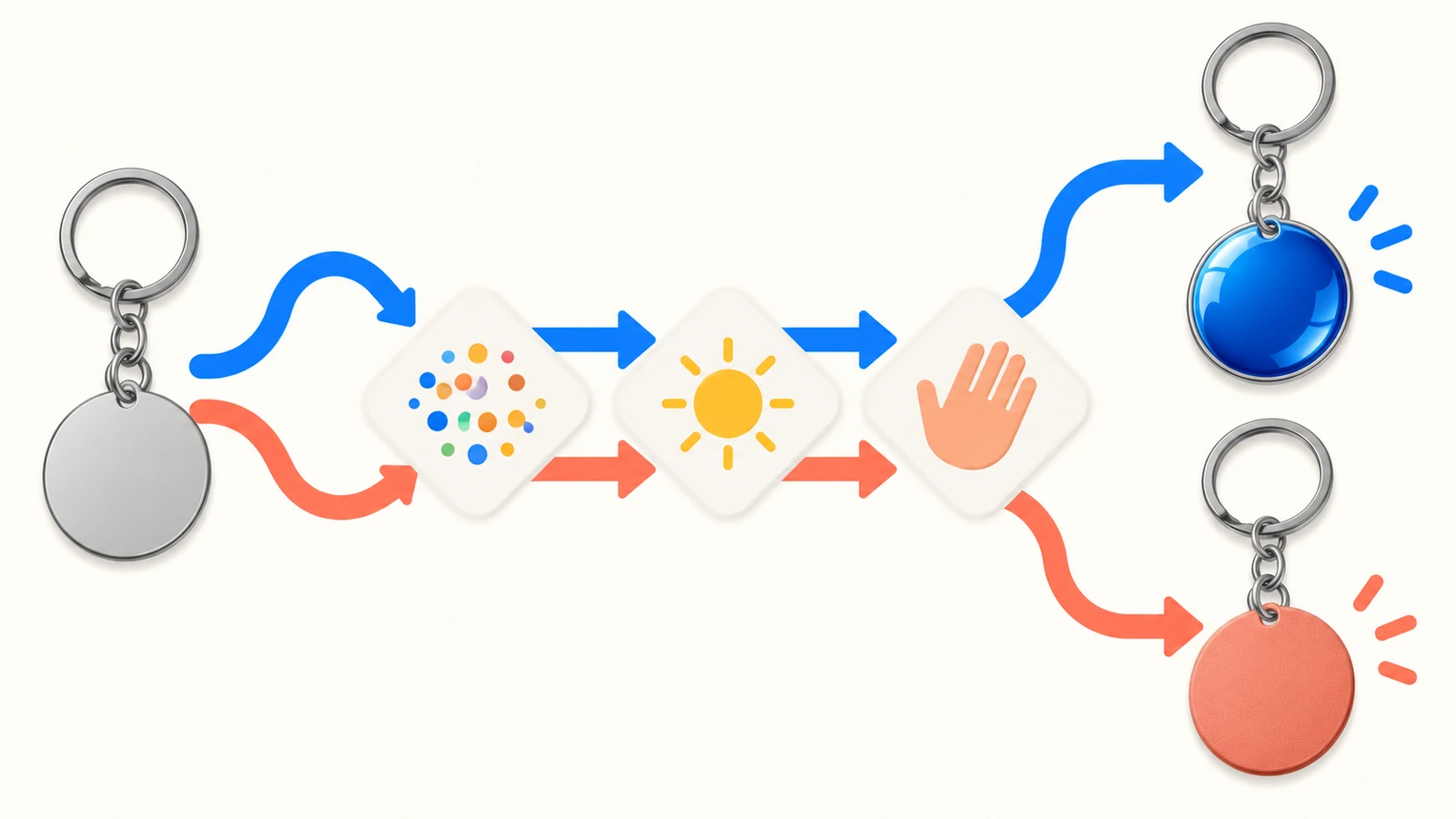
Fine multi-color art points toward PVC; heat, sun and a soft-touch brand story point toward silicone.
Soft PVC or Silicone for Promotional Keychains: Side-by-Side Comparison
The table shows the difference between PVC and silicone keychains as a buyer experiences it, with the action to take for each row.
Factor
Soft PVC
Silicone
What to ask for
Detail sharpness
Strong: colors sit in separate walled cells, so edges stay crisp
Moderate: best for bold shapes and debossed or embossed logos
A digital proof at actual size, then a physical sample for fine text
Color matching
Opaque, saturated, glossy or satin; reads close to brand references
Matte and slightly translucent; colors can look softer
A molded color swatch in the chosen material
Printing on surface
Accepts printed details readily
Needs silicone-based inks to stay bonded
The ink type used and a rub test on the sample
Feel
Smooth, slightly firm
Softer and grippy; attracts lint
Hand samples of both if feel is part of the brand story
Heat behavior
Softens at elevated temperatures (thermoplastic)
Holds shape (thermoset)
Choose silicone for car, outdoor and travel use
Long-term aging
Lower grades can stiffen or turn tacky as plasticizer migrates
No plasticizer to migrate
The plasticizer type in the PVC compound
Tear at ring hole
Good
Weaker once notched in standard grades
Reinforced ring area or attachment design
Odor out of the box
Faint plasticizer smell possible
Near odorless if properly post-cured
Smell the sample after it has been sealed in a bag for a day
Key compliance question
Phthalates (CPSIA, Prop 65)
Cure system; food-grade claims only if relevant
A third-party report on the actual compound plus a hardware lead test
Typical cost position
Lower
Higher
Quotes for both on an identical specification
What Drives Unit Cost for Each Material
Material price is only one part of the quote. These are the drivers that differ between the two materials. Order quantity, packaging and shipping affect both in the same way.
Tooling: Both materials need a custom mold. Tooling is a one-time cost spread across the order, so it weighs most heavily on small runs. Confirm whether the mold can be reused for reorders.
Color count: In soft PVC, each color is dispensed separately, so every extra color adds handling time per piece. Silicone has a similar effect, and multi-color silicone can need extra molding steps.
Cure cycle: Silicone needs a crosslinking cure under heat and pressure, and sometimes a post-cure. That ties up mold time and is a major reason silicone usually costs more.
Raw material: Silicone compounds generally cost more than PVC compounds, and food-grade or platinum-cured grades add to that.
Finishing: Compression-molded silicone usually needs flash trimming. Printed details on silicone need specialty inks.
Attachments: Ring type, metal finish and any reinforcement apply to both materials and can change the total noticeably.
The overall market for these choices is large. ASI reported that the promotional products industry reached a record $26.6 billion in sales in 2024[11], so suppliers compete hard on headline unit price. Compare full quotes, not per-piece figures. We do not publish fixed prices or minimums in this guide because they change with size, color count and attachments; request a quote with your artwork to get exact numbers.
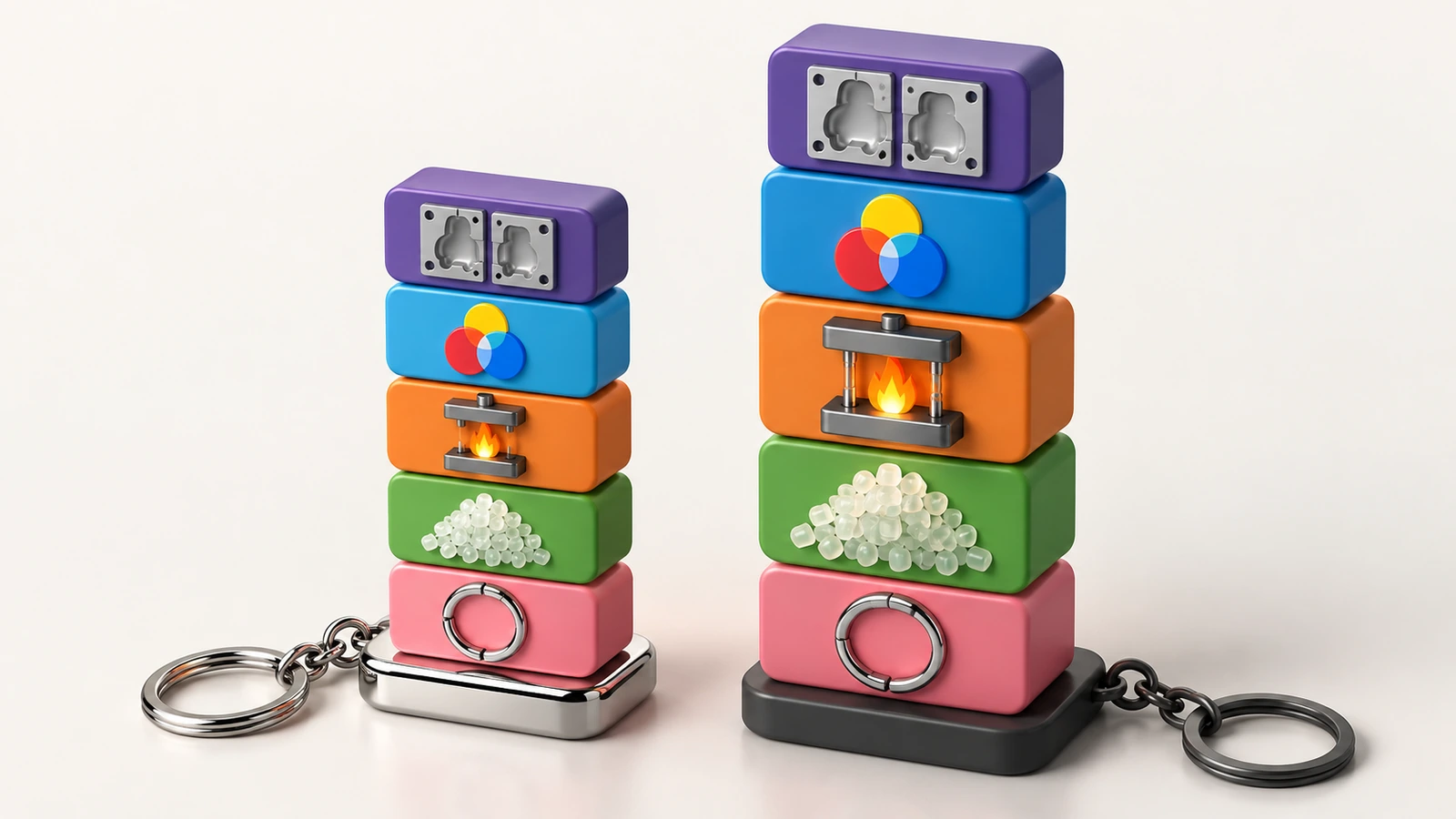
Silicone's cure cycle and material cost usually make its stack taller, while color count raises costs for both materials.
FAQ
FAQ: Is silicone always better than PVC for keychains?
No. Silicone performs better on heat, aging and odor. Soft PVC usually gives crisper multi-color detail, more saturated brand colors and a lower unit cost. For a detailed logo handed out at an indoor event, PVC is often the better choice. For a keychain that will hang in a car or travel outdoors, silicone usually is.
FAQ: Are "rubber" keychains actually made of rubber?
Rarely. Most products sold as rubber keychains are soft PVC, and some are silicone. Ask the supplier to name the polymer and, for PVC, the plasticizer type before you compare prices.
FAQ: Which material is safer for keychains given to children?
Silicone avoids the phthalate question entirely, but either material can be appropriate if it is documented. If the item is designed mainly for children aged 12 or under, it falls under CPSC children's product rules. That includes the limit of 0.1% for restricted phthalates in toys, lead limits that also cover metal hardware, and third-party testing.
FAQ: Can silicone keychains match a Pantone color?
They can come close, but silicone's matte, slightly translucent surface often makes colors read softer than on glossy, opaque PVC. Approve color from a physical swatch molded in silicone, not from a screen proof.
FAQ: Why does a new PVC keychain sometimes smell?
The odor usually comes from the plasticizer and is strongest when many pieces are sealed together. A properly post-cured silicone keychain should be close to odorless. A strong smell from silicone points to incomplete curing.
FAQ: Will printed details rub off?
Printed elements wear faster than molded color in either material. On silicone, ordinary inks bond poorly, so confirm that silicone-based ink is used and rub-test the sample. Wherever possible, mold logo details in color rather than printing them on top.
Key Takeaways
Soft PVC's main compliance risk is phthalates, so request a test report on the actual compound. — 0.1% limit per restricted phthalate in children's toys (Source)
Metal hardware needs checking whichever body material you choose. — about 12,000 charm key chains recalled by the CPSC in 2008 over lead exposure risk (Source)
Durability is the value signal buyers weigh most, which favors silicone for heat and outdoor exposure. — 70.4% of distributors cite durability as the strongest value signal (Source)
Plan for months of daily use, not just the day of the giveaway. — 94% of recipients keep promotional items at least six months (Source)
Food-grade silicone only matters if you will make a food-contact claim. — China's GB 4806.16-2025 standard takes effect September 2, 2026 (Source)
Compare full quotes on an identical specification, because headline unit prices hide tooling, color and attachment costs. — $26.6 billion promotional products market in 2024 (Source)
Conclusion
Four questions settle the choice between PVC and silicone. Fine, multi-color artwork that must match brand colors points to soft PVC, provided the compound is documented phthalate-free. Heat, sunlight, odor sensitivity or a soft-touch brand story point to silicone, provided the ring area is designed to resist tearing and printed details use the right ink. Agree on compliance documents and compare quotes on an identical specification before you approve anything.
If soft PVC suits your design, our custom rubber keychains in 2D molded soft PVC page explains what you are ordering and how artwork moves to production. Send your artwork and intended use with your quote request, and we will tell you whether soft PVC fits the brief.
Hi there! I'm Bruce, proud dad to my amazing son. I'm the founder of Zigpac, a printing and packaging company empowering small and medium-sized businesses with custom solutions. Let's create something great together!



 Blog PDF for offline reading













The information below is required for social login
Sign In
Create New Account