We use cookies to enable our websites to remember information, to help some website functionalities to work properly, to understand how you interact with and use our websites and to display you content and ads that are relevant and engaging for you.
By clicking Accept All you consent to the use of these cookie.
The store will not work correctly when cookies are disabled.
Quick answer: To start a hoodie business, pick a niche you can reach directly, validate it with paid pre-orders, and choose print-on-demand for zero inventory or small-batch bulk for better unit margin. Price from your full landed cost, wash-test a sample run, then lock a written spec so every reorder matches the first drop.
If you are researching how to start a hoodie business, you probably already have a design, a community, or a brand idea. What you need now is a sequence that protects your cash. This playbook covers niche validation, choosing a production model, pricing for margin, testing a small batch, and scaling into reorders with a production partner. It does not cover how to pick decoration methods or blank fabrics. Those topics live on our custom pullover hoodies page, and this guide links there when you reach that step.
Why Most First Hoodie Drops Stall
The usual failure is not a bad design. It is a sequence error. A founder orders inventory before proving demand, guesses the size split, prices from the blank cost alone, and then finds out after the first wash complaints that the print or the fit does not hold. Each mistake is small on its own. Together they leave unsold XXLs, thin margins, and a second order that does not match the first.
The market will not cover those mistakes for you. PPAI's 2025 U.S. Distributor Sales Volume Estimate put branded-merchandise distributor sales at $27.13 billion, up only 1.3% year over year, and the association's own summary was that many distributors "sold more but made less" (PPAI sales volume estimate[1]). In the same release, 60% of distributors expected higher 2026 sales but only 53% expected better profit. Demand for logo apparel exists. Margin is what you have to earn.
The fix is to run the business in a fixed order, with a go/no-go check at each step. The rest of this article lays out that order.
What a Hoodie Business Actually Is (and Which One You Are Building)
A hoodie business sells decorated fleece garments under a brand the buyer recognizes, whether that is a streetwear label, a creator's merch line, a gym, or a club store. You do not need to sew anything. Most founders buy finished blanks and pay a partner to decorate them, which is why the real decisions are about cash flow, inventory risk, and consistency rather than machinery.
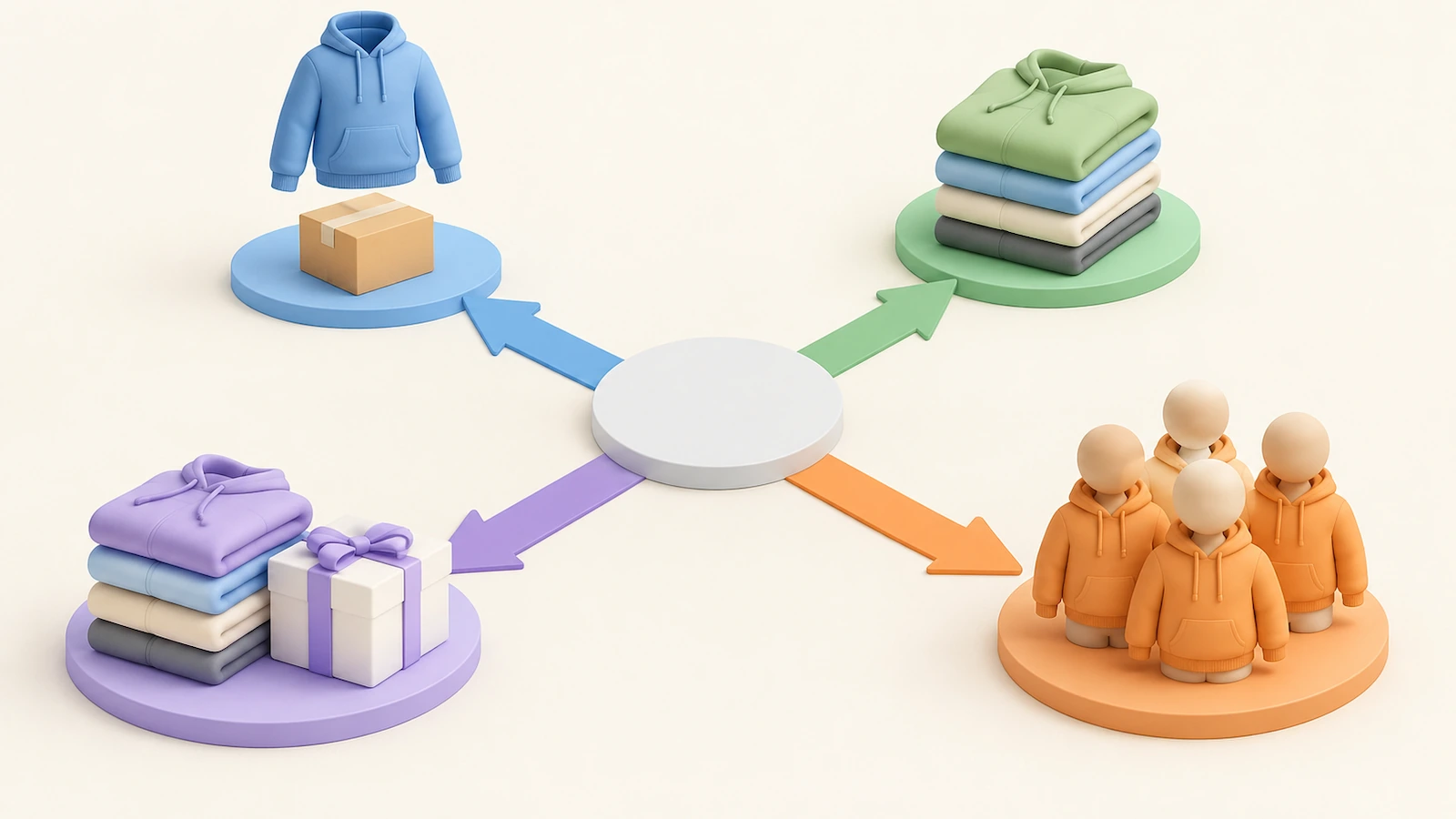
Founders usually fall into one of four models:
Print-on-demand (POD): each hoodie is decorated and shipped after a customer pays. You hold no stock.
Small-batch bulk: you order a run of decorated hoodies, hold the inventory, and ship them yourself or through a fulfillment service.
Private label: the same as bulk, plus custom neck labels, hang tags, and packaging, so the garment reads as your product rather than a decorated blank.
Organization merch: a team, company, or event sells to a known group with a fixed deadline and a known headcount.
Many founders establish hoodies as a core product by moving through these in order. They start on POD to learn what sells, then shift proven designs to bulk once the numbers support holding stock.
How to Start a Hoodie Business in Seven Steps
Step 1: Choose a niche you can reach without paid ads
A niche is only viable if you can name the specific places its buyers already gather, such as a Discord server, a run club, a subreddit, a school, or an email list you control. If the only route to buyers is paid traffic, your margin has to cover customer acquisition from day one, which most first drops cannot do. Write down three reachable channels and an estimate of how many people each one actually reaches. If you cannot fill in that list, narrow the niche until you can.
Step 2: Validate with money, not likes
Mockups and polls measure interest. Pre-orders and deposits measure demand. Run a short pre-order window, typically one to two weeks, using flat mockups of two or three designs. Before you open it, set your go/no-go threshold: the number of paid orders needed to cover your sample cost plus your first production run, which you can calculate with the break-even formula in Step 4. Pre-orders also give you something guessing cannot: a real size split. Use it to set your size curve instead of copying a generic ratio.
Step 3: Choose your production model
POD removes inventory risk but gives you the thinnest per-unit margin and the least control over which blank and finish arrive at the customer's door. Bulk improves unit economics and consistency, but it ties up cash in stock, and every unsold size is a direct loss. The comparison table below sets out the trade-offs. Industry sources expect founders to mix methods rather than commit to one. One equipment specialist interviewed by Graphics Pro[2] said "People are coming back to DTG" after two years in which most of the attention went to DTF. In practice, the same brand might print one-offs digitally and run proven designs in bulk.
Step 4: Price for margin from your landed cost
Pricing from the blank-plus-print quote is the most common math error. Build your total landed unit cost (C) from every line below:
Decorated unit cost from your partner's quote
Samples and setup, divided across the run
Inbound freight and any import duties
Packaging, labels, and tags
Payment processing and marketplace or platform fees
Outbound shipping you absorb, plus pick-and-pack
A reserve for returns, exchanges, and misprints
Then set the price with Price = C ÷ (1 − target gross margin). The resulting multipliers on C are 1.67× for a 40% margin, 2.0× for 50%, 2.5× for 60%, and 3.33× for 70%. Check the result against what your niche will actually pay. If the price your target margin requires is above what your pre-order buyers paid, change the cost stack, not just the price. Finally, calculate break-even units = fixed launch costs ÷ (price − variable cost per unit). That number becomes your go/no-go threshold in Step 2.
Step 5: Test a small batch before the full run
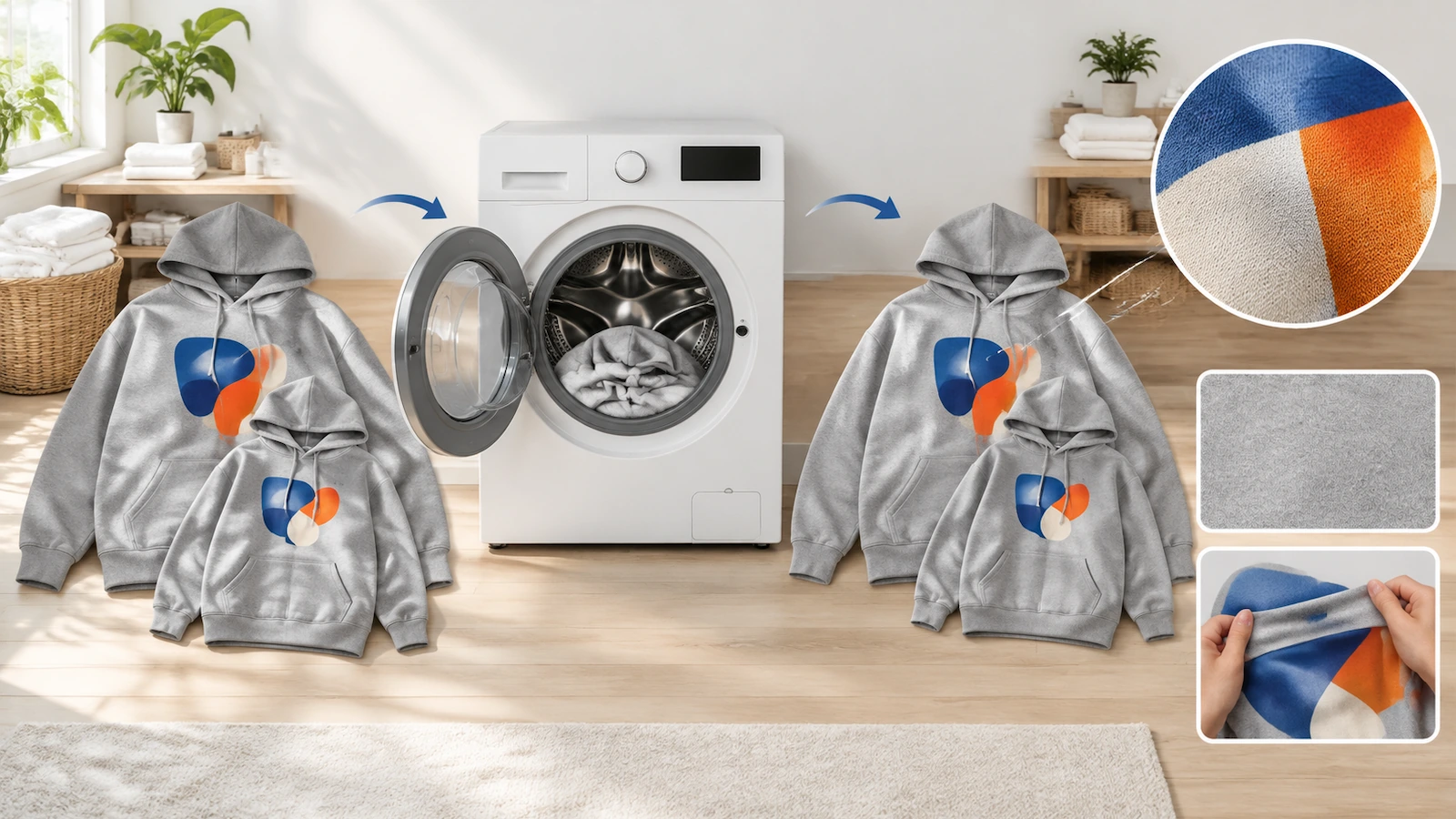
Spotting a custom hoodie high quality enough to carry your brand takes evidence, not first impressions. A print can look perfect out of the bag and still crack after laundering. Order samples in at least your smallest and largest sizes, then run them through a repeatable wash protocol. AATCC TM61, the industry's accelerated laundering test, approximates the color loss of five home launderings in one 45-minute cycle and grades results on a grey scale from 5 (no change) to 1 (severe change). If you test at home, follow the care label you plan to print, then measure chest, body length, and sleeve on each size before and after washing. Independent sourcing guides warn that poorly pre-shrunk blanks can shrink at different rates across sizes, which breaks your size curve after the first wash. Stretch the heaviest ink area by hand and check it for cracking. If a sample fails, fix the spec before you order the run.
When you choose between decoration methods and blank weights, our custom pullover hoodie guide covers how artwork, quantity, and fabric face affect the result, so this article does not repeat it.
Step 6: Get the paperwork right before you sell
Your own neck label turns a decorated blank into your product, and it carries legal duties. Under the FTC's textile rules, the label must list fiber content by weight, country of origin, and the manufacturer's name or RN (16 CFR Part 303[3]). It also needs care instructions (16 CFR Part 423[4]). If you switch to a blank with a different fiber blend, the label has to change too (Textile World[5]). Fleece is a raised-surface fabric under CPSC flammability guidance (CPSC[6]), with classes defined in 16 CFR 1610.4[7]. Youth sizes for children 12 and under also need permanent tracking labels[8]. The full rule summary is on the product page.
Step 7: Scale into reorders with a locked spec
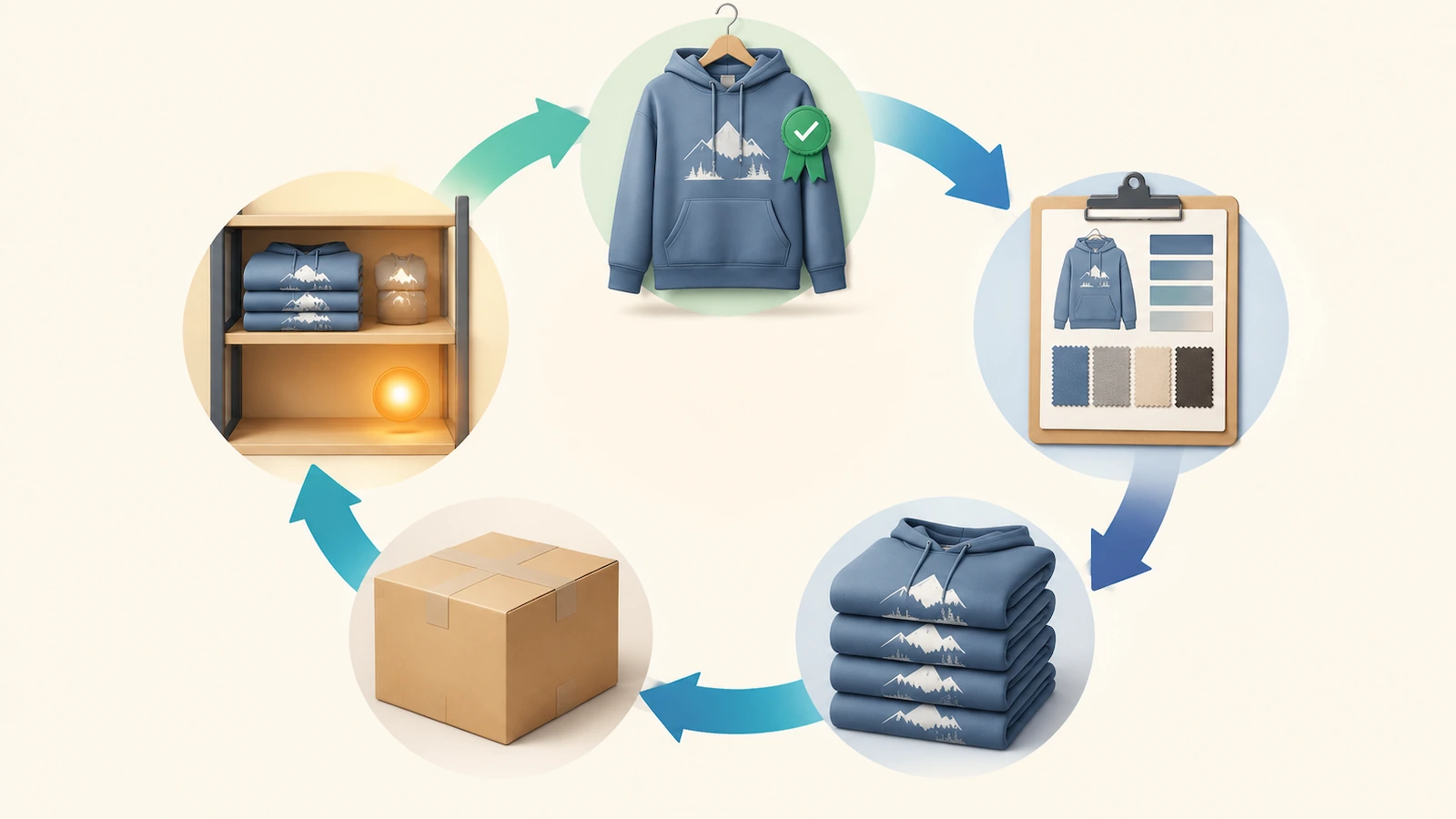
Reorders are where a hoodie business makes or loses its reputation. Customers who bought a size M in March expect the same fit in October. Before the first bulk run, write a one-page spec and have your production partner sign off on it. It should record the blank style and color, fiber blend, decoration method, print position and size, ink or thread colors, label placement, and fold-and-bag format. Keep one approved sample as the physical reference. On every reorder, ask whether the blank comes from the same fabric lot or a new one, and wash-test a unit from any new lot. Set a reorder trigger for each design and size, such as when stock covers fewer weeks of sales than your production-plus-shipping time, so best-sellers do not sell out and then sit empty for a month.
If your blanks are imported, keep fiber-to-garment records on file. CBP issued 8 Withhold Release Orders and stopped 3,138 shipments worth about $220.67 million in FY2026 through June 30 (CBP[9]). A Section 301 surcharge of 10% or 12.5% also took effect on 2026-07-24 for most source countries (USTR[10]). Add duty to your cost stack in Step 4, and see the landed-cost section on our pullover hoodie page for the details.
Production Models Compared
The table below compares the four models on the factors that matter most at launch. It deliberately leaves out prices. Costs depend on artwork, quantity, and blank choice, so get them from current quotes.
Factor
Print-on-demand
Small-batch bulk
Private label
Hybrid (POD to bulk)
Upfront cash
Lowest; samples only
Moderate; full run paid before sales
Highest; run plus labels and packaging
Low at start, rising as designs prove out
Inventory risk
None
Unsold sizes are a direct loss
Same as bulk, plus branded packaging stock
Limited to proven designs
Per-unit margin
Thinnest; fulfillment is built into unit cost
Better, if the size curve sells through
Best perceived value per unit
Improves as volume moves to bulk
Control over blank and finish
Limited to the catalog
You choose the blank and approve a sample
Full spec, including neck label
Grows over time
Reorder consistency
Can shift between print locations
Strong with a locked spec
Strongest; spec plus reference sample
Strong once in bulk
Best stage
Testing designs and audiences
Validated niche with pre-order data
Established brand with repeat buyers
Most first-time founders
The online channel matters for every model. PPAI reported $7.1 billion in online distributor sales in 2025, 26.3% of the total. Oxford Economics research commissioned by PPAI sized total U.S. branded-merchandise spending at $174 billion (PPAI and Oxford Economics[11]). That includes licensed goods, so read it as the ceiling of the category rather than your addressable market.
FAQ
FAQ: How much money do I need to start a hoodie business?
It depends on the model. POD needs little more than samples and a storefront. Bulk needs enough to pay for a full run before you sell it. Instead of guessing a figure, add up your fixed launch costs (samples, setup, labels, storefront, first marketing push) and use the break-even formula in Step 4 to see how many units you must sell. Then ask a production partner for a quote on your actual artwork and quantity.
FAQ: Can I launch with custom hoodies no minimum order?
Yes. POD and digital decoration let you start with single units, which is the cleanest way to test designs. The trade-off is unit cost and consistency. Move your best-selling designs to a batch run once pre-orders or sales data show which sizes and colors actually sell.
FAQ: How do I make sure my hoodies are high quality before I sell them?
Wash-test samples in your smallest and largest sizes, measure them before and after, and stretch the heaviest print area to check for cracking. If you want a lab result, AATCC TM61 approximates five home launderings in one 45-minute test and gives you a grey-scale grade you can write into your spec.
FAQ: How should I decide how many of each size to order?
Use the size split from your own pre-orders rather than a generic ratio. If your sample wash test shows uneven shrinkage between sizes, fix the blank or the size chart before you order. Do not try to compensate by changing quantities.
FAQ: Do I need my own labels to sell hoodies in the US?
If the garment is sold under your brand, it needs fiber content, country of origin, the manufacturer's name or RN, and care instructions under FTC rules. Youth sizes for children 12 and under also need tracking labels. Our product page summarizes the rules that apply to fleece pullovers.
FAQ: When should I switch from print-on-demand to bulk?
Switch when a design sells steadily enough that bulk unit economics, after you account for storage and unsold-size risk, beat your POD margin. Run the break-even formula with a bulk quote. If you can expect to clear that number within one selling season, the switch usually pays off.
Key Takeaways
Branded apparel demand is real, but growth is slow. — $27.13 billion in 2025 U.S. distributor sales, up 1.3% (Source)
Profit is harder to win than sales. — 60% of distributors expected higher 2026 sales, but only 53% expected better profit (Source)
Online selling is a major channel, not a side channel. — $7.1 billion, 26.3% of 2025 distributor sales (Source)
The category ceiling is large; your niche is what makes it reachable. — $174 billion in U.S. branded-merchandise spending (Source)
Imported blanks need duty in the cost stack. — 10% or 12.5% Section 301 surcharge since 2026-07-24 (Source)
Supply-chain records protect your reorder timeline. — 3,138 shipments stopped in FY2026 through June 30 (Source)
Youth sizes carry extra labeling duties. — Tracking labels required for products intended for children 12 and under (Source)
Conclusion
Learning how to start a hoodie business mostly means learning the right order of operations. Reach a niche you can contact directly, prove demand with paid pre-orders, choose the production model your cash can support, price from your full landed cost, wash-test before you scale, and lock a spec so every reorder matches the first drop. When you are ready to turn a validated design into a production run, review the decoration, blank, and ordering details on our custom pullover hoodies page and request a quote for your artwork and quantity.
Hi there! I'm Bruce, proud dad to my amazing son. I'm the founder of Zigpac, a printing and packaging company empowering small and medium-sized businesses with custom solutions. Let's create something great together!



 Blog PDF for offline reading












The information below is required for social login
Sign In
Create New Account