


 Blog PDF for offline reading
Quick answer: Magnetic closing boxes are rigid or collapsible paperboard boxes that use hidden magnets to hold the lid shut. These are usually neodymium discs paired with a second magnet or a steel plate. How well the lid stays closed depends on magnet grade, the air gap through board and wrap, alignment and lid load. Buyers should check it with pull, inverted-hold, cycle and parcel-transit tests before choosing a construction style.
Last reviewed: October 2026. Written for packaging buyers, brand managers and sourcing teams.
Magnetic closing boxes look simple: a lid, a hidden magnet and a satisfying snap. Most buyer complaints, however, trace back to the parts you cannot see. In parcel reviews, the recurring failures are lids that will not stay shut once the product is inside, flaps that need pressing "several times" before they catch, and boxes that arrive creased with the magnets no longer meeting. This explainer covers how the closure actually works, how to test it, and how the four main construction styles compare on durability, relative cost and recycling.
Why closure engineering decides whether a premium box works
The problem: Buyers often judge the closure by its look rather than its mechanics. A magnet pair that feels firm on an empty sample can fail once a 400 g product sits against the lid. The same is true after a week in a hot container or 200 openings by the end customer. One industry failure analysis traced the main causes to five issues: weak magnets, thin board, poor gluing, misaligned magnets and missing corner reinforcement.
The pain: When the closure fails, the failure is public. Open lids show up in unboxing photos, returns rise, and the box that was meant to signal value signals the opposite. Overpowered magnets cause a different problem. Packaging engineers sum it up this way: "A weak closure feels cheap; an overpowered closure feels clumsy." Sustainability adds a third risk. The EU's Packaging and Packaging Waste Regulation has applied since 12 August 2026, so mixed-material boxes now carry regulatory weight as well as an image cost.
The solution: Treat the closure as an engineered component with a specification, a test method and an end-of-life plan. The sections below explain each part in the order a sourcing team would work through them.
What are magnetic closing boxes?
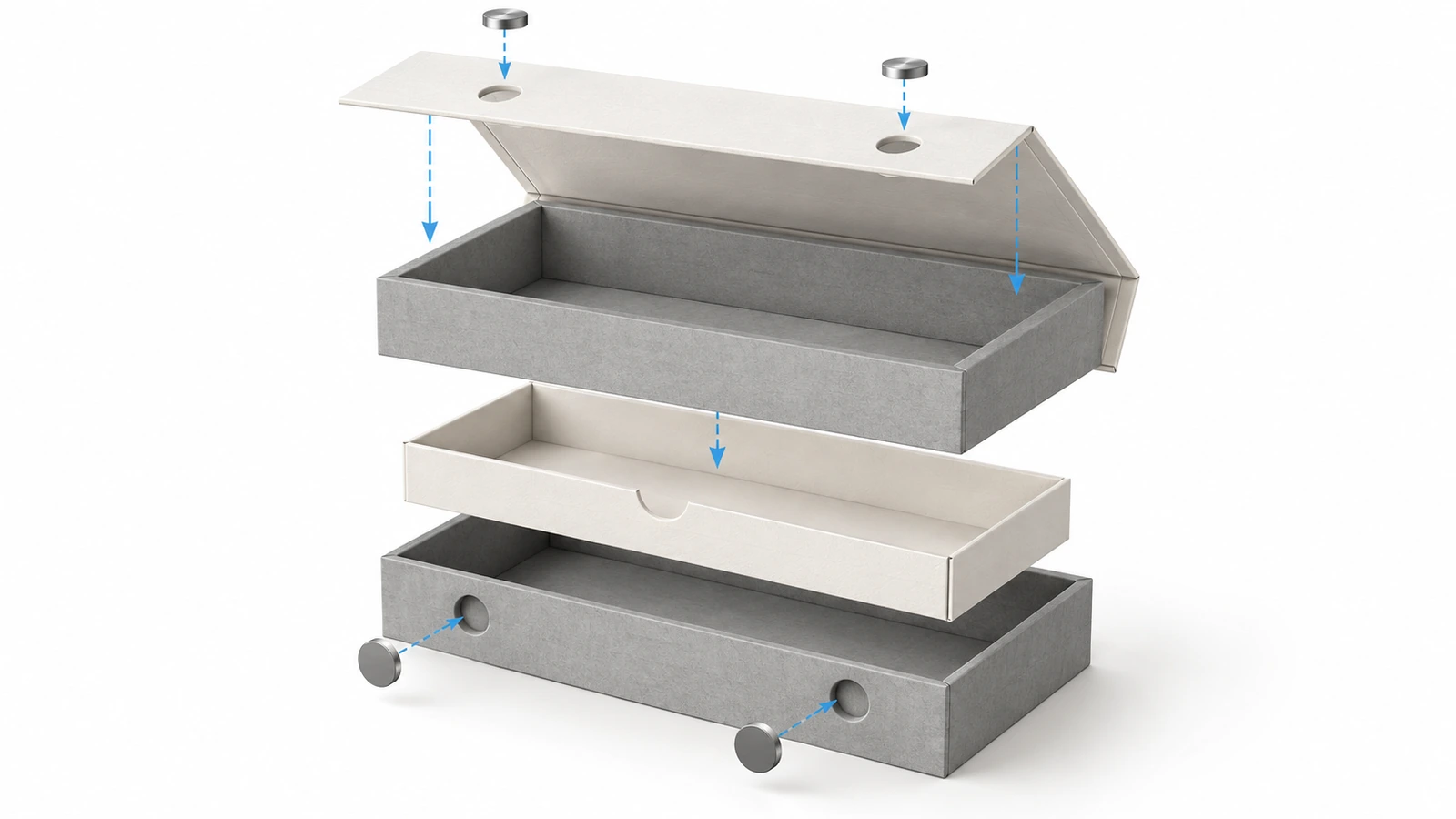
A magnetic closing box is a paperboard box in which the lid or front flap is held shut by magnets recessed into the board and hidden under the outer wrap. There are no tuck flaps, ribbons or latches. The typical build has four layers:
- Structural board: greyboard (chipboard), typically 1.5–3 mm thick, roughly 1,200–2,000 gsm. Thinner board suits light cosmetics and accessories. 2–3 mm suits heavy items such as bottles.
- Wrap: printed art paper, kraft, textured or soft-touch paper glued over the board, which hides the magnets.
- Closure set: usually 2–4 small disc or block magnets in the lid. Each one faces either a matching magnet or a thin steel plate in the base or front wall.
- Insert (optional): paper tray, foam or textile lining that keeps the product from moving.
The format is commercially significant. One market estimate values the global magnetic closure box segment at about $4.2 billion in 2025, rising to about $6.8 billion by 2034 (5.8% CAGR). In that estimate, cosmetics and personal care account for 32.5% of demand magnetic closure box market[1]. Analysts link the growth mainly to demand for premium and luxury packaging premium packaging demand[2]. The wider customized gift box market is estimated at $6.8 billion in 2025 customized gift boxes market[3].
Magnet types: neodymium, ferrite and flexible strip
Three magnet families appear in packaging. The main difference is how much holding force each delivers per gram of material, which sets how small and invisible the closure can be.
| Property | Sintered neodymium (NdFeB) | Ferrite (ceramic) | Flexible magnetic strip |
|---|---|---|---|
| Max energy product (typical) | ~33–52 MGOe (N35 to N52) | ~3.5–4 MGOe | ~0.6–1.5 MGOe |
| Size needed for a crisp closure | Small discs, often 10 mm × 1–2 mm | Several times larger by volume | Long strips along the flap edge |
| Corrosion behavior | Rusts unless plated (commonly Ni-Cu-Ni) | Inherently corrosion-resistant | Resistant (polymer-bonded) |
| Standard max operating temperature | ~80 °C for standard N grades | ~250 °C | ~60–80 °C |
| Risk of telegraphing (visible bump through wrap) | Low: thin enough to recess flush | Higher: thicker blocks | Low, but strip edges can show |
| Typical packaging use | Premium rigid and collapsible boxes | Budget boxes, large thick-walled formats | Folders, light flaps, display cases |
For most premium magnetic closing boxes, neodymium is the default because a magnet only 1–2 mm thick can sit fully inside 2 mm board. Ferrite can work in thick-walled or large boxes. But its low energy density means a weak-feeling closure unless the magnet is much larger, which is a frequent root cause of "magnets are weak" complaints on low-cost stock boxes.

What magnet grades (N35–N52) actually mean
The number after "N" is the magnet's maximum energy product in mega-gauss-oersteds (MGOe), a measure of how much magnetic energy the material stores. An N35 disc holds roughly 33–36 MGOe and an N52 disc roughly 50–53 MGOe. At identical size, then, an N52 magnet pulls noticeably harder than an N35. Three practical points follow:
- N35 is the industry baseline. It gives a firm snap through normal board and wrap at the lowest neodymium cost, and most gift-box specifications start here.
- N38–N42 suits heavier or wider lids. Large flip lids, book covers that cantilever over a deep base, and boxes carrying dense products often need the extra margin. Adding a magnet pair is the alternative.
- Grade suffixes matter for heat. Letters after the number, such as N35H, indicate a higher temperature rating, roughly 120 °C for H grades versus about 80 °C for standard grades. If boxes will sit in shipping containers or summer warehouses, ask whether a heat-rated grade is warranted. Exposure above the rating can cause permanent loss of strength.
Higher grade is not automatically better. A closure that takes noticeable effort to open, or that slams shut, hurts the experience as much as a loose one. Specify the grade together with magnet size, count, counterpart and board thickness, because all five variables interact.
Magnet placement, air gap and polarity
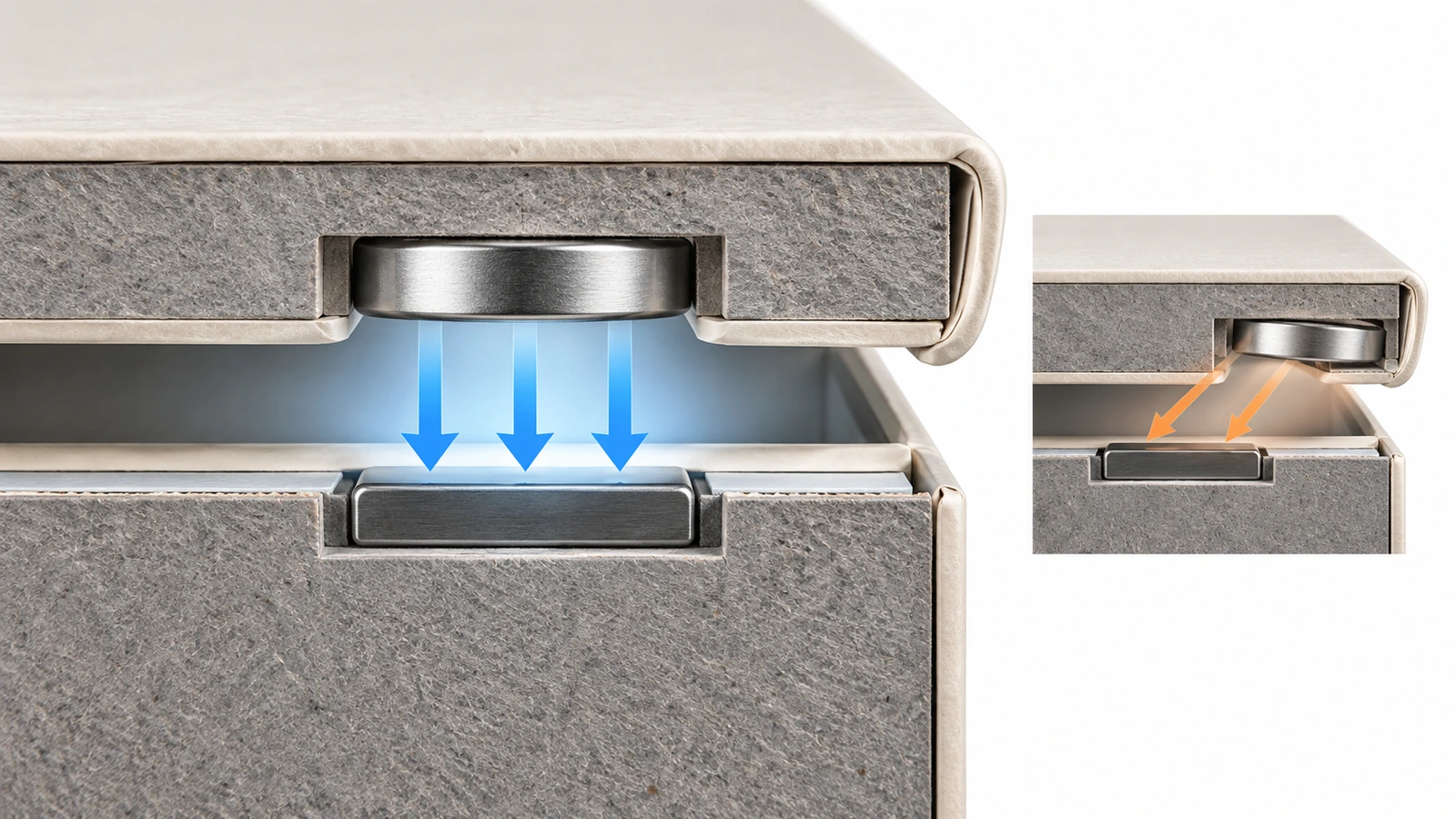
Placement often matters more than grade. Datasheet pull figures are measured with the magnet in direct contact with steel. In a box, two layers of board and paper usually separate the magnet from its partner. Magnetic force falls off steeply with distance, so even a 1 mm gap can cut usable pull by half or more for a 10 mm disc. That is why the same magnet performs very differently in a 1.5 mm and a 3 mm build.
Pairing options. A magnet-to-magnet pair delivers the most force for a given size. It also adds a failure mode: one reversed magnet makes the lid repel instead of attract. A magnet-to-steel-plate pair produces less force, but it cannot be installed with the wrong polarity, uses half the rare-earth material, and leaves only one magnet per position to remove at end of life. Many specifications use magnets in the moving lid and steel plates in the fixed wall.
Position. Magnets work best at the free edge of the flap, farthest from the hinge, where they have the most leverage against a lid that wants to spring open. Narrow boxes usually use two magnets placed symmetrically. Wide lids use three or four so the lid closes evenly instead of gapping at the corners. "The lid did not close evenly" is a classic symptom of too few or off-center magnets.
Alignment and recess. Magnet and counterpart have to meet squarely once the box is wrapped and folded. Misalignment of even a millimeter or two reduces force and gives a gritty, sliding feel. The recess depth also has to match the magnet thickness. Too shallow and the magnet telegraphs through the wrap as a visible bump. Too deep and the air gap grows.
How closure strength is tested for transit and repeated opening
A useful test protocol reproduces three real conditions: the product pressing on the lid, the box being opened many times, and the parcel network shaking and dropping the shipment. A practical sequence a buyer can request from any supplier has seven steps:
- Define the load case. Record the product's weight and where it sits, especially whether it rests against the lid when the box is upside down. Every later test is run with the real product or an equivalent dummy weight inside.
- Pull test. Use a digital force gauge to measure the force needed to open the closed lid, in newtons. Measure at the free edge, perpendicular to the lid. Recording the average and the lowest value across several samples shows how consistent magnet insertion is.
- Inverted-hold and shake test. Hold the loaded box upside down, then shake it by hand or on a shaker. The lid must stay fully closed. This is the simplest acceptance criterion to put in writing.
- Open/close cycle test. Open and close the lid repeatedly, then repeat the pull test. Basic checks run tens of cycles. More rigorous protocols run 500–1,000 cycles to simulate long keepsake use and to reveal hinge cracking, wrap tearing at the magnet pocket or loosened magnets.
- Conditioning. Store samples in heat and humidity representative of the supply chain, then re-test. This exposes adhesive creep, board warping and, for under-rated magnets, thermal loss of strength.
- Parcel-transit simulation. If the box ships to consumers, test the complete shipper, not the gift box alone. Use the International Safe Transit Association's procedure ISTA 3A[4], which covers conditioning, vibration and drop sequences for parcel-delivered packages up to 150 lb (68 kg). Check after testing that the lid is still closed, the magnets are still seated and the corners are intact.
- Record and retain. Keep gauge readings, cycle counts and photos with the approved golden sample, so production lots can be compared against a measured baseline rather than a feeling.
Safety is a separate check. US toy safety requirements built on ASTM F963 restrict small, powerful magnets that a child could detach: a loose magnet small enough to swallow must have a flux index below 50 kG²mm². The CPSC applies these requirements to children's products CPSC toy safety guidance[5]. Gift-box magnets are normally sealed under the wrap. If the box packages a toy or is aimed at children, confirm with the supplier that the magnets cannot be pulled out under abuse testing.
These closure tests are one part of a wider sample sign-off. Our collapsible magnetic gift box page lists the full set of approval checks, covering color, dimensions and finishing.

Construction styles of magnetic closing boxes compared
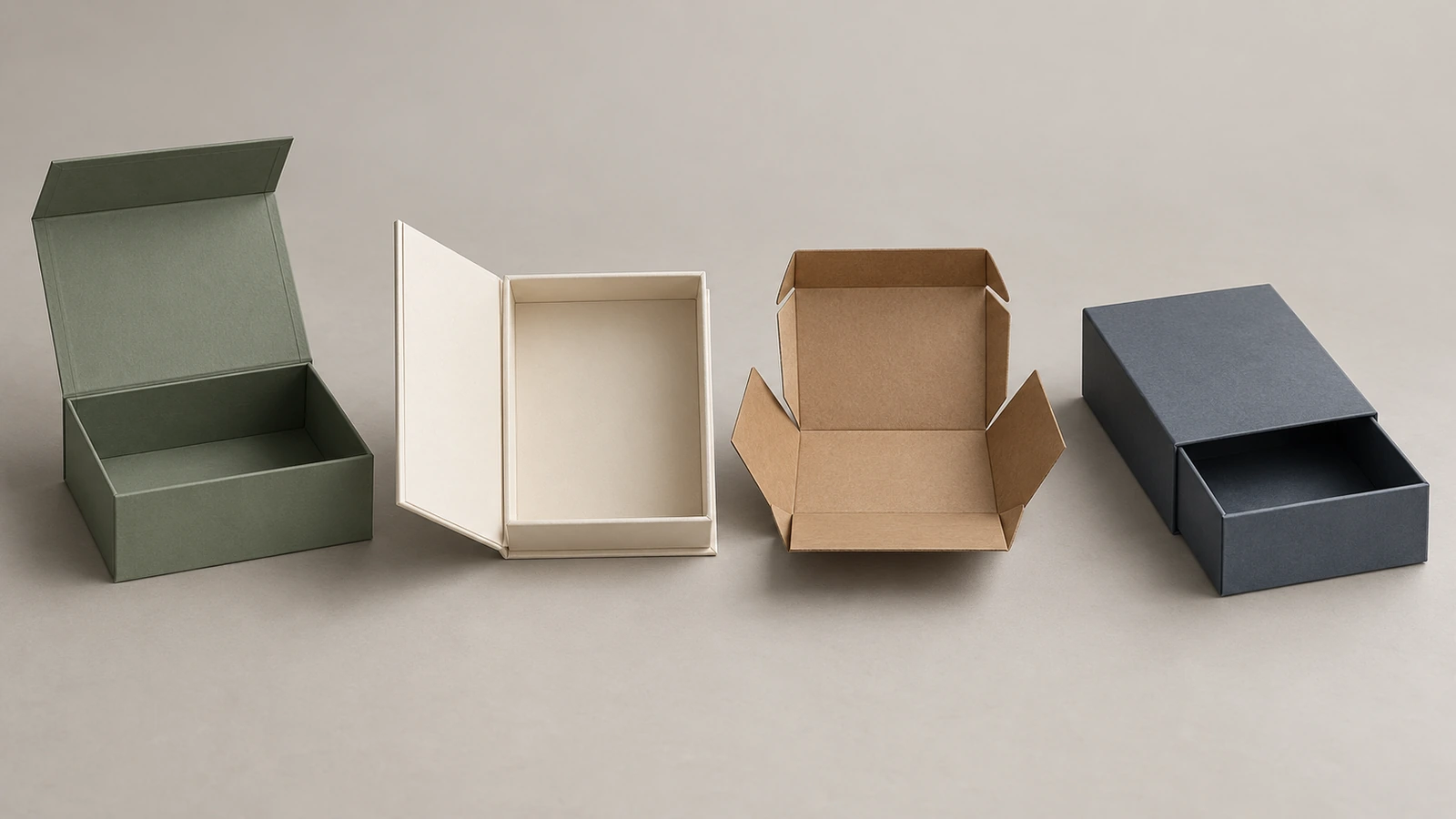
The closure behaves differently depending on the box structure around it. Four construction styles cover most B2B programs. The table compares them on the factors that matter after the sample stage. Cost is shown as a relative ranking, because actual pricing depends on specification and quantity.
| Factor | Flip-lid rigid | Book-style rigid | Collapsible (fold-flat) | Drawer-hybrid |
|---|---|---|---|---|
| How it opens | One-piece hinged lid swings up from the back | Front cover wraps over a spine and closes on the front wall | Ships flat; walls fold up and lock, flap closes magnetically | Tray slides out of a sleeve; magnetic flap or tab secures the end |
| Closure load path | Magnets fight lid weight plus hinge spring-back | Long cantilevered cover magnifies any warp | Magnets may also help hold walls upright | Magnet only stops the tray sliding; friction does most of the work |
| Structural durability | High; fixed corners resist crushing | High; spine can crack if board is thin | Medium-high; depends on fold quality and adhesive tabs | High; sleeve protects the tray |
| Feel and density | Dense, solid | Dense, "opening a hardcover" reveal | Slightly lighter feel than fully rigid | Staged, sliding reveal |
| Relative unit cost | Medium | Medium-high (spine plus extra wrap) | Medium; savings come mainly in freight and storage | High (two components) |
| Shipping and storage volume | Ships assembled, takes the most space | Ships assembled, takes the most space | Flat; manufacturers cite volume cuts of up to ~70% versus assembled rigid | Ships assembled, usually more compact |
| End-of-life | Magnets plus plates to remove; board recyclable once separated | Same, plus a laminated spine if used | Same, plus adhesive tabs; easiest to flatten for collection | Fewer magnets; sleeve and tray separate easily |
Flip-lid rigid is the classic format. Its closure margin has to cover the lid's own tendency to spring back at the hinge, so wide lids often need three or four magnets.
Book-style boxes put the magnets in the front cover. Because the cover is long and unsupported, board warping from humidity shows up first as a gap at the closure. Thicker board and humidity-conditioned testing matter more here than in any other style.
Collapsible boxes reduce the freight and warehouse burden. As one industry guide notes, they "may not feel as dense as a fully rigid box." The trade-off is acceptable for most retail and e-commerce programs. Assembly quality at the packing station becomes part of closure performance: a wall that is not fully seated misaligns the magnets. The format is covered in detail on our collapsible custom magnetic gift boxes page.
Drawer-hybrid builds use magnets lightly, often a single pair, because friction between tray and sleeve already keeps the box shut. Magnet strength is rarely the problem with this style. A tray that is too loose in the sleeve is.
End-of-life: what happens to magnets, board and wrap
The paper parts of a magnetic closing box are recyclable in principle. In practice, three design choices decide whether they are recyclable at scale:
- Magnet removal. Embedded magnets add a manual separation step. Fewer magnets, steel counterplates instead of a second magnet, and pockets that can be peeled open make separation realistic for the end user.
- Lamination. Paper bonded to polypropylene film cannot be separated at standard paper recycling facilities. Unlaminated wraps, or coatings accepted by paper mills, avoid this.
- Adhesives and inserts. Water-based adhesives and paper inserts keep the box single-stream. Foam inserts make it a multi-material item.
Regulation is turning these choices into compliance questions. In the EU, the Packaging and Packaging Waste Regulation (EU) 2025/40 replaced Directive 94/62/EC and has applied since 12 August 2026 European Commission packaging rules[6]. From 2030, packaging must be recyclable "in an economically viable way" and meet design-for-recycling grading PPWR analysis[7]. In the US, seven states (Maine, Oregon, Colorado, California, Minnesota, Maryland and Washington) had enacted comprehensive extended producer responsibility (EPR) packaging laws as of 1 October 2025. Under those laws, producers fund recycling based on the materials they put on the market EPR packaging laws[8]. This matters for a large market: US custom packaging alone is estimated at about $10.08 billion in 2025, and paper and paperboard form the largest segment US custom packaging market[9].
For fiber sourcing, chain-of-custody certification from the Forest Stewardship Council[10] lets a brand trace certified board and paper through the supply chain. It covers where the fiber came from, not whether the finished box is recyclable, so treat the two as separate claims. How to word environmental claims accurately is covered on our product page and not repeated here.

FAQ
FAQ: Can magnetic closing boxes ship to customers without an outer carton?
Generally not. The magnetic box is a presentation layer, and parcel handling can crease the wrap, dent corners and knock magnets out of alignment. Ship it inside a corrugated shipper with an insert that stops movement, and validate the complete system with a parcel test such as ISTA 3A.
FAQ: How many magnets does a magnetic closing box need?
Small flaps typically use two magnets placed symmetrically near the free edge. Wide or heavy lids use three or four so the lid closes evenly along its full width. Adding magnets is often a better fix than moving to a much higher grade, because it also corrects uneven closing at the corners.
FAQ: Will heat in containers or warehouses weaken the magnets?
Standard neodymium grades are rated to roughly 80 °C. Above that, they can lose strength permanently. Most supply chains stay below this, but sealed containers in hot climates can get close. If that applies, specify a heat-rated grade (for example an H suffix, rated around 120 °C) and include heat conditioning in your closure tests. Heat also softens adhesives, which can let magnets shift in their pockets.
FAQ: Can the magnets affect the products inside?
The small disc magnets used in boxes have short-range fields that drop off sharply within a few centimeters. Most products are unaffected. Items sensitive to direct magnetic contact, such as magnetic-stripe cards or mechanical watch movements, should not rest directly against a magnet pocket. An insert that holds the product away from the closure removes the risk.
FAQ: Are collapsible magnetic boxes weaker than rigid ones?
Once assembled correctly, a well-made collapsible box holds its shape and closure comparably for most gift and retail uses, though it feels slightly less dense. Its closure performance depends on the walls being fully seated during assembly, so include assembled samples, not just flat blanks, in your testing.
FAQ: Are magnetic closing boxes recyclable?
The board and paper can go into paper recycling once the magnets and any steel plates are removed, provided the wrap is not laminated with plastic film. To make recycling realistic, reduce magnet count, use steel counterplates and choose unlaminated wraps and water-based adhesives.
Key takeaways
- Magnetic closure boxes are a large, growing packaging segment. — about $4.2 billion in 2025, projected $6.8 billion by 2034 (Source)
- Loose small magnets in children's products face strict US limits. — flux index below 50 kG²mm² under ASTM F963-based requirements (Source)
- Test the complete shipper, not only the gift box. — ISTA 3A covers parcel-delivered packages up to 150 lb (68 kg) (Source)
- EU recyclability rules now apply to every box sold there. — PPWR applicable since 12 August 2026, with design-for-recycling requirements from 2030 (Source)
- US producers increasingly pay for packaging end-of-life. — 7 states with comprehensive EPR packaging laws as of 1 October 2025 (Source)
- Paperboard dominates the US custom packaging market. — about $10.08 billion in 2025, growing around 5% a year to 2033 (Source)
Conclusion
A good closure comes from five matched variables: magnet type, grade, count, counterpart and board thickness. It should be verified with numbers rather than by feel, through pull readings, inverted holds, cycle counts and a parcel-transit test. The right construction style then depends on what matters most to your program. Flip-lid and book-style boxes give density, collapsible boxes save freight and storage space, and drawer-hybrids give a staged reveal. Each comes with its own end-of-life profile.
If you are planning a program and want a closure specified and tested for your product weight and supply chain, start with our collapsible magnetic gift box options and request a quotation based on your exact specification.
Sources
- MarketIntelo – Magnetic Closure Box Market Research Report 2034 (published August 2025). ↩
- Future Market Insights – Magnetic Closure Boxes Market (April 2025). ↩
- Dataintelo – Customized Gift Boxes Market Research Report 2034 (updated 2026). ↩
- International Safe Transit Association – ISTA 3A, Packaged-Products for Parcel Delivery System Shipment. ↩
- U.S. Consumer Product Safety Commission – Toy Safety Business Guidance (ASTM F963, 16 C.F.R. part 1250). ↩
- European Commission – Packaging waste. ↩
- Fieldfisher – New EU Packaging and Packaging Waste Rules: 10 Key Things Every Global Business Should Know (April 2025). ↩
- Proskauer Rose LLP – The 2025 Guide to EPR Packaging Compliance (October 2025). ↩
- Grand View Research – United States Custom Packaging Market Size & Outlook, 2033 (October 2025). ↩
- Forest Stewardship Council – Chain of Custody certification (FSC-STD-40-004). ↩












The information below is required for social login
Sign In
Create New Account