


 Blog PDF for offline reading
Quick answer: Paper tubes are rigid cylinders made by gluing layers of paperboard around a steel mandrel. Spiral-wound tubes wrap plies at an angle and suit most retail and mailing packaging. Convolute (parallel-wound) tubes wrap plies straight around the axis and suit stiffer, heavier-duty uses. Wall thickness, the inner liner and the end closure decide how well a tube protects, seals and opens for your product.
If you are sourcing paper tubes for the first time, supplier pages tend to look alike. They all show round, printed, kraft-finished cylinders. The engineering choices behind those photos determine whether the tube holds up, and suppliers rarely explain them. A tube that looks premium on a render can still arrive with a lid that pops off, a wall that dents in a humid warehouse, or an outer carton full of air that you pay to ship.
Those are the complaints that keep recurring in public buyer reviews of cylindrical packaging. Lids are either too tight or too loose, inner edges fray because they were cut straight instead of rolled, and freight bills grow because a finished tube cannot be shipped flat the way a folding carton can. Almost all of these failures trace back to a construction decision made before artwork was ever discussed.
This guide explains how tubes are built: winding method, wall thickness, liners and end closures. It then matches each construction to the product categories and supply-chain conditions it handles best. Use it to brief a supplier in their own vocabulary and to recognize when a quote has left out something your product needs.
What Are Paper Tubes?
A paper tube is a hollow cylinder built from several plies of paperboard. Each ply is coated with adhesive and wound around a polished steel rod called a mandrel, and the resulting tube is then cut to length. The same basic product is sold under several names. "Cardboard canister packaging" usually means a retail tube with a lid. "Paper cylinder packaging" and "round tube packaging" are broader terms. In industrial settings the same structure is called a core, which carries rolls of film, textile or paper.
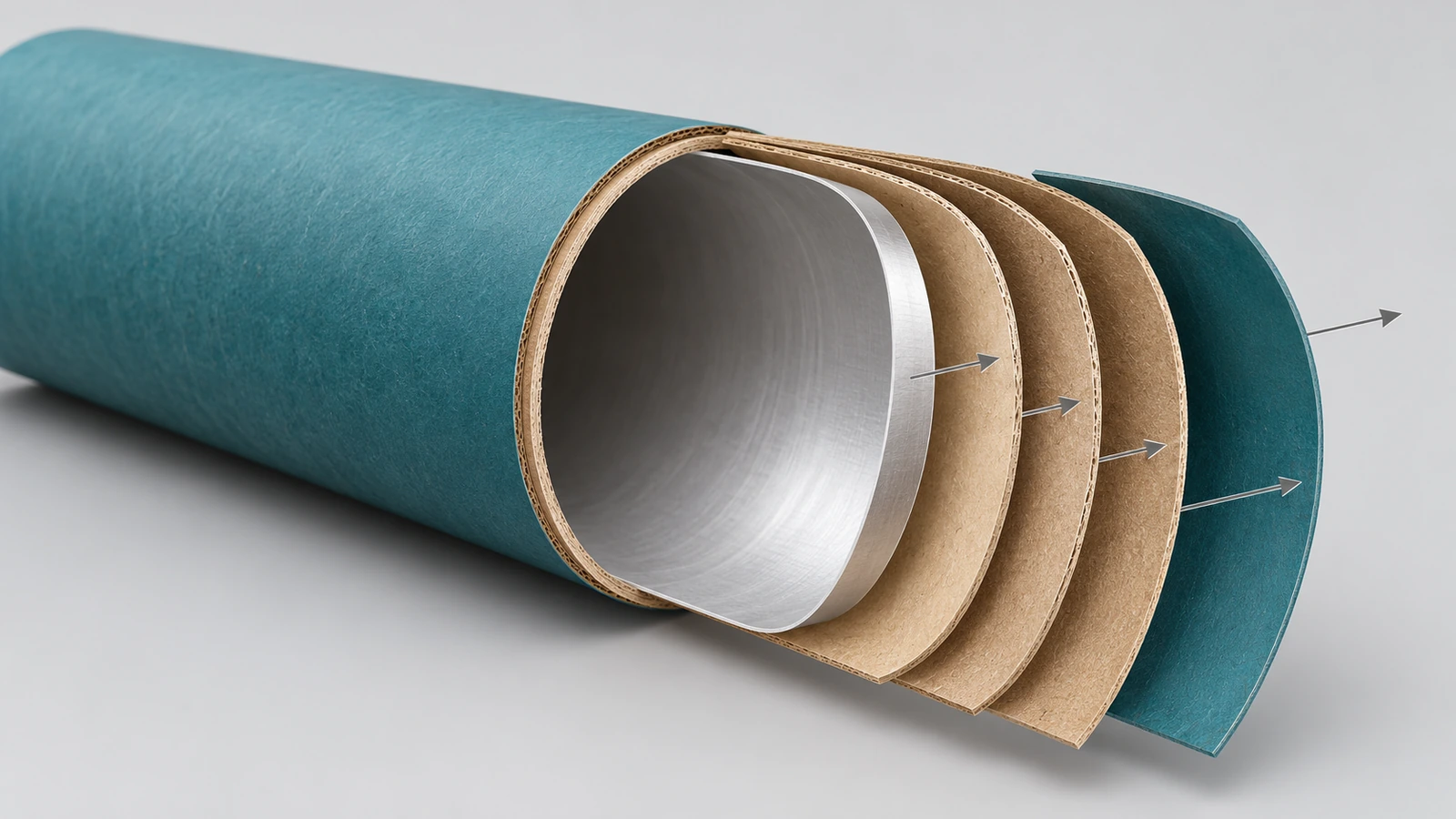
Retail tubular packaging adds three layers to that structural body. An inner liner controls contact with the product and sets the moisture or grease barrier. A printed outer wrap, either a label paper or a pre-printed sheet laminated over the body, carries the branding. End closures seal the top and bottom. Because each layer is specified separately, two tubes with the same diameter can perform very differently.
Spiral-Wound vs. Convolute: How Paper Tubes Are Made
Spiral winding
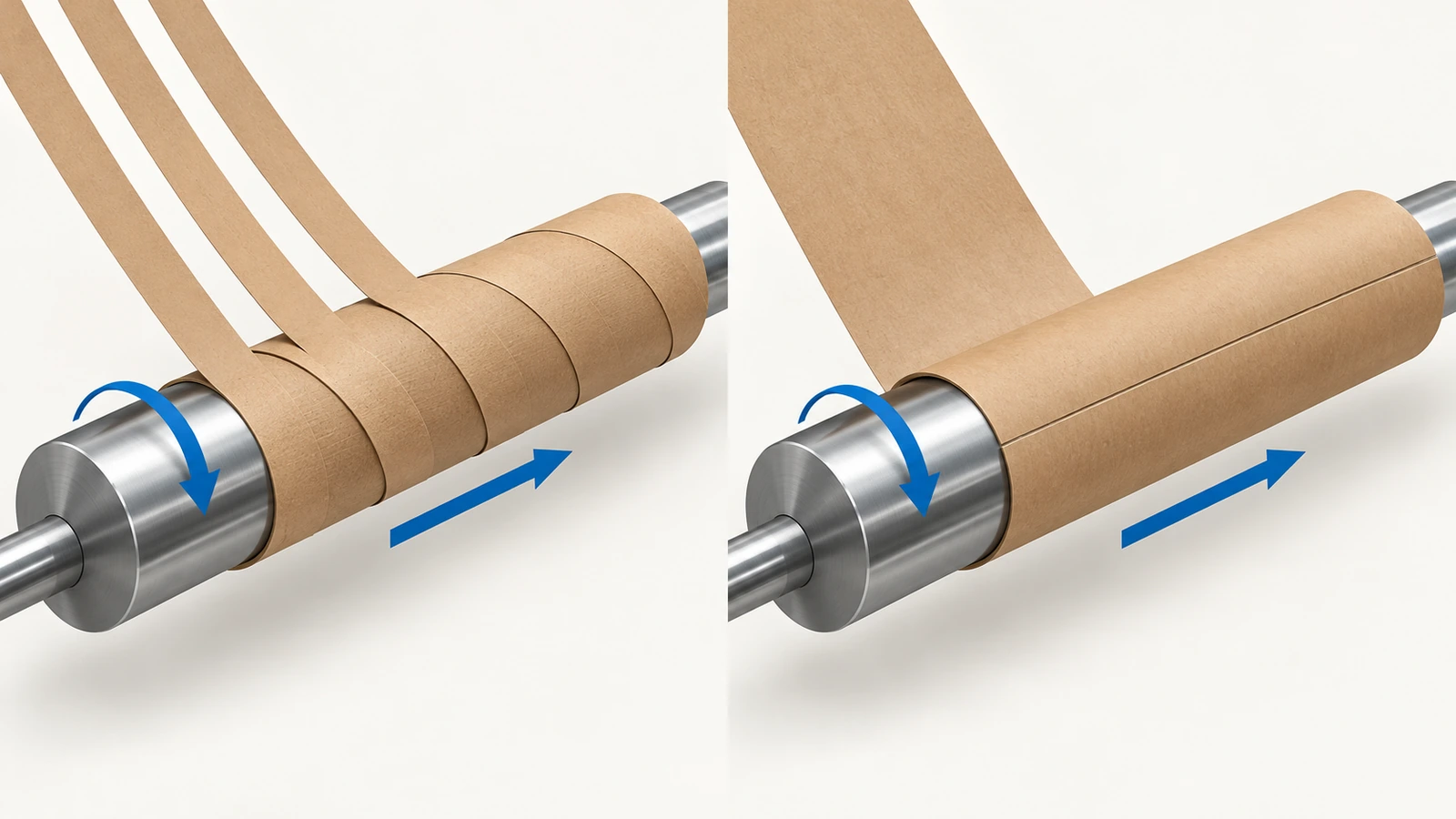
In spiral winding, narrow paperboard strips are fed onto a fixed mandrel at an angle. A belt drive rotates the forming tube and pushes it forward, so the strips wrap around it in overlapping helixes. The process runs continuously, and a flying saw cuts the tube to length as it advances. Each ply is offset from the one beneath it, so the seams never line up. The result is a uniform wall with a faint diagonal seam that shows through on unprinted or thin-wrapped tubes.
Spiral winding is efficient at holding a consistent diameter across long runs, and a change in length only requires moving the cut point. For these reasons most consumer tubes, mailing tubes and retail canisters are spiral-wound.
Convolute (parallel) winding
In convolute winding, one wide sheet of paperboard is fed parallel to the mandrel axis and rolled on top of itself until the wall reaches the target thickness. Tubes are produced in batches at a fixed length, and the wall has a single longitudinal seam. Each ply runs the full length of the tube, so convolute tubes generally have higher bending stiffness and handle thick walls well. The trade-off is slower output and less flexibility in length and diameter.
Convolute construction is the usual choice for heavy cores, tubes that must resist bending across a long span, and some precision applications where a smooth, seam-free surface matters along the length.
Assembly after winding
Retail tubes go through more steps after winding. The body is cut, the outer wrap is laminated, and the edges are either rolled inward or left straight. Closures are then fitted. A rolled or curled inner edge is the detail buyers most often miss. Straight-cut inner edges can fray after repeated opening and are a common source of the "frayed lid" complaints in public reviews.
How Wall Thickness and Plies Change Performance
Wall thickness depends on the number of plies and the caliper of each ply. Industry guides commonly describe retail tube walls as roughly 1 to 5 mm thick. Thinner walls are used for lightweight cosmetics and apparel. Thicker walls are used for glass jars, candles and tubes stacked in pallet loads. A thicker wall raises flat-crush and edge resistance. It also adds weight and paperboard cost, and it shrinks the inner diameter for a given outer diameter, which affects your shelf footprint and your fit to shipping cartons.
Two industry test frameworks describe how this performance is measured. The Composite Can and Tube Institute (CCTI), a trade association, publishes methods including a flat-crush test (T-108) and a flexural-stiffness test (T-150). The ISO 11093 series covers testing of paper and board cores, including three-point bending strength. For complete shipping systems, U.S. buyers usually rely on distribution simulations from ASTM paper and packaging standards[1] such as D4169, which runs a sequence of drop, vibration and compression hazards on the packed unit.
When you request quotes, ask which wall specification is proposed and whether it was chosen for your product's weight and stacking height. Do not accept a single generic "sturdy" claim. If your shipping lanes include humid seasons, ask whether test results were recorded at controlled humidity, because paperboard loses strength as it absorbs moisture.
End-Closure Types and What Each One Does
The closure determines how a tube opens and seals, and how premium it feels. It also accounts for most fit complaints. These are the common options:
- Two-piece telescoping: A lid tube slides over the full base tube. It is simple and stacks well, and it gives a controlled reveal on opening. Fit depends on air escaping between the walls, so the inner-to-outer tolerance is the critical number. If this is the structure you are considering, our two-piece telescoping paper tube boxes page covers the fit and sampling questions in detail.
- Three-piece with neck (shoulder) tube: A shorter inner "neck" tube is glued inside the base and stands slightly above it. The lid closes down onto the neck and sits flush with the base. Resistance is easier to tune than with two-piece designs, and the flush line looks more finished, which makes it common for cosmetics and spirits.
- Paper end discs or rolled-in bottoms: A paperboard disc is glued or crimped into the base. This keeps the tube all-paper, which helps recyclability.
- Metal ends: Seamed steel or tinplate ends give the closure strength and a tighter seal for powders and foods, at some cost to mono-material recycling.
- Plastic plugs and caps: These are used on mailing tubes because they press-fit and are reusable. They are less common in plastic-reduction programs.
- Push-up base: A movable inner disc that dispenses solid sticks such as balm and deodorant. It must be matched to the hardness of the formula and tested both filled and empty.
- Membrane or foil seals: Peelable inner seals under the lid that provide tamper evidence and a barrier for food.

How to Choose a Tube Construction in Five Steps
- Define the load. Record the product's weight, its fragility (glass, wax or fabric) and the maximum stack height it will see in storage. A lightweight, crush-insensitive item can use a thin spiral wall. A heavy glass jar needs more plies or an insert.
- Map the environment. List humidity exposure along the route, such as ocean freight, coastal warehouses and bathroom shelves. Paperboard alone is not waterproof. Humid lanes call for a barrier liner, a coating or an inner pouch.
- Decide on contact. Determine whether the product touches the tube directly. U.S. food-contact paperboard falls under FDA rules such as 21 CFR 176.170[2] for aqueous and fatty foods. Dry foods often avoid direct-contact requirements by using a sealed inner bag.
- Pick the opening experience. Choose telescoping for a reveal, a neck tube for a flush and tunable fit, push-up for dispensing and a membrane seal for tamper evidence.
- Plan the outer shipper. Finished tubes cannot be flattened, so the case pack and pallet pattern drive freight cost. The product page explains how to control shipping and repeat-order risk, so this guide does not repeat it.
Construction-to-Product Comparison
The table matches common constructions to the categories they serve. Use it as a starting point for a supplier conversation, not as a final specification.
| Construction | Strength profile | Typical closure | Best-fit products | Supply-chain note |
|---|---|---|---|---|
| Spiral-wound, thin wall, kraft liner | Moderate crush resistance, uniform diameter | Paper disc base, telescoping lid | Apparel rolls, tea sachets, gift sets | Efficient for long runs and repeat orders |
| Spiral-wound, thick wall, insert | Higher flat-crush and stacking resistance | Telescoping or neck-tube lid | Candles in glass, fragrance, spirits | Add pulp or paperboard insert to stop rattle |
| Spiral-wound with foil or barrier liner | Moderate; barrier is the priority | Metal or paper end plus membrane seal | Coffee, powders, snacks, spices | Check local recyclability of the liner |
| Convolute, thick wall | Highest bending stiffness | Plastic plug or metal end | Long mailers, heavy cores, technical parts | Batch lengths; less size flexibility |
| Spiral-wound with push-up base | Light, functional | Push-up disc plus cap | Lip balm, solid deodorant, solid perfume | Test with filled formula before scaling |
A tube compares differently against each common alternative. Against folding cartons, it gives more shelf presence and better reusability, but it takes up more storage and shipping volume. Against plastic or metal canisters, it is lighter and easier to recycle in paper streams, but it is weaker against water and harder to make airtight.

Recyclability, Liners and Regulation
Tubes made of plain paperboard enter a well-established recovery stream. According to the American Forest & Paper Association[3], the U.S. paper recycling rate in 2024 was 60–64%, and cardboard reached 69–74%. Sourcing can be documented through FSC chain-of-custody certification[4], and FSC reports that 56% of consumers globally recognize its logo. If you plan to make an FSC claim, confirm your supplier's certificate status when you request a quote.
Barrier choices add complexity. The European Environmental Bureau[5] notes that recycling processes cannot cope with more than about 3–10% non-pulpable material. Heavy foil or plastic laminates can therefore undermine an "eco" message. The industry is responding with fiber-based barriers. Packaging Gateway[6] has reported on barrier papers that combine a low oxygen transmission rate with a low water-vapor transmission rate. Brand surveys covered by Packaging World[7] describe a broad "paperization" shift across consumer goods.
Regulation reinforces the same direction. The EU Packaging and Packaging Waste Regulation[8] has applied since 12 August 2026 and requires all packaging on the EU market to be recyclable by 2030. The EUR-Lex summary[9] also covers restrictions on PFAS in food-contact packaging. In the U.S., PRINTING United Alliance[10] tracks state extended producer responsibility laws, several of which cover paper packaging and tie producer fees to recyclability. For dry foods, FDA also lists substances migrating from paper and paperboard as generally recognized as safe under 21 CFR 182.90[11].
FAQ
FAQ: Are paper tubes and cardboard tubes the same thing?
In everyday use, yes. Both describe wound paperboard cylinders. "Cardboard" is the consumer term, while manufacturers use "paperboard" and "composite" when a liner or metal end is added.
FAQ: Is spiral-wound or convolute stronger?
For the same wall thickness, convolute tubes usually show higher bending stiffness because each ply runs the full length. Spiral-wound tubes are uniform and strong enough for most retail and mailing uses, and they are more economical on long runs. Choose based on load and span, not on the label alone.
FAQ: Can paper tubes hold liquids or moist products?
Not on their own. Paperboard absorbs moisture and loses strength. Liquids should stay in a primary container such as a bottle or jar, with the tube acting as secondary packaging. Moist or oily products need a barrier liner or coating that is matched to the product.
FAQ: Why do some tube lids fit inconsistently?
Paperboard dimensions shift slightly with humidity and with variation between batches, and telescoping lids depend on a tight air-gap tolerance. Neck-tube designs, rolled edges and pre-production fit checks reduce the problem. The product page covers which closure details deserve sampling.
FAQ: Are lined tubes still recyclable?
It depends on how much non-fiber material the tube contains and on local collection rules. Thin, repulpable barrier coatings generally recycle better than heavy foil or plastic laminates. Confirm with the liner specification and your local guidance before making on-pack claims.
FAQ: What do order minimums, pricing and lead times look like?
They vary with diameter, wall specification, closure, liner and finishing. Instead of relying on generic ranges, share your product dimensions and target quantity and request a quote for your exact construction.
Key Takeaways
- Plain-fiber tubes enter a mature U.S. recovery stream. — 60–64% paper recycling rate in 2024 (Source)
- Heavy laminates can undermine recyclability claims. — recycling copes with only about 3–10% non-pulpable material (Source)
- EU rules now require a recyclability plan for every tube sold there. — PPWR applies from 12 August 2026, with full recyclability required by 2030 (Source)
- Certified sourcing is a recognizable trust signal. — 56% of consumers globally recognize the FSC logo (Source)
- Food-contact tubes need regulated components. — 21 CFR 176.170 governs paperboard in contact with aqueous and fatty foods (Source)
Conclusion
A paper tube is a set of engineering decisions. The winding method sets stiffness and run economics, the wall specification sets crush resistance, the liner sets the barrier and recyclability, and the closure sets fit and the opening experience. If you settle these four choices first, artwork, sampling and freight planning become much easier. If a telescoping structure fits your product, continue to our custom paper tube packaging page and send your product dimensions for a quote based on your construction.
References
- ASTM International, Paper and Packaging Standards. https://www.astm.org/Standards/paper-and-packaging-standards.html ↩
- U.S. eCFR, 21 CFR 176.170, Components of paper and paperboard in contact with aqueous and fatty foods. https://www.ecfr.gov/current/title-21/chapter-I/subchapter-B/part-176/subpart-B/section-176.170 ↩
- American Forest & Paper Association, Recycling (2024 recycling rates). https://www.afandpa.org/priorities/recycling ↩
- Forest Stewardship Council, Paper and Packaging. https://fsc.org/en/businesses/paper-and-packaging ↩
- European Environmental Bureau, Paper-based Packaging Report (September 2023). https://eeb.org/wp-content/uploads/2023/09/Paper-based-packaging-report-1.pdf ↩
- Packaging Gateway, FunctionalBarrier Paper Ultimate (2025). https://www.packaging-gateway.com/news/mondi-functionalbarrier-paper-ultimate/ ↩
- Packaging World, Annual CPG Sustainability Survey Points to Paperization. https://www.packworld.com/sustainable-packaging/recycling/article/22932241/annual-cpg-sustainability-survey-points-to-paperization ↩
- European Commission, Packaging Waste (Regulation (EU) 2025/40). https://environment.ec.europa.eu/topics/waste-and-recycling/packaging-waste_en ↩
- EUR-Lex, Packaging and packaging waste (from 2026), summary. https://eur-lex.europa.eu/EN/legal-content/summary/packaging-and-packaging-waste-from-2026.html ↩
- PRINTING United Alliance, State of Paper and Packaging EPR Laws in the USA (February 2026). https://www.printing.org/content/2026/02/05/state-of-paper-and-packaging-epr-laws-in-the-usa ↩
- U.S. eCFR, 21 CFR 182.90, Substances migrating to food from paper and paperboard products. https://www.ecfr.gov/current/title-21/chapter-I/subchapter-B/part-182/subpart-A/section-182.90 ↩













The information below is required for social login
Sign In
Create New Account