We use cookies to enable our websites to remember information, to help some website functionalities to work properly, to understand how you interact with and use our websites and to display you content and ads that are relevant and engaging for you.
By clicking Accept All you consent to the use of these cookie.
The store will not work correctly when cookies are disabled.
Quick answer: To plan metal keychain charms as a collectible series, start by choosing one carry format and one size family. Build four to eight designs on shared design rules, and create variety through a controlled colorway palette rather than new shapes. Weight the assortment toward core designs and add one limited "chase" piece. Before launch, clear compliance checks on lead and cadmium.
Most charm programs begin with a single hero design. It sells, so the team adds a second, then a seasonal piece, then a collaboration. Each one is approved on its own merits. Eighteen months later, the retail display holds charms of three different sizes and two loop styles. The finishes do not read as one family, and collectors cannot tell which pieces belong to the set.
The cost of this drift is concrete. Every new silhouette usually means new tooling and another round of approvals. Mismatched sizes make counter displays look like clearance bins. Colorways chosen one at a time compete with each other instead of encouraging a second purchase. Buyers who might have completed a set stop at one piece because the set was never designed.
This guide covers the decisions that come before a specification: format, size family, series structure, colorway strategy, assortment mix and a compliance gate. It is written for brand, licensing and retail merchandise teams. Once those choices are made, the manufacturing side becomes a much shorter conversation.
What are metal keychain charms, and how do they differ from a standard keychain?
A metal keychain charm is a small, decorative metallic keychain piece designed to be carried, collected and displayed rather than simply to hold keys. It differs from a utilitarian key tag in three ways.
Visibility. Charms are meant to be seen, often hanging from a bag handle at eye level.
Belonging. They are usually part of a set, so each piece has to look as if it belongs with the others.
Repeat purchase. Their value grows when an owner buys a second or third piece.
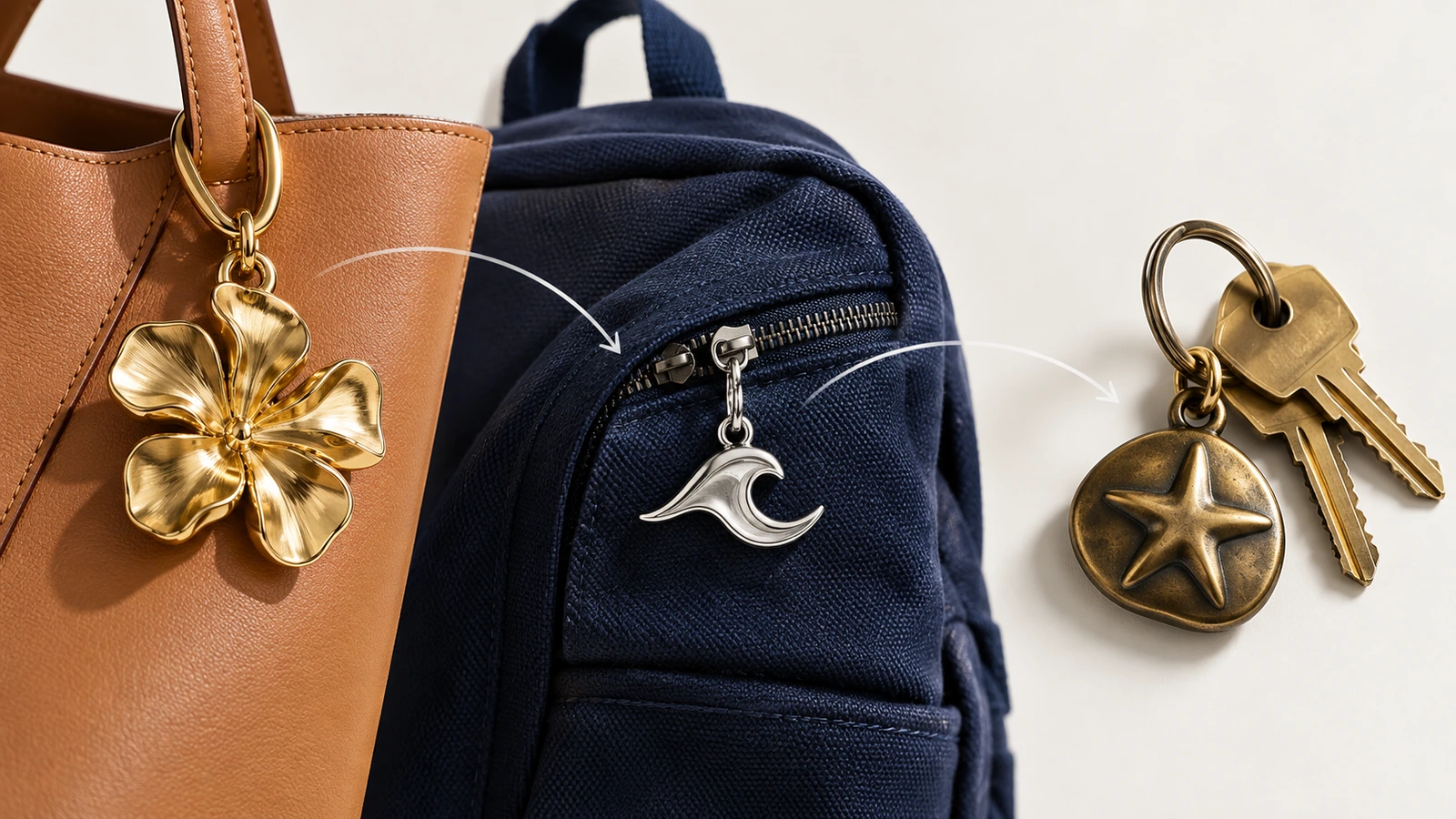
Charms appear in three main carry formats:
Bag charms hang from handbags, totes and backpack straps.
Zipper pulls attach to jacket, pencil-case or luggage zips.
Key-ring charms travel in a pocket alongside keys.
The same artwork can serve all three, but each format places different demands on size, weight and finish. That is why format comes first in the planning sequence below.
Most sculpted charms with irregular outlines and layered relief are cast in zinc alloy. If you need to understand how casting differs from stamping, that comparison is covered on our custom die cast keychains page, so it is not repeated here.
Why series planning matters now
Demand for branded merchandise is growing. The way it is bought is shifting toward collectible, personal pieces. North American promotional products distributors grew sales by 4.2% in 2025 to a record $27.7 billion, according to the Advertising Specialty Institute[1].
Globally, the picture is larger. A PPAI study with Oxford Economics estimated that $108.6 billion was spent on promotional products in 2025. That sits within $338.3 billion of total branded merchandise spending[2].
Younger buyers are a big part of the collectible shift. PPAI's consumer research on Gen Z[3] highlights personalization and self-expression as reasons promo items stay in use. Those are exactly the motivations that drive people to clip several charms onto one bag.
Market research included in this brief points the same way, though it does not come from a public source. Buyer reviews of metal charms repeatedly mention weight, detail and "conversation starter" value. Negative reviews cluster around peeling plating and broken rings. A series plan can exploit the first set of signals and design out the second.
How to plan a series of metal keychain charms: seven decisions
1. Choose the carry format before the artwork
Decide where the charm will live: on a bag handle, on a zipper, or on a key ring. If one series must cover several formats, assign each design a primary format.
A bag charm swings freely and knocks against buckles. It can be larger, bolder and more sculptural.
A zipper pull is tugged every time it is used, so its loop takes direct pulling force. A flatter back keeps it from snagging fabric.
A key-ring charm rubs against keys all day. Rounded edges and wear-tolerant finishes matter more than fine surface texture.
Choosing the format first prevents the most common rework: a beautiful sculpted design that is too heavy to work as a zipper pull.
2. Lock one size family for the whole series
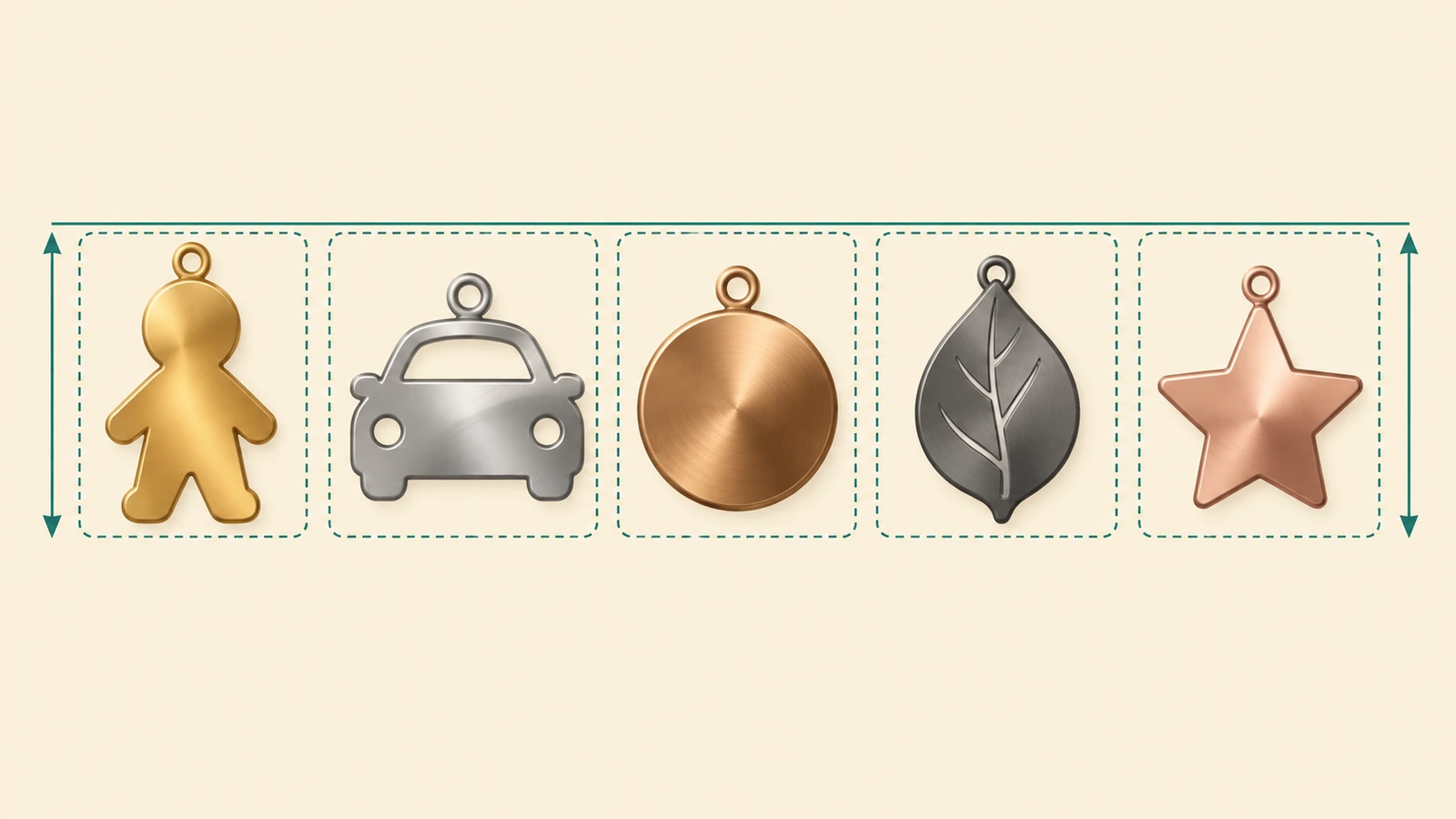
A series reads as a set when every piece shares a visual footprint. Define an invisible bounding frame that every design must fit. Then choose one anchor dimension to hold constant across the set: either all charms share the same height or all share the same width.
Silhouettes can vary inside that frame, such as a tall character next to a wide vehicle. The display shelf and the bag strap will still show a consistent rhythm.
Print every design at actual size on one sheet, cut them out and lay them side by side. Any piece that looks noticeably heavier or lighter than its neighbors needs adjusting before tooling, not after. The detailed trade-off between readable detail and comfortable carrying is covered on the product page. At this stage, only check the family resemblance.
3. Write shared design rules so the series holds together
Beyond size, collectors recognize a set through repeated details. Before designers sketch individual pieces, write down three to five rules every design must follow. Typical rules cover:
the same outline or border weight on every piece;
the loop in the same position, for example always top-center;
a common back design or texture shared by the whole series;
a consistent level of relief, so no single charm looks flat next to deeply sculpted siblings;
one recurring motif, such as a star, wave or brand icon, hidden somewhere on each design.
A shared back is especially practical. It gives the series a unifying signature, and it can carry series identification such as edition marks, which can be engraved or cast. It also reduces the number of unique surfaces to approve.
4. Structure the series: core, variant and chase
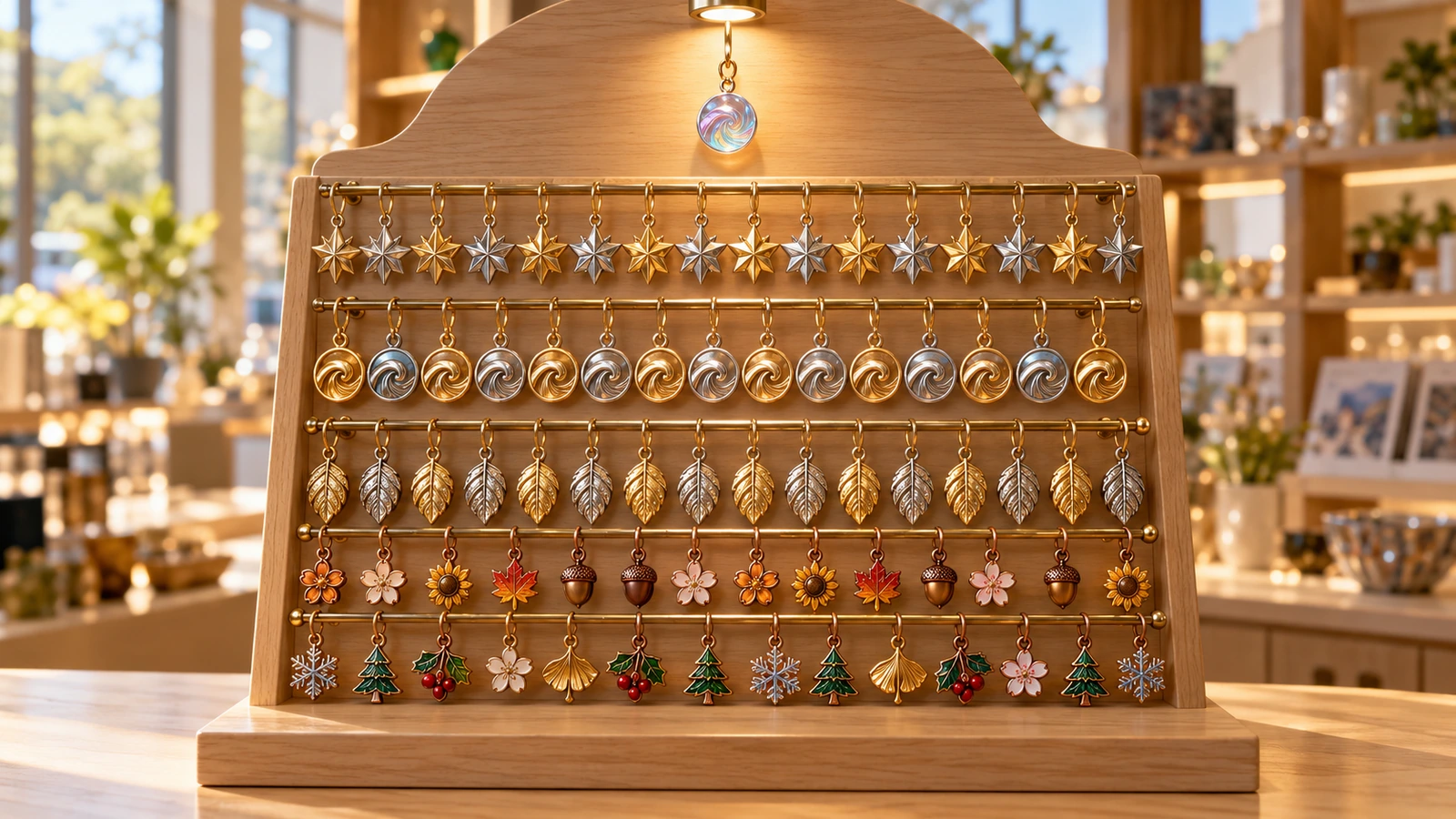
A useful first series typically contains four to eight designs, split into three roles.
Core designs (the majority). These are the evergreen pieces most buyers will see first, and they carry the brand story.
Variant designs. These are seasonal, regional or event-specific pieces that refresh the display without replacing the core.
A chase piece. This is one deliberately scarcer item, often a special colorway of a core design. It gives collectors a reason to keep buying.
Keep the first drop small enough that each design gets real shelf presence. It is easier to add a second wave to a series that sold through than to clear a twelve-design launch where half the pieces stalled. Number your series and waves from day one, for example series 1, wave 1. Later drops can then extend the set without confusing earlier buyers.
5. Use colorways for variety, not new shapes
New silhouettes add the most cost and risk. New colorways of an existing silhouette usually add far less, because they generally reuse the same tooling. Confirm this with your supplier for your specific construction.
That makes colorway the cheapest lever for variety. It only works if the palette is controlled.
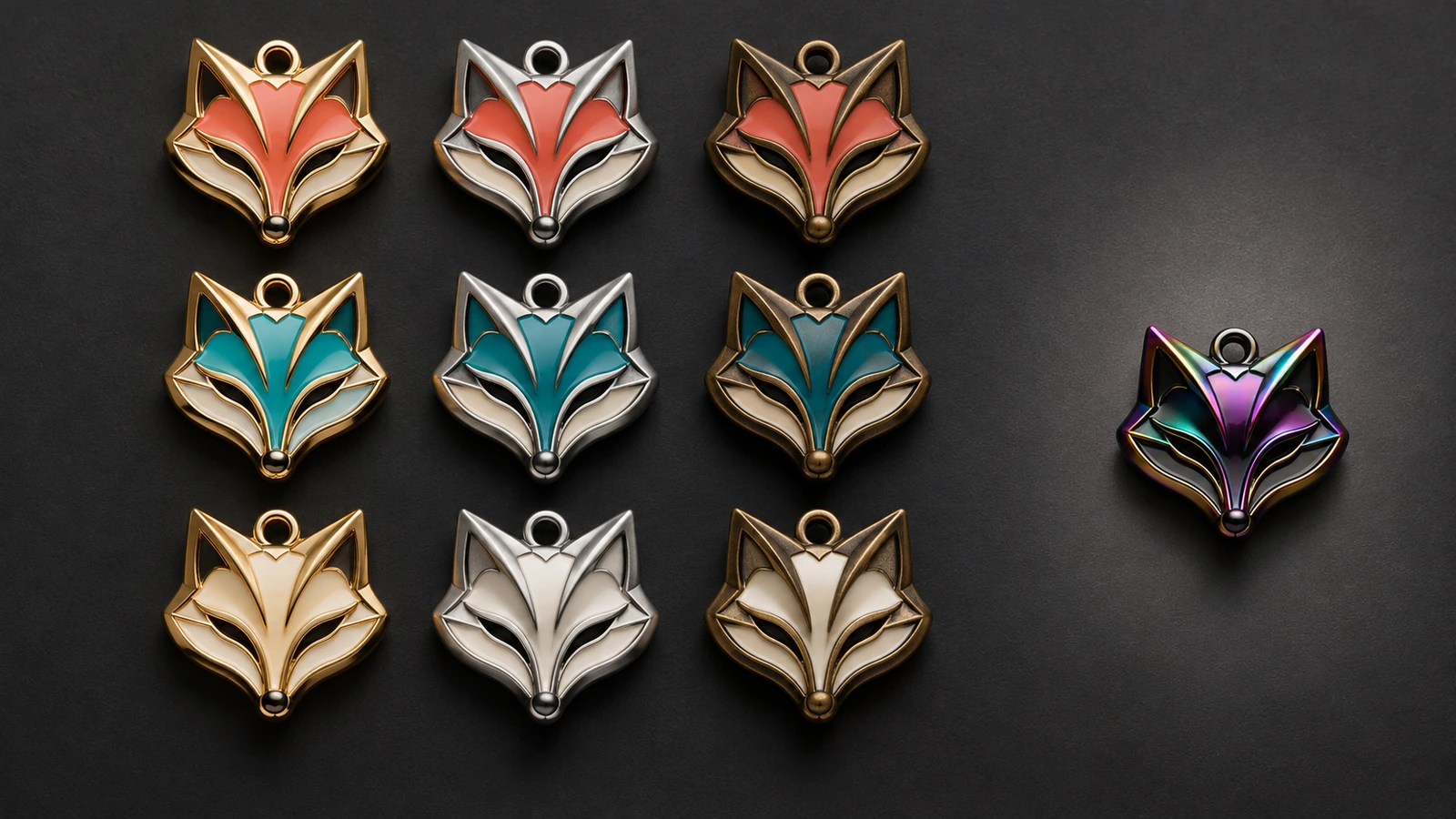
Lock a series palette. Choose a fixed set of metal tones and fill colors, then build every colorway from that set. Three or four metal tones plus a short list of fill colors can produce many combinations that still look related.
Change one variable per colorway. For example, keep the metal tone and swap the fill, or keep the fill and swap the metal. Changing everything at once makes the colorway look like a different product.
Reserve one finish for the chase. Use a metal tone or fill that appears nowhere else in the series, so collectors recognize the chase on sight.
Match finish to format. Bright, high-contrast colorways suit bag charms that are seen from a distance. Darker or antiqued tones hide abrasion better on key-ring charms.
How specific platings and color fills behave is a specification question, covered on the product page. At the series stage, decide only how many colorways each design gets and which colorway plays which role.
6. Set the assortment mix and display allocation
Assortment mix is the share of units each design and colorway receives. Treat it as a forecast you will correct, not a fixed ratio. As an illustrative starting point for a six-design series:
three core designs in two colorways each take most of the units;
two seasonal variants in a single colorway take a smaller share;
one chase colorway takes the smallest share.
Match the mix to how the charms will be sold:
Open assortment. Shoppers pick what they see, so allocation should follow expected popularity.
Blind or mystery packaging. The ratio itself is part of the product. Publish the odds, keep them consistent between production runs, and make sure each case pack contains the intended mix.
Corporate or event programs. Recipients usually receive one piece, so an even split across the core designs, or a pre-packed set, avoids "everyone wanted the blue one" problems.
Plan reorders at the same time. Decide which designs are permanent and which will be retired after a wave. Announcing retirement in advance is one of the few levers that creates collectibility without changing the product.
7. Pass a compliance gate before any drop
Charms are small, metal and sometimes handled by children. Regulators have a long history with this exact product type.
The problem is not only historical. A study in Occupational and Environmental Medicine[6] found that 64% of the items it tested contained more lead than the limits Minnesota set for keys. That Minnesota law restricting lead and cadmium in keys and similar items was still generating industry exemption requests in 2025[7].
Build these checks into the series plan:
Audience. Decide whether any design is marketed to, or likely to appeal to, children. That decision changes which requirements apply.
Product classification. The scope of ASTM F2999 for adult jewelry[8] excludes items whose primary purpose is functional, such as key chains. A bag charm sold purely as a fashion accessory may sit closer to jewelry, so confirm its classification with your compliance advisor.
Destination warnings. California's Proposition 65 enforcement has reached keychains before, as this 60-day notice[9] shows. Check labeling for each market you sell into.
Finish durability for exposed formats. Bag charms face rain and handling. Ask how plating durability is evaluated, for example against salt-spray methods such as ISO 9227[10], and agree what result you will accept.
Alloy documentation. Impure zinc alloys can suffer zinc pest[11], a slow intercrystalline corrosion that makes castings brittle. Request material documentation for the alloy used in every wave, not just the first.
Once the series plan is fixed, the next stage is turning each design into an approved specification, then sampling and inspection. That workflow is laid out on our custom die cast keychains page.
Comparing charm formats and series structures
The first table helps you assign each design a primary carry format. The second helps you choose how the series is sold.
Format
Carry context
Size priority within the family
Typical series role
Colorway tolerance
Main watch-out
Bag charm
Hangs from a handle or strap, seen at eye level
Largest; the silhouette must read from a distance
Hero designs, statement and chase colorways
High: bold, contrasting finishes work
Swing impact against hardware; weather exposure on plating
Zipper pull
Attached to a zip and pulled repeatedly
Smallest and flattest; must not snag
Entry-level add-on, high-volume core
Medium: stay within the core palette
Direct pulling force on the loop
Key-ring charm
In a pocket, rubbing against keys
Medium, with rounded edges
Everyday core designs
Lower: bright finishes show abrasion
Surface wear and ring failure
Series structure
How it works
Best for
Inventory risk
Planning note
Open assortment
All designs visible; the buyer chooses
Gift shops, museum and venue retail
Uneven sell-through by design
Allocate by expected popularity and rebalance on reorder
Numbered set
A fixed, labeled set (e.g. 1 of 6)
Brand loyalty programs, fan merchandise
Low if the set stays small
Shared design rules matter most here
Blind or mystery box
Contents hidden; published odds
Collector communities, IP drops
Medium: the ratio must hold across runs
Treat the chase ratio as part of the product
Seasonal drop
Time-limited waves added to a core
Retailers with a launch calendar
Low for the core, higher for variants
Announce retirements to build collectibility
FAQ
FAQ: How many designs should a first charm series have?
Four to eight is a practical range for a first wave. It is enough to feel like a collection, but small enough that each design earns visible display space and can be judged on sell-through. Grow the set with numbered waves rather than launching everything at once.
FAQ: Does every charm in a series have to be exactly the same size?
No, but every charm should fit the same bounding frame and share one anchor dimension, either height or width. Silhouettes can vary inside the frame. What breaks a set is a mix of footprints, where one piece looks like it belongs to a different product line.
FAQ: Are bag charms regulated like jewelry?
It depends on how they are classified and marketed. ASTM F2999 excludes functional items such as key chains, but a charm sold purely as a fashion accessory may be viewed differently. Lead and cadmium limits for children's products, and state laws such as Minnesota's, can apply regardless of classification. Confirm with a compliance advisor for each market.
FAQ: How do I make colorways feel collectible without diluting the brand?
Build every colorway from one locked series palette and change only one variable at a time, either the metal tone or the fill. Reserve a single finish that appears only on the chase piece, so collectors recognize it instantly and the core colorways stay on-brand.
FAQ: Can I add new designs to a series later?
Yes, provided the original size frame, loop position, back design and palette are documented as series rules. New waves that follow those rules extend the set. New waves that ignore them start a new one. Keep master artwork files and colorway references for every released design.
FAQ: Is a metallic keychain charm the same as a die-cast keychain?
"Metallic" describes the look and "die-cast" describes the manufacturing method. Many sculpted charms are die-cast in zinc alloy, but some metallic-looking pieces are stamped metal or coated plastic. If a heavy, all-metal feel is part of your brand promise, specify the construction explicitly.
Key takeaways
The market rewards branded merchandise that people keep using. North American promo distributor sales grew 4.2% to $27.7 billion in 2025 (Source).
Charms compete in a large global category, so the series concept is what differentiates them. An estimated $108.6 billion was spent on promotional products worldwide in 2025 (Source).
Lead in small metal charms is a documented, recurring recall trigger. About 396,000 metal key chains were recalled in a single 2007 action (Source).
Compliance testing belongs in the plan, not the post-mortem. 64% of items in one study exceeded Minnesota's lead limits for keys (Source).
Variety should come mainly from colorways, with new shapes added deliberately. Four to eight designs on one size frame, with one chase piece, form a manageable first wave (planning guideline from this article; durability reference: Source).
Conclusion: plan the set, then specify the pieces
A successful charm line comes from decisions made before any artwork goes to a factory. Settle these six in order:
the carry format each design is made for;
the size family every design fits;
the shared design rules;
the core, variant and chase roles;
the colorway palette and assortment mix;
the compliance gate for each drop.
With those written down, every individual design has clear boundaries, and later waves can extend the set instead of fragmenting it.
When your series plan is ready, take it to the specification stage. Our custom die cast keychains page explains how to turn each design into an approved specification, sample and inspection plan. Send your series outline for a quotation on tooling, colorways and assortment packing.
Footnotes
Advertising Specialty Institute (ASI), "North America Promo Industry Grows 4% in 2025," press release, January 21, 2026. asicentral.com. Accessed October 2026. ↩
PPAI and Oxford Economics, "Global Economic Impact Study Reveals Branded Merch's $472 Billion Footprint," September 8, 2026. ppai.org. Accessed October 2026. ↩
PPAI, "PPAI Consumer Study: Why Promo Clicks with Gen Z." ppai.org. Accessed October 2026. ↩
U.S. Consumer Product Safety Commission, "Wal-Mart Recalls Charm Key Chains Due to Risk of Lead Exposure," 2008. cpsc.gov. Accessed October 2026. ↩
U.S. Consumer Product Safety Commission, "Various Metal Key Chains Recalled by Dollar General for Lead Poisoning Hazard," April 2007. cpsc.gov. Accessed October 2026. ↩
Occupational and Environmental Medicine (BMJ), vol. 81, issue 11, p. 592. oem.bmj.com. Accessed October 2026. ↩
Axios Twin Cities, "Minnesota key makers seek metal ban exemption," April 9, 2025. axios.com. Accessed October 2026. ↩
ASTM International, ASTM F2999, Standard Consumer Safety Specification for Adult Jewelry. astm.org. Accessed October 2026. ↩
State of California, Office of the Attorney General, Proposition 65 60-Day Notice 2013-00806. oag.ca.gov. Accessed October 2026. ↩
International Organization for Standardization, ISO 9227, Corrosion tests in artificial atmospheres — Salt spray tests. iso.org. Accessed October 2026. ↩
Hi there! I'm Bruce, proud dad to my amazing son. I'm the founder of Zigpac, a printing and packaging company empowering small and medium-sized businesses with custom solutions. Let's create something great together!



 Blog PDF for offline reading












The information below is required for social login
Sign In
Create New Account