


 Blog PDF for offline reading
Quick answer: Order pre printed labels on a roll from a converter when one design repeats across long runs, needs full color or a laminated film finish, and rarely changes. Print blank roll stock in-house with a thermal-transfer printer when you run many SKUs in short batches or when most of the label is lot codes, dates, weights or barcodes. Many food, beverage and personal-care lines use both: converter-printed rolls for the brand panel, with variable data overprinted in-house.
The choice usually gets framed as "buy finished labels or buy a printer." That framing hides the real cost drivers. This guide compares the two routes on five measurable factors: SKU count, how much of each label is variable data, run length per artwork version, total cost per applied label, and the ways each route can stop your line. It is written for the person who owns the filling or packing schedule, not the person choosing colors.
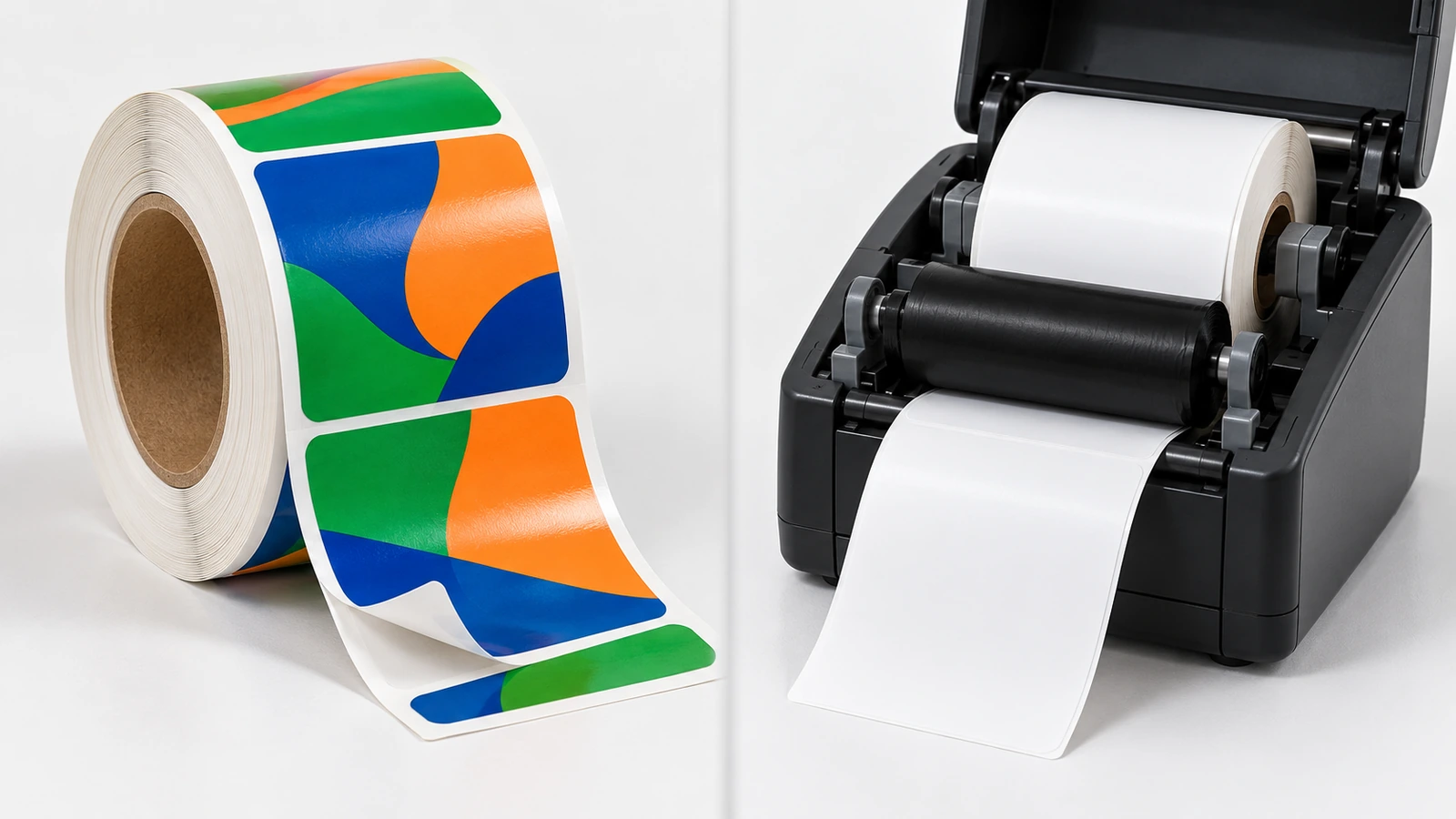
Why the roll-label decision often goes wrong
Most teams compare a converter's unit-price quote against the cost of a box of blank labels and a ribbon. That comparison leaves out three expensive things: inventory that becomes obsolete, labor at the printer, and minutes of stopped line time.
Obsolescence is the cost teams most often miss. Healthcare packaging analysts describe pre-printed label stock that sits in a warehouse until a regulatory update, artwork correction or discontinued product forces its destruction[1]. Food brands saw a concrete example in 2026. California's AB 660 requires standardized date phrases ("BEST if Used by", "USE by") on food manufactured on or after July 1, 2026, and bars consumer-facing "sell by" wording[2]. Any roll with an old date phrase printed into the static artwork became scrap for California-bound product.
Downtime is the second missed cost. Buyer complaints in our research describe 500 labels delivered as four rolls of 125, which meant stopping the applicator every 125 labels to reload. They also describe adhesive oozing from label edges until the applicator had to be cleaned roughly every 100 labels. In-house printing fails in different ways: a worn printhead, a ribbon that runs out mid-batch, or an operator who loads the wrong template. Neither route is risk-free. They put the risk in different places.
The fix is to decide field by field and SKU by SKU, using a cost-per-applied-label model rather than a quote comparison.
Pre-printed rolls vs. blank roll stock: what each route means
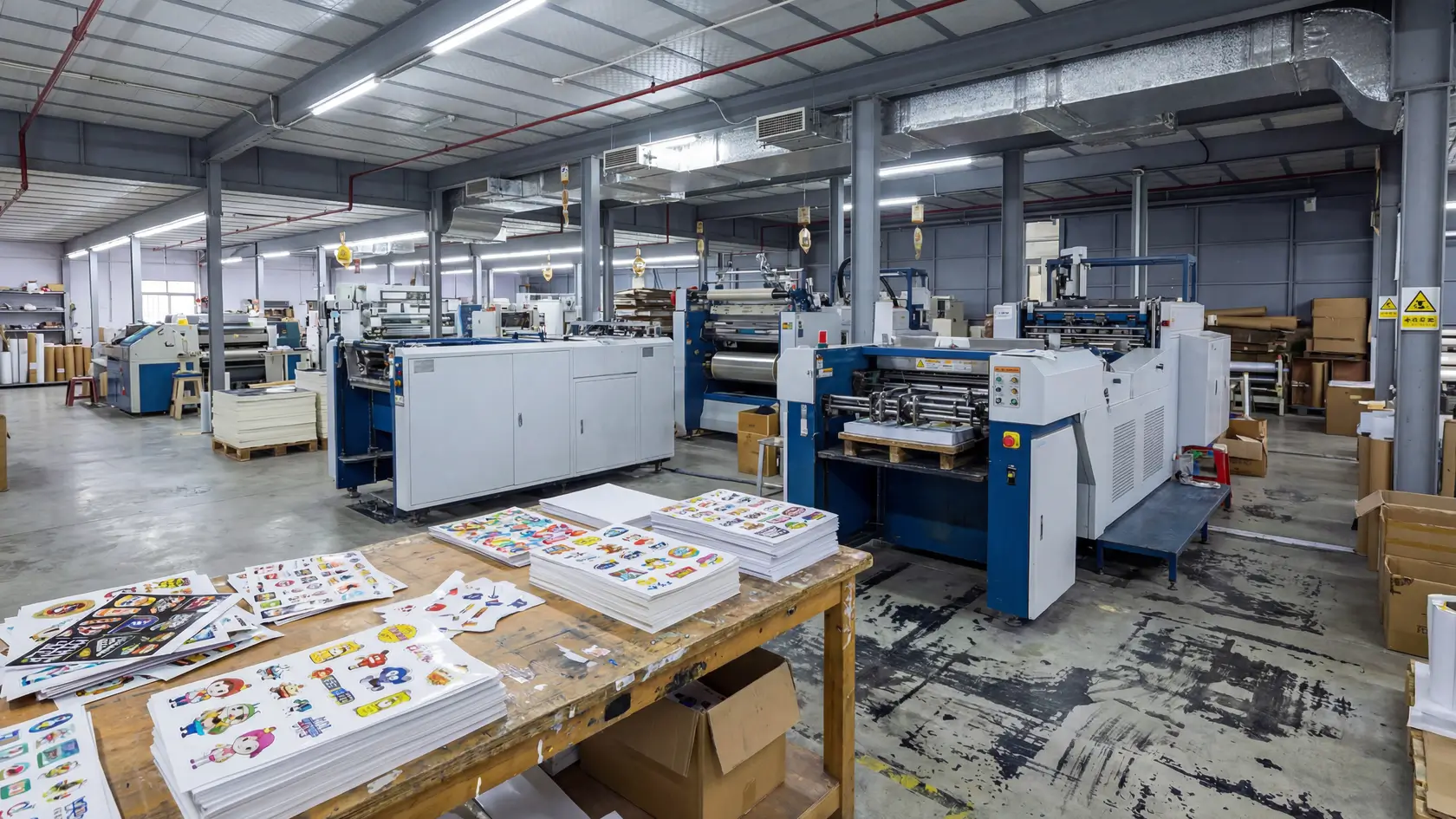
Converter-printed rolls (also called printed roll labels) arrive with the graphics already applied. A converter prints the label on flexo or digital presses, often adds a laminate or varnish, die-cuts it, and rewinds it onto cores to your unwind spec. Inks are cured at press speed, so color, coverage and scuff resistance are usually better than a desktop device can produce. In exchange, every artwork change becomes a new production job. If you want to understand the construction itself (facestock, adhesive and liner), our product page explains how a pressure-sensitive roll label is built. This guide does not repeat that material.
Blank roll stock is the same pressure-sensitive construction without graphics. You print it at the point of use, and there are three common technologies:
- Thermal transfer: a heated printhead melts ink from a ribbon onto the label. It is durable, sharp enough for barcodes, and with resin ribbons it bonds well to film. Output is usually one color.
- Direct thermal: heat-sensitive paper darkens under the printhead, so no ribbon is needed. The image fades with heat and light, which makes it suitable for shipping labels but a poor fit for anything that sits on a shelf.
- Desktop color inkjet roll printers: full color in short runs. Throughput, ink cost per label and water resistance depend heavily on the stock and the coating.
The market context matters for timing. Smithers reports that pressure-sensitive labels account for 61.9% of the packaging label market by value[3]. Digital printing's share of label volume is forecast to rise from 7.0% in 2024 to 11.3% in 2030, and flexo still produces more than 40% of output. As converters add digital capacity, short-run pre-printed jobs get cheaper. That shifts the break-even point you may have calculated a few years ago.
How to decide in six steps
- Count artwork versions, not products. Every flavor × size × market × regulatory variant is a separate version. A product line with 6 flavors, 2 sizes and a separate California date panel has 24 versions, not 6. Pre-printed economics depend on volume per version.
- Split every label into static and variable fields. Static fields are brand art, ingredient panels and color blocks. Variable fields are lot code, date, net weight, price, serial number and barcode. Under FDA's food traceability rule, foods on the Food Traceability List must carry a Traceability Lot Code through key events, with enforcement deferred to no earlier than July 20, 2028[4]. Fields like this cannot be pre-printed, so a label that is mostly variable data points toward in-house printing.
- Measure months of cover against your artwork change cycle. Divide the quantity you would order for a version by its monthly usage. If that stock would last longer than the version usually goes between artwork changes, the gap is probable write-off. Count it as a cost.
- Build a cost-per-applied-label model. Use the formula in the box below. Include labor and waste, not just consumables.
- Score downtime exposure. Estimate what one stopped hour costs you, multiply by the likely stoppages for each route (see the downtime section), and add the result to the model.
- Pilot before committing. Run a short converter job and an in-house batch on the same SKU. Apply both to real containers, then check edges, scuffing and code legibility after at least 48 hours of dwell. Adhesive bond builds over time, so same-day checks can mislead you.
Cost per applied label = (label or blank-stock cost + ribbon/ink + print labor + equipment amortization + changeover time + scrapped labels + obsolete inventory + downtime cost) ÷ labels that reach a saleable package.
Run the model for each artwork version separately. When converter pricing is involved, ask for a quote at your real annual volume per version. The quantity on a quick quote form is rarely the right input.
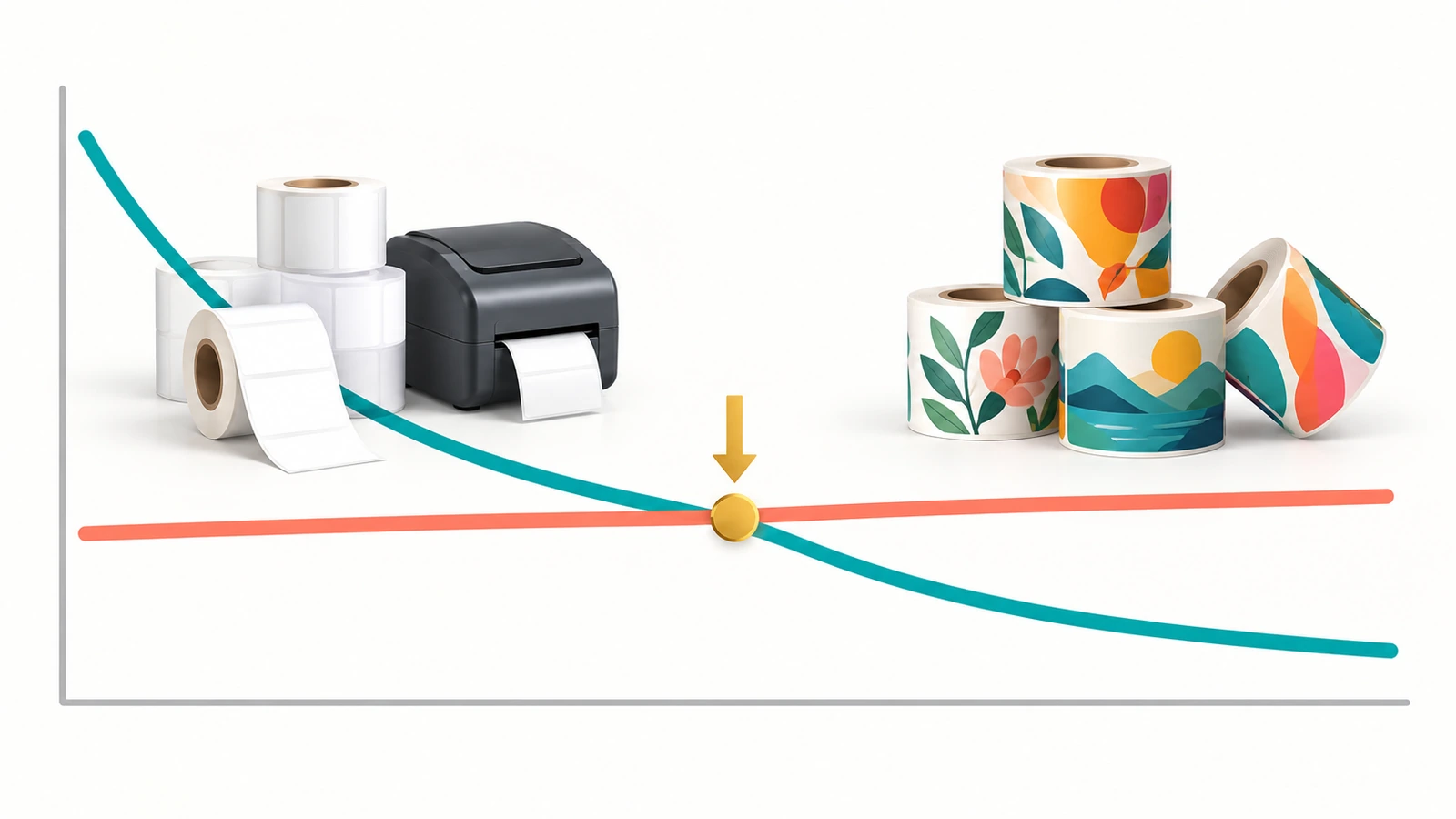
When pre printed labels on a roll win, and when they don't
| Factor | Leans to converter-printed rolls | Leans to in-house blank stock | Hybrid fit |
|---|---|---|---|
| SKU / artwork versions | Few versions, each with steady volume | Many versions, frequent launches or seasonal variants | Shared base design across versions, with variant details overprinted |
| Variable data share | Little or none (brand panel only) | Most of the label is lot, date, weight, price or serial data | Static brand art plus a small variable window |
| Run length per version | Long, with stable forecasts | Short, irregular or made to order | Long base runs, short variable batches |
| Color and finish | Full color, spot colors, metallics, laminate | One-color text and barcodes (thermal transfer); basic color (inkjet) | Premium base print with monochrome codes |
| Durability | Cured inks and laminate resist scuffing, oil and condensation | Resin thermal transfer on film is durable; direct thermal is not shelf-durable | Depends on whether ribbon and topcoat are compatible |
| Capital and labor | No printer to buy; receive, store, load | Printer, spare printheads, ribbons, operator time | One printer per line, but less print time per label |
| Obsolescence risk | High if artwork or regulations change mid-stock | Low: blank stock is generic | Moderate: only the base art can become obsolete |
| Typical failure modes | Split rolls, wrong unwind, adhesive ooze, late delivery | Printhead wear, ribbon mismatch, wrong template, faded codes | Smearing if the ribbon doesn't suit the topcoat |
A practical reading of the table: if you would answer "converter" on four or more rows for a version, buy that version pre-printed. If variable data and version count both point in-house, keep that SKU on blank stock until volume stabilizes. Most mixed results point to the hybrid route described next.
Two technical checks apply to both routes. First, the adhesive question is the same whether you buy labels by the roll pre-printed or blank. For food packaging, suppliers usually cite 21 CFR 175.105, which governs adhesives used in food packaging[5]. That regulation covers the adhesive under defined indirect-contact conditions. It does not certify the whole label, and it does not cover direct application to food. Second, when a supplier says a label is "peel tested," ask which method was used. ASTM D3330 measures peel adhesion of pressure-sensitive tapes[6], and its own text notes that peel values do not map directly to end-use performance. FINAT FTM 1 measures 180° peel at 300 mm/min for labels[7] and allows longer dwell times. Results from the two methods cannot be compared directly.
The hybrid route: converter rolls plus in-house overprint
The most common answer for food, coffee, supplement and personal-care lines is to buy printed labels on rolls with a deliberately empty zone, then print lot, date and price data on the line with a thermal-transfer unit. Practitioners report this gives them shelf-quality branding while keeping variable data flexible. It also limits obsolescence to the brand art, which changes far less often than dates or compliance wording.
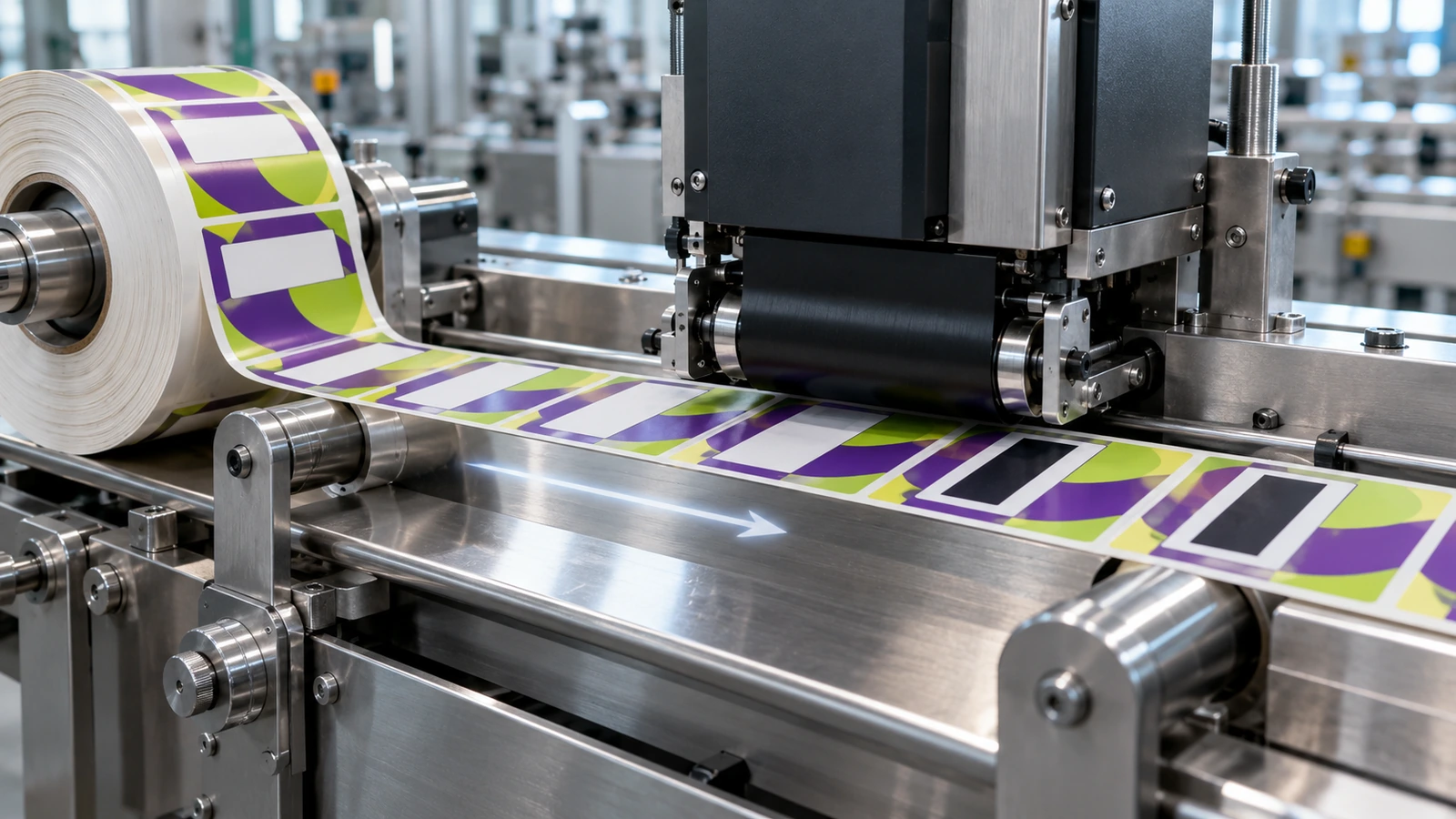
Getting the hybrid right takes three specifications agreed with the converter before the first press run:
- A print-receptive window. Laminated or heavily varnished film can reject wax and wax-resin ribbons. Either leave the variable window unvarnished or confirm a resin ribbon bonds to the topcoat. Test with a tape pull and an alcohol rub before approving.
- Window position relative to the printhead. The empty zone has to line up with where your printer prints as the label travels through. Give the converter your printer's print-area offset, not just the label size.
- Barcode quality if a code is printed in-house. Retail and logistics barcodes follow the GS1 General Specifications (Release 26.0, January 2026)[8]. Linear-code print quality is graded under ISO/IEC 15416:2025[9]. Industry guides commonly cite grade C (2.0) as the retail minimum, but confirm the requirement for your symbol in the GS1 tables. Verify codes at the start of each shift, because printhead wear shows up first as failing bars.
Teams that print variable data in-house can also look at liner reduction. Linerless labels made up about 6% of global pressure-sensitive label volume in 2025[10], growing at a high single-digit rate. They need compatible printers, so treat them as an equipment decision rather than a label swap.
Line-downtime risk by route
Downtime is where the two routes differ most, and it rarely appears in a quote. List the failure modes for each route and assign an owner to each one.
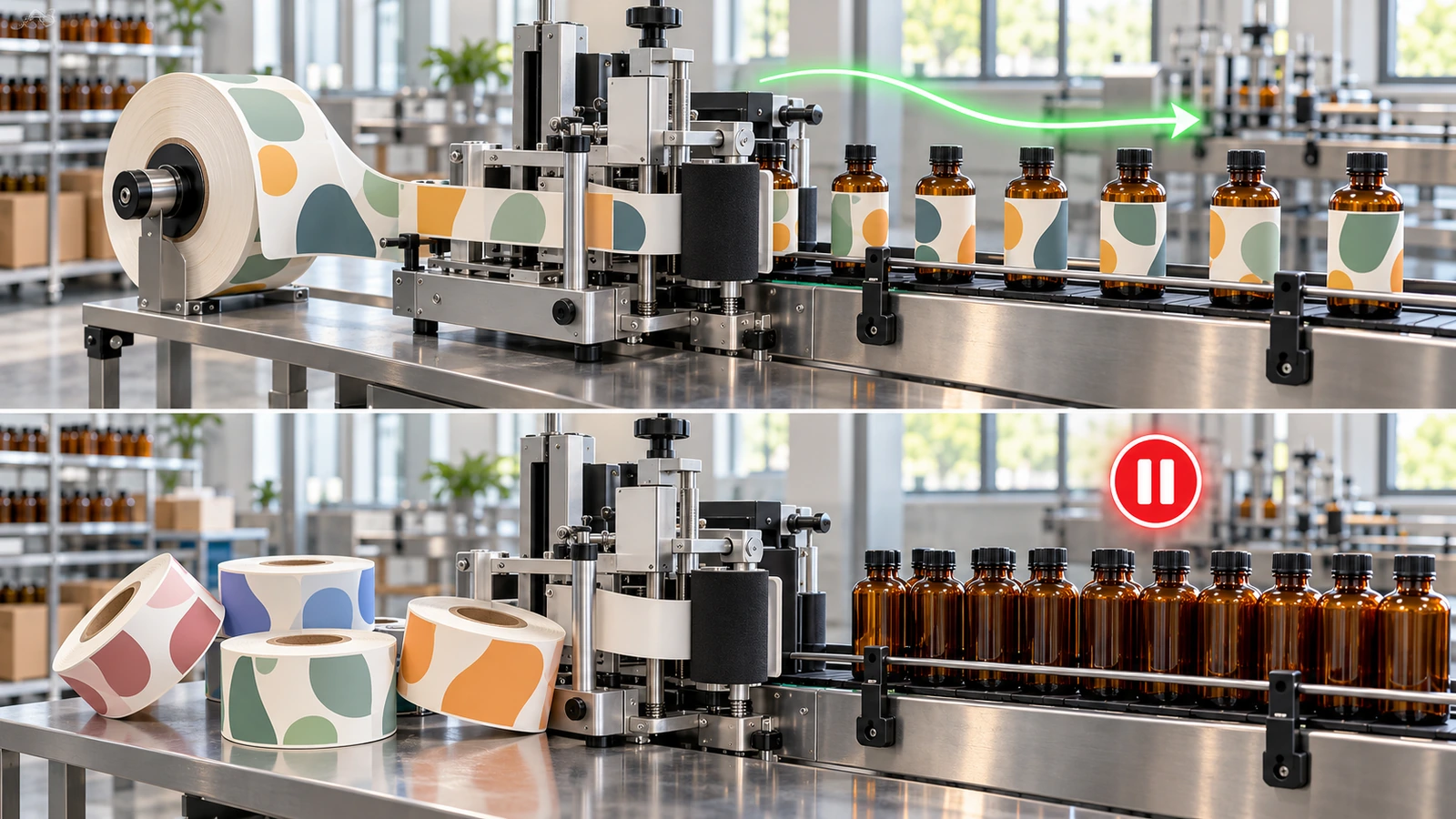
Converter-printed rolls fail at handover. The common problems are the wrong unwind direction, cores or outer diameters that don't fit your applicator, orders split into small rolls, and adhesive that migrates to die-cut edges. Most of these are prevented by a written roll specification. Our product page covers how to specify a roll that runs on day one, so the checklist isn't repeated here. Adhesive ooze is a formulation issue. A 2023 PSTC technical paper flags lab static shear below roughly 1,000 minutes (1 in × 1 in × 1 kg) as a warning sign for buildup on dies and rollers[11]. You can reasonably ask your converter about this. Delivery timing is also a risk. Keep safety stock sized to cover your longest realistic reorder cycle, including proof approval time.
In-house printing fails during operation. Printheads wear and start dropping dots, which damages barcodes first. Ribbons that are shorter than the label roll force an extra changeover mid-roll. Operators can select the wrong template or date format, which is a compliance error rather than a cosmetic one. Mitigate these by matching ribbon length to label count, locking templates so operators choose from a list instead of typing, and stocking a spare printhead for each line. Never use direct thermal stock for anything that will sit on a shelf or near heat.
A useful exercise is to estimate stoppages per 10,000 labels for each route from your own records, multiply by your cost per stopped hour, and add that figure to the cost-per-applied-label model. The route with the lower quote often loses once downtime is counted.
FAQ
FAQ: Can I add lot codes and dates to pre-printed roll labels?
Yes. Ask the converter to leave an unvarnished or print-receptive window and confirm your thermal-transfer ribbon bonds to it. Test with a tape pull and an alcohol rub before you approve the first production run.
FAQ: Should I use thermal transfer or direct thermal for in-house roll labels printing?
Use thermal transfer for anything on a retail shelf, in a cold chain or exposed to light. Direct thermal images fade with heat and light, so they suit short-life shipping and logistics labels, not product labels.
FAQ: Is a desktop color roll printer a substitute for converter printing?
It works for very short runs, prototypes and frequent seasonal variants. For long runs, compare ink cost per label, print speed and water resistance on your actual containers against a converter quote at your real volume per version.
FAQ: How many SKUs justify printing in-house?
There is no universal threshold. What matters is volume per artwork version and how often each version changes. If ordered stock would outlast your typical artwork lifespan, the obsolescence cost alone often favors blank stock or the hybrid route.
FAQ: Does printing in-house make compliance easier?
It makes changes faster, for example switching date phrases for California AB 660. It also makes your team responsible for template control, barcode verification and adhesive suitability, which a converter would otherwise share.
FAQ: What minimum order and lead time should I expect for pre-printed rolls?
They depend on size, material, finish and roll specification. Request a quote with your annual volume per artwork version and your applicator details so the figures reflect your actual job.
Key takeaways
- Short-run pre-printed jobs are getting cheaper, so revisit old break-even math. Digital's share of label volume is forecast to rise from 7.0% (2024) to 11.3% (2030) (Source)
- Regulatory wording changes can turn pre-printed stock into scrap. California's standardized date terms apply to food made on or after July 1, 2026 (Source)
- Traceability codes are variable data, so plan an in-house print step. FDA enforcement of the Food Traceability Rule is deferred to no earlier than July 20, 2028 (Source)
- Barcodes printed in-house need regular verification, not a single check at setup. Print quality is graded under ISO/IEC 15416:2025 (Source)
- Ask converters about adhesive shear to reduce ooze on your applicator. A PSTC paper flags static shear below about 1,000 minutes as a warning sign (Source)
- Pressure-sensitive remains the dominant label format whichever route you choose. It accounts for 61.9% of the packaging label market by value (Source)
Conclusion
Don't make this decision at the company level. Make it for each artwork version, and judge it by cost per applied label, including inventory write-offs and downtime. Stable, high-volume, full-color designs belong on converter rolls. Volatile, data-heavy, short-run SKUs belong on blank stock. Everything in between is a candidate for the hybrid route. When your analysis points to converter-printed rolls, send us your container, applicator details and volume per version, and we will quote custom roll labels specified for your line.
Footnotes
- Healthcare Packaging, "The Label Nobody Counted: Why Labeling Is Regulated Packaging's Overlooked Sustainability Problem." ↩
- California Legislative Information, AB 660 (Food and Agricultural Code §82001), effective July 1, 2026. ↩
- Smithers, "Significant growth for printed packaging labels," May 2025. ↩
- U.S. FDA, FSMA Final Rule on Requirements for Additional Traceability Records for Certain Foods. ↩
- eCFR, 21 CFR Part 175 Subpart B, §175.105 Adhesives. ↩
- ANSI Webstore, ASTM D3330/D3330M-04(2025), Standard Test Method for Peel Adhesion of Pressure-Sensitive Tape. ↩
- FINAT, Test Methods (FTM 1 and related methods). ↩
- GS1, General Specifications, Release 26.0, January 2026. ↩
- ISO, ISO/IEC 15416:2025, Bar code print quality test specification for linear symbols. ↩
- Label & Narrow Web, "Linerless labels," October 2026. ↩
- PSTC, "Identifying the Right Pressure Sensitive Adhesive for Filmic Applications," May 2023. ↩









The information below is required for social login
Sign In
Create New Account