


 Blog PDF for offline reading
Quick answer: A puffy sticker is a printed film laminated over a soft foam or PU core with a pressure-sensitive adhesive. It needs different handling from flat vinyl once it arrives. It bonds best to clean, dry, smooth surfaces that are flat or only gently curved, applied at room temperature, with pressure on the perimeter rather than the dome, and about 24 hours of dwell time before stress. Store sheets flat in their sleeves, in cool, dry, dark conditions, and use them first-in, first-out. Heat, tight curves, heavy stacking, abrasion and long soaks are what flatten domes and lift edges.
The cartons arrive and every sheet looks right. Three weeks later the picture changes. Corners are lifting on the seals of a batch of coffee bags. Sheets stored near the loading dock have domes that stay dented. Jars packed in a warm fulfillment room show a thin ring of adhesive squeezed past the cut line. None of these are print defects. They are handling problems, and they show up after the proof has been approved and the invoice paid.
The cost lands on the brand. Packed orders get reworked, influencer mailers arrive with peeling seals, and customers read a lifting corner as a sign of cheap packaging. The risk is growing because raised stickers are moving out of children's stationery and onto adult packaging and merch. NHK reported that one Japanese maker shipped 22 million 3D bubble-sticker sheets between September 2025 and the end of March 2026, with demand spread across children, young adults and adults22 million 3D bubble-sticker sheets[1]. More brands are now putting soft, raised stickers on jars, tins, boxes and bottles, and those surfaces behave very differently from a sticker album.
This guide starts the day the cartons arrive. It covers inspection, application, surface matching, storage, heat, humidity and shelf life. If you are still choosing a format or planning a run, the custom puffy sticker sheets page covers construction, ordering and format selection.
What Changes in a Puffy Sticker After It Leaves the Factory?
A flat vinyl sticker is essentially a printed surface. A puffy sticker, or puff sticker as some buyers call it, is a small object with depth, and it compresses under a fingertip. That depth introduces three properties that keep changing after delivery. Each one fails in its own way.
- Dome recovery. The soft core should spring back after it is pressed. Sustained weight, such as heavy carton stacks, crushes it slowly. Heat softens it, and repeated sharp bending can crack it internally so it loses its bounce for good.
- Adhesive bond. Pressure-sensitive adhesive builds strength with pressure and time and loses strength with heat, cold, dust and moisture. The core adds mass and stiffness that a flat label does not have. Each time the substrate flexes or the temperature swings, that mass pulls on the bond, and the corners are the first place to let go.
- Film-to-core lamination. The cut edge exposes the core, so the layers can separate there. Collectors of vintage foam stickers describe the classic end state: the printed face peels away and leaves a foam outline still glued to the surface. Abrasion, moisture at the edge and plasticizer migration all speed that up.
Everything below aims to protect these three properties, from receiving through storage to the moment the sticker is pressed onto a box.
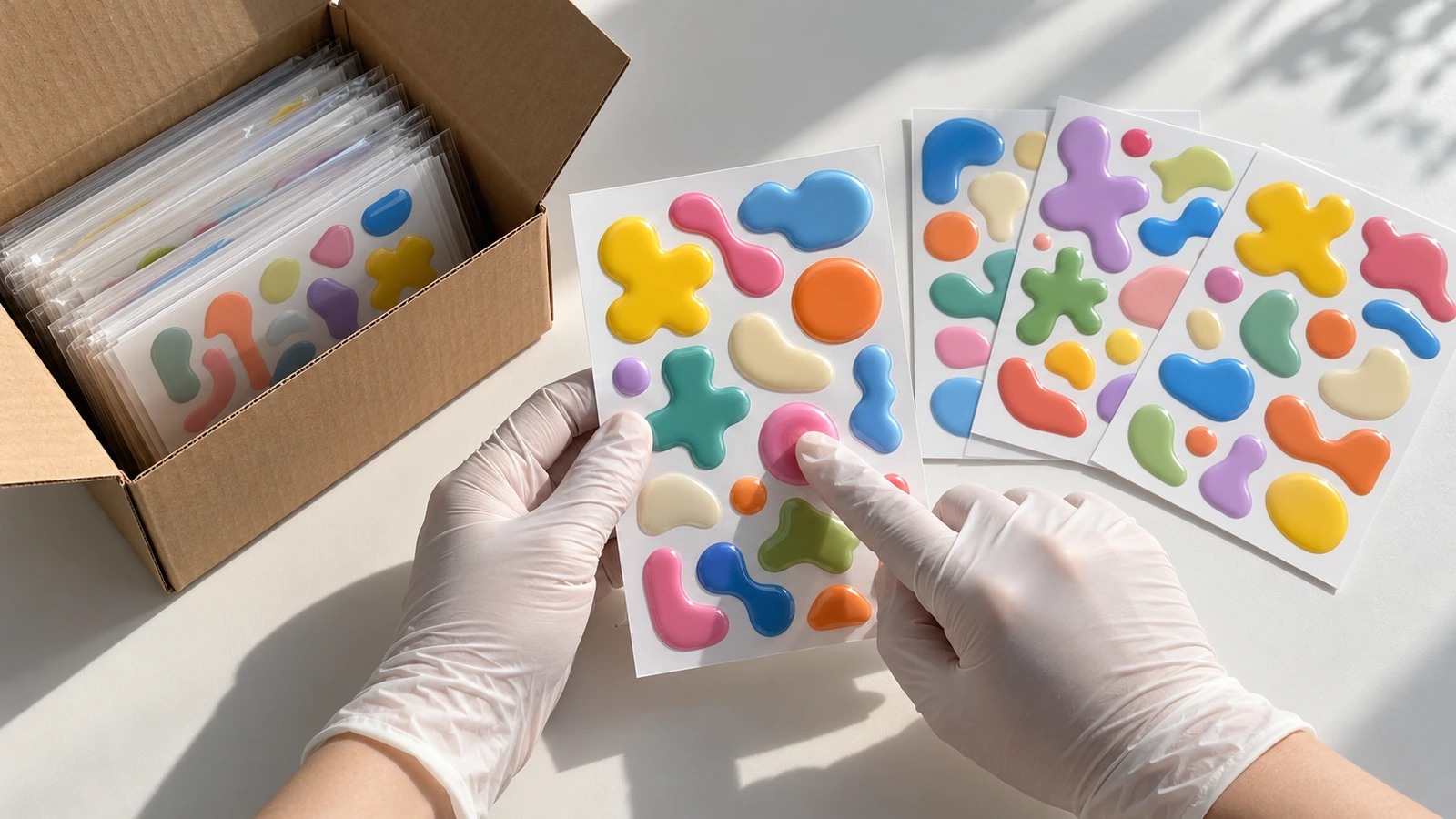
How to Inspect a Puffy Sticker Shipment on Arrival
Most suppliers set a short window for damage and misprint claims, so do this check in the first week, not when the stock is first needed. Budget about 30 minutes per lot.
- Read the cartons before opening them. Note crushed corners, damp patches or cartons that feel warm. A carton that sat in a hot truck is the one to sample most heavily.
- Pull sheets from the top, middle and bottom of each carton. Stacking pressure is highest at the bottom, so dome damage concentrates there. One sheet from the top tells you little about the lot.
- Run a dome recovery check. Press the center of three stickers per sheet with a fingertip for about two seconds, then release. A healthy core rebounds within moments. If a dent stays, record which carton position it came from.
- Inspect the edges under raking light. Look for the film lifting from the core, adhesive squeezed past the cut line (a sign of heat or pressure in transit), and cut lines that drift off the artwork.
- Peel five stickers by hand. Note whether the liner releases cleanly and whether small kiss-cut pieces tear or stretch. Peel difficulty that seems minor at five stickers becomes hours of labor on a full packing run.
- Apply three stickers to your real packaging. Use the exact box finish, jar or bottle, and write the date beside each one. Check them at 24 and 72 hours for corner lift and edge gaps.
- Keep a reference sheet per lot. Bag it, label it with the lot or PO, and store it with your quality records. When a complaint arrives months later, this sheet shows whether the stock changed or the handling did.
How to Apply Raised Stickers So the Edges Stay Down
Application technique decides most adhesion complaints. The goal is full adhesive contact at the perimeter without crushing the core.
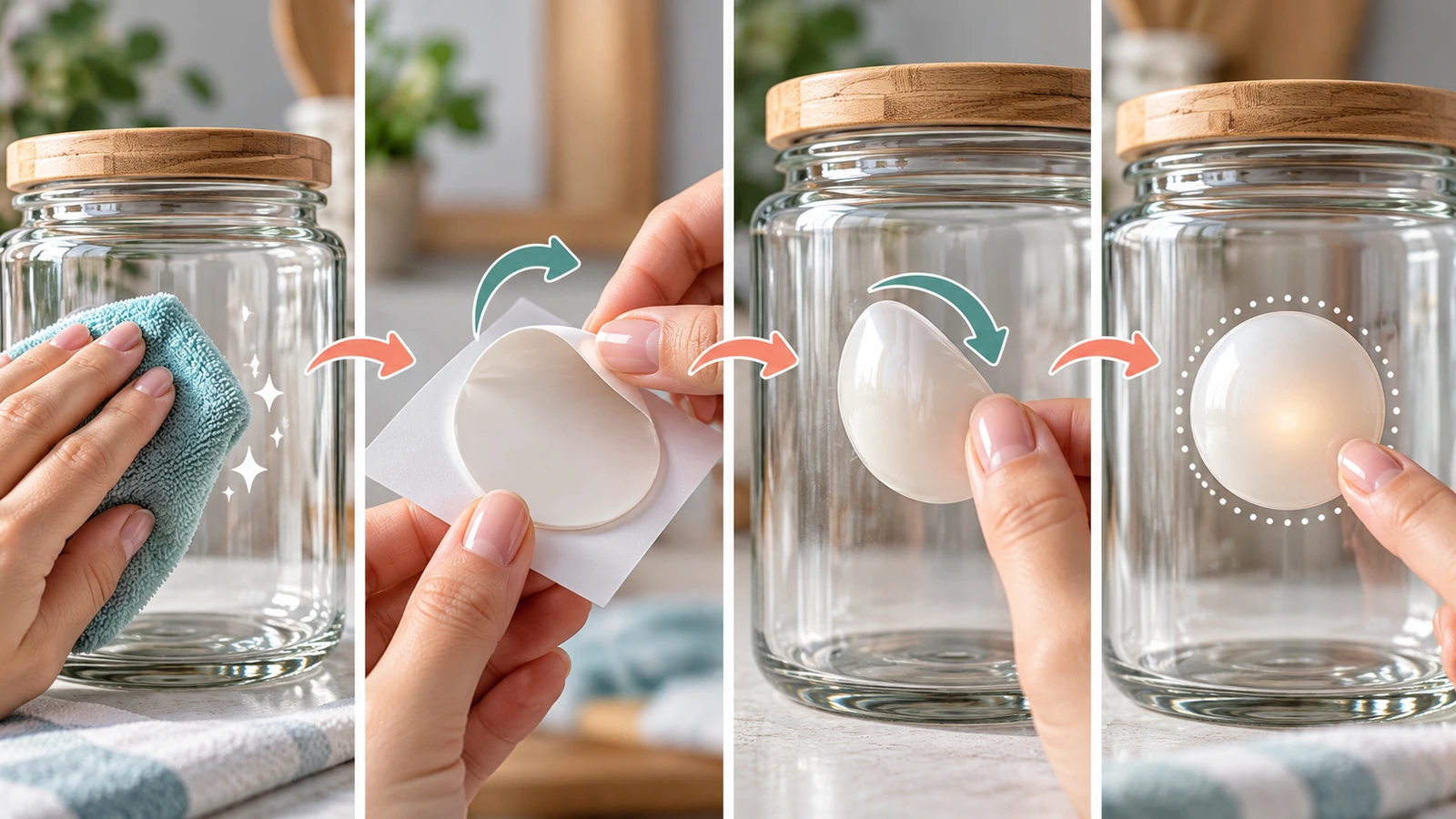
- Let materials reach room temperature. Sheets delivered in winter, and jars or tins straight from cold storage, should warm up before use. Cold adhesive has low initial tack, and cold glass or metal collects condensation that breaks the bond. The reverse applies too: do not apply to containers still warm from hot filling.
- Clean non-porous surfaces. Wipe glass, metal and smooth plastic with isopropyl alcohol and let it evaporate completely. Avoid household sprays that leave silicone or wax films. On cartons, brush off dust and paper fibers.
- Peel at a low angle from one corner. Bending the sticker sharply back on itself creases the core and starts lamination failure before the sticker has touched the package.
- Hinge it into place. Align one edge, then lay the rest down in a single motion. Lifting and repositioning picks up dust and weakens the adhesive face.
- Press the perimeter, not the dome. Run a fingertip or a soft roller firmly around the edge. Heavy pressure on the center adds little to the bond and can leave a permanent dent.
- Allow dwell time before stress. Where the schedule allows, give the adhesive about 24 hours before shrink wrapping, refrigeration, stacking or shipping. The bond keeps building during that time, and long-term journal users report the same effect.
- Set up a jig for volume runs. A simple guide block keeps placement consistent and keeps fingers off the adhesive. Clean gloves help on glossy finishes that show prints.
The curve check
Gentle curves work. Tight curves pull the edges up over time. The core resists bending, and that springback acts against the adhesive every hour the sticker sits on a curve. Before committing a full run, apply five stickers to the actual container. On round bottles, orient the longer dimension along the height of the bottle, where the surface is straight, rather than around the circumference. Keep the samples in the warmest room in your facility for 72 hours. If any corner lifts, move the sticker to a flatter panel, use a smaller sticker on that surface, or switch to flat vinyl.

Storage, Heat, Humidity and Shelf Life
Puffy stickers age in storage in ways flat labels do not. The core can be crushed, and the soft materials respond to heat. The table summarizes the conditions that matter most.
| Storage condition | Effect on the dome | Effect on the adhesive | What to do |
|---|---|---|---|
| Heavy stacking or cartons loaded on top | Slow flattening; may not fully recover | Pushed toward cut edges, causing ooze and sheets sticking together | Store sheets flat in their sleeves and keep stack height low; never place other cartons on top |
| Heat (vehicles, upper racking, summer containers) | Core softens and deforms; supplier technical notes commonly flag softening around 120°F (49°C) | Softens, flows past the cut line, transfers to the liner back | Keep in climate-controlled space, away from roofs, dock doors and heaters |
| Direct sunlight or UV | Face film can yellow and colors fade over months | Indirect effect through heat buildup | Keep in closed, opaque cartons; never stage stock on windowsills |
| High humidity | Little direct effect on the core | Paper liners absorb moisture and curl, which lifts sticker edges on the sheet | Reseal opened packs in polybags; let sheets flatten before use |
| Cold | Core stiffens and is more likely to crack if bent | Initial tack drops sharply | Warm stock to room temperature before opening or applying |
| Rolled or folded sheets | Internal cracking along the bend | Edge lift along the bend line | Never roll sheets; ship and store flat |
Is there a fixed shelf life?
No universal number applies. Shelf life depends on the specific face film, core and adhesive system, and on how the stock is stored. In most cases the adhesive is what limits shelf life, not the print. Ask your supplier for the stated shelf life of the adhesive used in your lot and record it next to the lot code. Use stock first-in, first-out. Before running older stock on a full packing job, repeat the three-sticker application test from the inspection steps. Your own result on your own packaging is more reliable than any general guideline.
Why cool storage matters more for soft vinyl
Soft vinyl gets its flexibility from plasticizers, and plasticizers can migrate into the adhesive over time. Heat speeds this up. The result is a gummy bond that loses holding power, or a face film that shrinks and becomes brittle. The same soft, plasticized body is where regulators look. In a 2026 survey of 20 children's stickers sold online, 16 exceeded phthalate limits, and every exceedance was found in the 3D soft-plastic body, not the flat paper face16 of 20 samples exceeded phthalate limits[2]. For U.S. children's toys and child care articles, CPSC prohibits more than 0.1% of eight specified phthalates in any accessible plasticized componentCPSC phthalate limit[3]. The rule is codified in 16 CFR Part 1307[4], and non-compliance can lead to fines, seizure and recallspenalties for phthalate violations[5]. For handling, the practical step is to file every test report under the same lot code you write on the retained reference sheet, so a stored lot can always be matched to its documents. The paperwork itself is covered on the product page.

Puffy Sticker Behavior by Surface: A Comparison
The same sheet can hold well on one package and fail on another. Use this table to decide where to apply first and where to run extra tests.
| Surface | Typical fit | What usually goes wrong | Handling tip |
|---|---|---|---|
| Coated folding carton, gloss or matte laminated boxes | Strong | Slip additives in some varnishes reduce tack; fingerprints on soft-touch films | Test on the exact finish; apply with clean gloves |
| Uncoated kraft, recycled corrugated | Moderate | The adhesive grabs loose fibers rather than the board, then lifts with them | Brush off dust, press the perimeter firmly, choose smoother board areas |
| Glass jars | Strong on flat panels and gentle curves | Condensation from cold or chilled product | Apply at room temperature to a fully dry surface |
| PET bottles | Good on rigid panels | Squeezable walls flex under the stiff core | Place on the stiffest area, away from grip zones |
| PP and HDPE tubs, caps and closures | Weak to moderate | Low-energy plastics resist wetting by standard acrylic adhesives | Ask whether your adhesive suits low-energy plastics; run the 72-hour test |
| Metal tins | Strong on flat lids | Cold-metal condensation; tight radius at lid edges | Keep the sticker inside the flat area of the lid |
| Laptops, phone cases, notebook covers | Good on flat areas | Abrasion from bags wears the face film at the edges | Avoid corners and hinge areas |
| Journal interior pages | Poor | Bulk builds up page by page, writing gets harder and bindings strain | Use on covers, dividers or collector pages instead |
| Outside of postcards and mailers | Poor | Domes catch in sorting machines and snag other mail | Pack stickers inside the envelope as an insert |
| Fabric and apparel | Not suitable | Pressure-sensitive adhesive does not hold on textiles and will not survive washing | Use patches or heat transfers for garments |
Water, dishwashers and outdoor exposure
A vinyl or PET face film resists water, but the exposed core at the cut edge is where moisture gets in. "Waterproof" is also a narrow claim. Independent coverage of sticker labeling notes that waterproof, weatherproof and dishwasher-safe are three separate claims. Waterproof only means the material does not absorb water and the ink does not run. It says nothing about UV, heat or abrasionwaterproof vs weatherproof vs dishwasher-safe[6]. Durability standards for harsh environments, such as BS 5609 for marine-use labels[7], are written for flat label stocks, not soft-core constructions, so they should never be cited for raised stickers. The safe working rule is indoor use and short outdoor exposure, wiping clean instead of soaking, no dishwasher, and flat vinyl for long-term outdoor signage.
FAQ
FAQ: Why did the printed face peel off and leave the foam behind?
That is lamination failure at the cut edge. It is usually triggered by abrasion, moisture working in from the side, heat, or sharp bending during peeling. The adhesive under the core holds, but the face-to-core bond gives way first. To reduce it, peel at a low angle, keep stickers away from high-friction zones such as bag corners and box edges, and do not soak them. If it happens on fresh stock within days, compare against your retained reference sheet and raise it with the supplier.
FAQ: Can puffy stickers be removed and repositioned?
With a permanent adhesive, plan on placing them once. Lifting a sticker stretches the face, can tear the core and contaminates the adhesive with dust. If your use case needs repositioning, for example reward charts or reusable displays, specify a removable adhesive at the quote stage, then test removal on your actual surface after a week, because adhesive bond usually increases over time.
FAQ: How long can I keep puffy sticker sheets in stock?
No universal figure applies. It depends on the adhesive system and your storage conditions. Record the supplier's stated adhesive shelf life against each lot, store sheets flat, cool, dry and dark, and use them first-in, first-out. Before using older stock on a big packing run, apply three stickers to the real packaging and check them at 24 and 72 hours.
FAQ: Will the domes recover after being crushed in transit?
Light, short-term compression usually recovers once the sheets are unpacked and laid flat at room temperature. Sustained weight, and especially heat combined with weight, can leave permanent dents. Sort affected sheets by carton position during inspection and document them within the supplier's claims window.
FAQ: Can I apply puffy stickers before shrink wrapping or cold storage?
Yes, but give the adhesive time first. About 24 hours of dwell before a heat tunnel, refrigeration or freezing gives the bond time to develop. Heat tunnels can also soften the core, so run a few test packs through your actual tunnel settings before a full run. For chilled products, apply to dry containers at room temperature and avoid condensation at the moment of application.
FAQ: What should I keep on file if the stickers go into a children's product?
Keep the test reports and certificate tied to the exact lot code, and store them alongside your retained reference sheet. U.S. rules declare children's products with more than 100 ppm total lead in an accessible component a banned hazardous substanceCPSC total lead limit[8]. Children's toys manufactured on or after April 20, 2024 must meet ASTM F963-23ASTM F963-23 toy safety requirement[9]. The full documentation checklist is on the product page.
Key Takeaways
- Raised, tactile stickers now sit on adult packaging, not just in sticker albums, so handling standards matter more — 22 million 3D bubble-sticker sheets shipped by one maker in about seven months (Source)
- Treat "waterproof" as a statement about water only; plan separately for UV, heat and abrasion — 3 separate claims: waterproof, weatherproof and dishwasher-safe (Source)
- Harsh-environment label standards describe flat label stocks, not soft-core stickers — BS 5609 covers marine-use labels (Source)
- The soft, plasticized body is both the storage weak point and the compliance hotspot — 16 of 20 children's sticker samples exceeded phthalate limits, all in the 3D soft body (Source)
- For U.S. children's lines, match test reports to every stored lot — 0.1% limit on eight phthalates in accessible plasticized parts (Source)
- Lead limits apply to every accessible component of a children's product, including sticker layers — 100 ppm total lead (Source)
Conclusion
Most puffy sticker complaints trace back to what happens after delivery: cold application, pressure on the dome instead of the edge, tight curves, heavy stacks and hot storage. A 30-minute inspection per lot, a 72-hour test on the real packaging, flat and cool storage, and a retained reference sheet catch nearly all of these before customers see them. If you are planning a run for a specific box finish, bottle or tin, include the substrate and your storage conditions when you request a quote for custom puffy sticker sheets. That lets the face film, core and adhesive be matched to how the stickers will actually be used.
References
- NHK WORLD-JAPAN News, "Why Japan is obsessed with 3D bubble stickers," 2026-05-31. https://www3.nhk.or.jp/nhkworld/en/news/backstories/4842/ ↩
- eco.gov.cn, report on phthalate testing of children's stickers sold online (May 2026 sampling, 20 samples). http://www.eco.gov.cn/news_info/66546.html ↩
- U.S. Consumer Product Safety Commission, "Phthalates" business guidance, accessed 2026-10. https://www.cpsc.gov/Business--Manufacturing/Business-Education/Business-Guidance/Phthalates ↩
- Electronic Code of Federal Regulations, 16 CFR Part 1307, "Prohibition of Children's Toys and Child Care Articles Containing Specified Phthalates," current as of 2026-10. https://www.ecfr.gov/current/title-16/chapter-II/subchapter-B/part-1307 ↩
- LegalClarity, "CPSIA Phthalate Restrictions in Children's Products and Testing." https://legalclarity.org/cpsia-phthalate-restrictions-in-childrens-products-testing/ ↩
- The Print Reviewer, "Waterproof vs Weatherproof vs Dishwasher-Safe Stickers: What Those Claims Actually Mean," 2026-02-06. https://printreviewer.com/waterproof-vs-weatherproof-vs-dishwasher-safe-stickers-what-those-claims-actually-mean/ ↩
- BSI, BS 5609, "Printed pressure-sensitive adhesive-coated labels for marine use, including requirements for label stock specification." https://knowledge.bsigroup.com/products/printed-pressure-sensitive-adhesive-coated-labels-for-marine-use-including-requirements-for-label-stock-specification ↩
- U.S. Consumer Product Safety Commission, "Total Lead Content" business guidance, accessed 2026-10. https://www.cpsc.gov/Business--Manufacturing/Business-Education/Lead/Total-Lead-Content ↩
- U.S. Consumer Product Safety Commission, "Toy Safety" business guidance (ASTM F963-23 for toys manufactured on or after April 20, 2024), accessed 2026-10. https://www.cpsc.gov/Business--Manufacturing/Business-Education/Toy-Safety ↩









The information below is required for social login
Sign In
Create New Account