We use cookies to enable our websites to remember information, to help some website functionalities to work properly, to understand how you interact with and use our websites and to display you content and ads that are relevant and engaging for you.
By clicking Accept All you consent to the use of these cookie.
The store will not work correctly when cookies are disabled.
Quick answer: The royal apparel adult 26051 unisex poly sublimation tee is a polyester, sublimation-ready blank built for full-color, no-hand-feel prints on light grounds. It suits event crews, volunteers and promo giveaways. Before bulk, confirm fiber content, wear-test sizing and run a wash test. For customer-facing staff and coaches, pair it with or upgrade to an all-over-print polo.
You found a blank that says "poly" and "sublimation" in the name, and your event, league or staff program is on a deadline. The risk is that a tee can look perfect on the press and still fail at the program level. Colors may grey out after the first wash because the fiber blend was lower than assumed. Sizes may run narrow, so half the crew asks for exchanges. A thin white knit may look fine at a 5K but cheap at a client-facing booth. This review breaks the royal apparel adult 26051 unisex poly sublimation tee down the way a buyer should: fabric, polyester content, print behavior, fit and compliance. It also shows where the tee stops being the right garment and a collared, all-over-print polo should take over.
How this review was built: We compared the style against the physical requirements of dye sublimation, published textile test methods, U.S. regulations, and buyer feedback on comparable unisex 100% polyester sublimated tees. Our research set did not include a published lab report or a verified fabric-weight figure for style 26051. Where a number depends on the current production lot, we tell you what to check rather than guess.
What Is the Royal Apparel Adult 26051 Unisex Poly Sublimation Tee?
Royal Apparel sells style 26051 as a blank. The decorator or print shop adds the artwork, and the garment ships plain. Each word in the style name is a buying signal you should verify against the current spec sheet.
Adult: The size run is adult only. Youth campers or junior players need a separate youth style, and that triggers different compliance rules (covered below).
Unisex: There is one pattern for every wearer. It is usually straighter through the body than a women's cut, so smaller-framed wearers often size down and broad-shouldered wearers size up.
Poly: The fiber is polyester, which is the only fiber sublimation dye bonds with permanently. Confirm whether the lot is 100% polyester or a poly-rich blend, because that decides how the print ages.
Sublimation tee: The fabric and color are chosen to accept dye at high press temperatures. In practice that means white or very light grounds.
"Sublimation-engineered" blanks have become their own category in the decoration supply chain. In March 2026, trade press reported a decoration fulfillment network[1] adding 100% polyester blanks designed specifically for the high heat of sublimation. That matters because a tee built for this process is judged on different specs than a fashion cotton tee. Dye uptake, heat stability and fabric whiteness come first. Softness and drape come second.
Spec attribute
What to check on the 26051 spec sheet or sample
Why it matters for your program
Fiber content
100% polyester vs. blend percentage
Below roughly 65% polyester, prints wash out visibly. 100% gives the strongest color.
Fabric weight
Weight stated by the mill and weight measured on your sample
Lighter knits breathe in heat but can look sheer under light.
Ground color
True white vs. off-white or tinted
Sublimation dye is translucent, so the base color shifts every printed color.
Cut and stretch
Body width, length, shoulder slope, any spandex
Pure polyester knit has little give. Narrow cuts drive exchanges.
Care label and tracking
Care symbols, country of origin, lot information
These are needed for reorders, color consistency and compliance records.
Fabric and Polyester Content: What Decides Print Quality
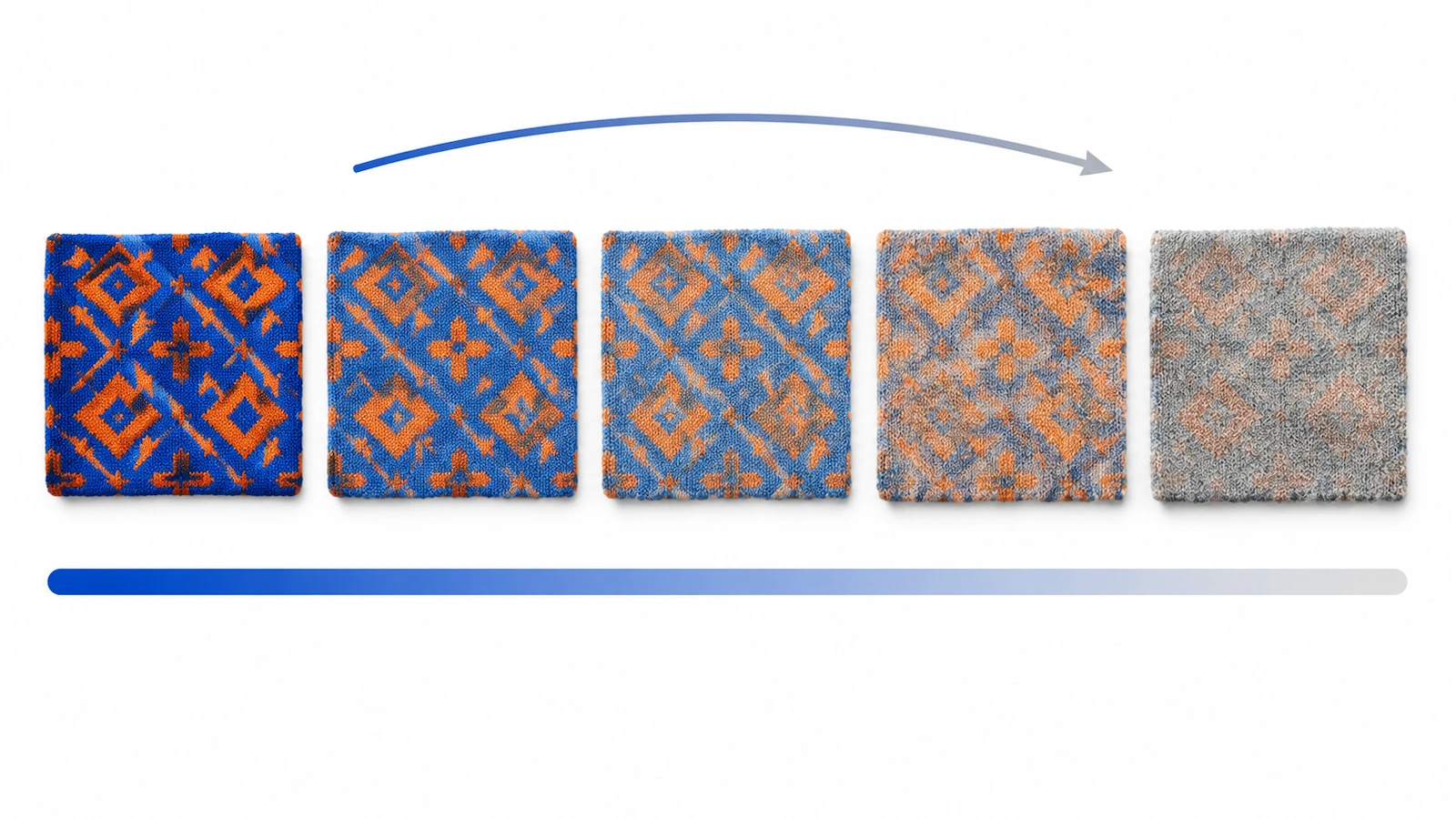
Sublimation dye turns from solid to gas at roughly 380–410°F (193–210°C) and enters the polyester fiber. It does not sit on top as an ink layer. That is why a good sublimation print has no hand feel and does not crack. It is also why fiber content matters more than any other spec on this tee. Cotton fibers do not take the dye. On a 50/50 blend, the color on the cotton half rinses out in the wash and leaves a faded, heathered look.
Independent maker testing supports a practical threshold. One long-running sublimation channel reported visible fading at 65% polyester, minimal fading at 75% and above, and a 100% polyester shirt still holding strong color after about 35 home washes. That is a single creator's test, not a lab result. It does match the industry rule of thumb: buy 100% polyester for team and staff programs, and treat any blend under 65% as a different, lower-performing product.
Heat stability is the second fabric question. Polyester softens near press temperatures, and disperse dyes can migrate when the garment is reheated. Two published methods let you ask a supplier for evidence instead of promises: ISO 105-P01:1993[2], which tests color fastness to dry heat, and the AATCC test methods[3]. The AATCC catalog covers hot pressing (TM133), home-laundering color fastness (TM61), light fastness (TM16) and dimensional change after laundering (TM135/TM150). For a tee that will be pressed once at the decorator and washed weekly by the wearer, TM61 and TM135 answer the two questions buyers care about most: will it fade, and will it shrink?
Print Behavior on a Finished Tee
Most 26051 programs are pressed as finished garments: the tee is already sewn when the transfer goes on. That workflow is fast and suits small runs, but it has physical limits that buyers should accept up front.
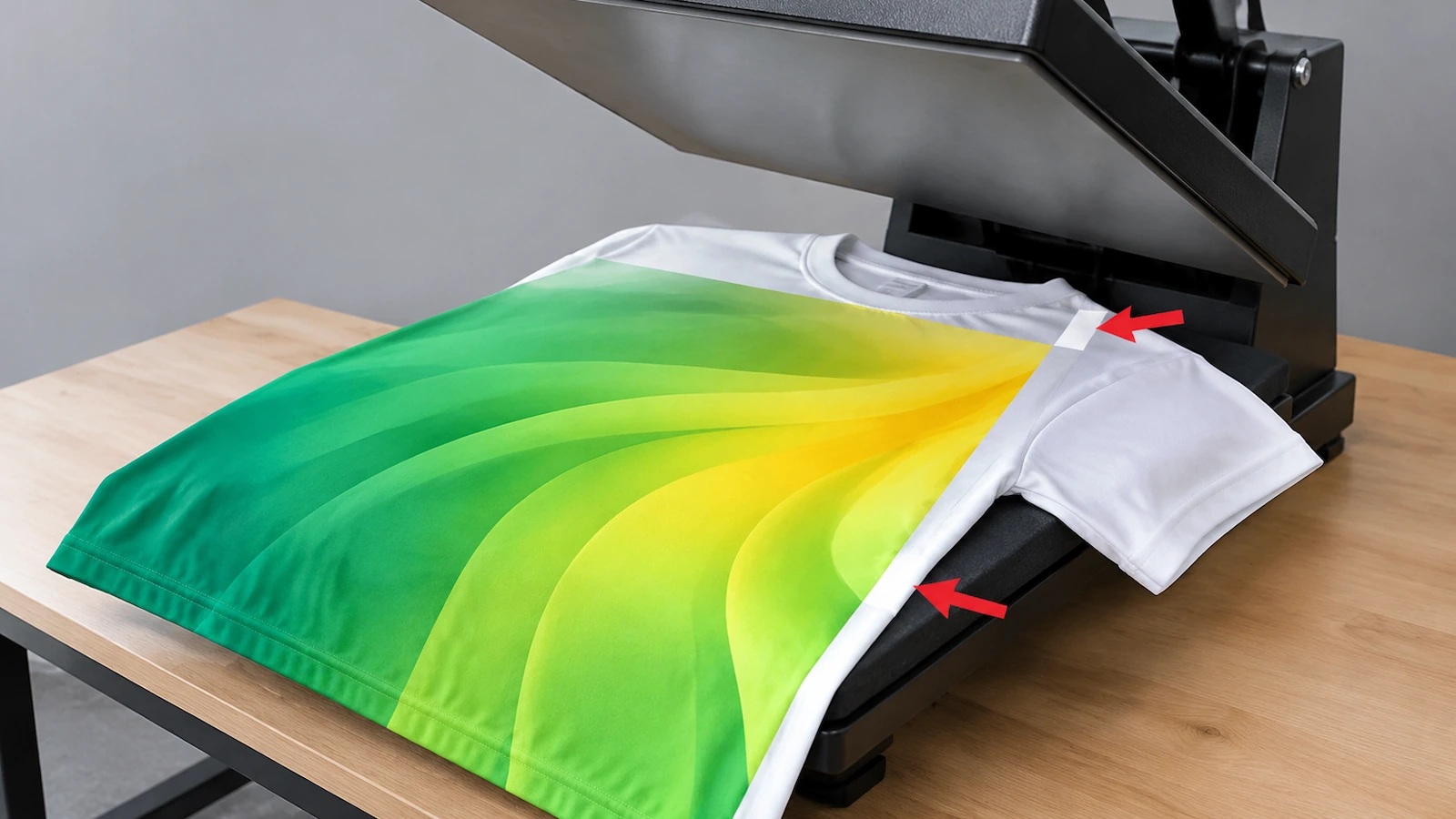
Seams and folds: Side seams, shoulder seams and the collar rib do not lie flat under the platen. Any area that is not in full contact stays white. A licensed 100% polyester sublimated tee sold to consumers, with more than 1,600 ratings, states openly that its process "creates slight imperfections over seams and/or folds." Expect the same on any finished-garment press.
Side voids on wraparound art: Designs that wrap from front to back leave a blank band at the side seams. If edge-to-edge coverage is the brief, the garment needs to be printed as flat panels before sewing. That is a different product, and it is how all-over-print polos are made.
Ghosting: If the transfer paper shifts while the tee is hot, it leaves a blurred second image. Heat-resistant tape on all four edges and a short rest before peeling prevent most cases.
Press box: Too much heat or pressure can leave a shiny or discolored rectangle around the print where the polyester surface has glazed. A test press on the actual lot catches this before production.
Ground color: Because the dye is translucent, there is no white ink. Light colors cannot be printed on a dark tee, and saturated greens, oranges and deep blues shift between screen and fabric. Approve a physical sample, not a screen proof.
Comparable reviews also reveal a pattern in color perception. Buyers who received the shirt as pictured called the print "vibrant" and noted it is "printed into the shirt," not a decal. Unhappy buyers on the same listing described colors as "very dull." The difference usually comes down to press temperature, dwell time and fabric lot, not the blank alone. Lock all three for the whole run.
Fit and Sizing: The Unisex Adult Cut
Fit generates more returns than print quality on sublimation programs, and buyer evidence on unisex polyester tees conflicts. On one heavily reviewed 100% polyester sublimated tee, one reviewer said a usual XL fit perfectly and an XXL was far too big. Another, at 5'10" and 178 lbs, said his usual Large was tight in the shoulders. A third said the shirt "will not stretch no matter how hard you try" and was narrow through the midsection. On a sublimated golf polo sample discussed by print-on-demand sellers, a wearer who normally takes L–XL said he needed at least a 4XL.
Those reports point to three structural causes. First, pure polyester jersey without spandex has little recovery or give. Second, unisex patterns are built on a straight block, so fit depends on chest-to-shoulder proportion more than on the size label. Third, sublimation blanks are often lightweight, and reviewers repeatedly call them thin, with light visible through the fabric. That is a plus for summer races. It is a minus for anything worn under office lighting.
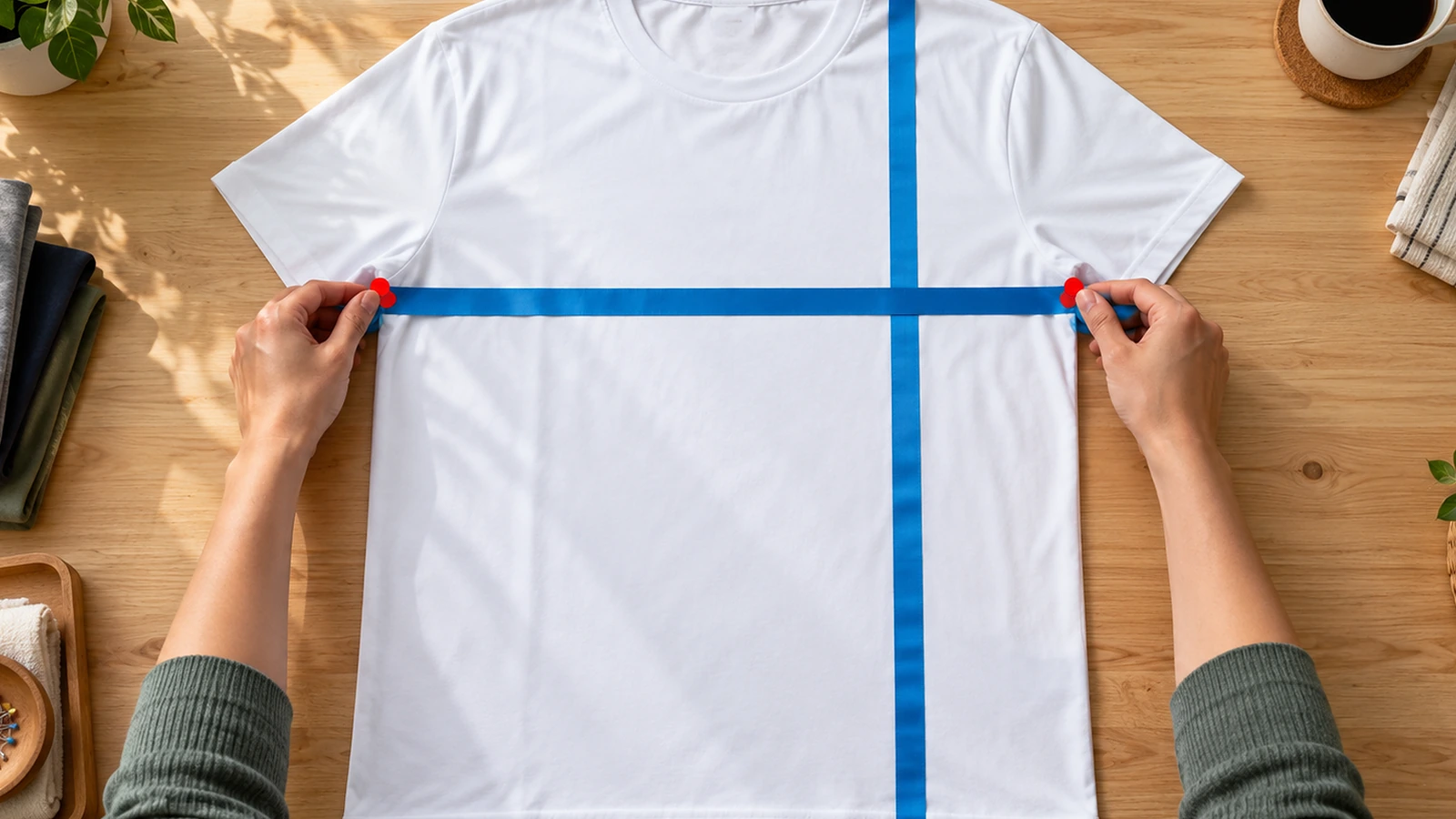
The fix is procedural, not a guess about "true to size." Order a size set, lay each piece flat, and measure chest width (armpit to armpit) and body length (high-point shoulder to hem). Then try the set on at least two wearer body types and publish those flat measurements on your order form so wearers pick by garment size, not habit. Because the 26051 is an adult style, any youth sizes in the same program need a separate youth garment. Youth garments also count as children's products under U.S. rules, which require a permanent tracking label[4] and a Children's Product Certificate where safety rules apply.
How to Spec-Check and Run a 26051 Program
Define the wear case. One-day event, season-long volunteer shirt or staff uniform? Single-day use tolerates a light, sheer knit. Weekly washing for a season makes TM61 and TM135 results worth requesting.
Pull the current spec sheet. Record fiber percentage, stated fabric weight, available colors and size range. If the sheet says "poly blend," ask for the exact percentage in writing.
Order a size set and measure it. Weigh one tee and compare it to the stated weight. Measure chest width and body length for every size you plan to order.
Test-press the actual lot. Start in the 385–400°F range with medium pressure, and adjust to the decorator's settings. Check for press box, ghosting and seam voids. Press your hardest color, often a brand green or navy, not just a logo in black.
Wash-test before approving bulk. At minimum, run five home washes cold, inside out, low or no dryer heat. Photograph the result next to an unwashed control. For larger programs, ask the decorator for an AATCC TM61 color fastness result and a TM135 shrinkage result on the printed garment.
Ask about chemical certification and PFAS. If your buyer requires chemical safety, ask for an OEKO-TEX STANDARD 100[7] certificate number and product class (Class II covers articles with large skin contact). If the shirts ship to California, California Health and Safety Code §108971[8] has banned regulated PFAS in new textile articles since January 1, 2025. The total organic fluorine threshold is 100 ppm now and 50 ppm from January 1, 2027. The NRDC's June 2026 testing report[9] notes that New York banned PFAS apparel at the same time. A plain sublimation tee rarely carries stain-repellent finishes, but get it in writing.
Verify recycled-content claims. If the program is marketed as "recycled," the Global Recycled Standard guidance[10] generally requires at least 20% recycled content for chain-of-custody tracking and at least 50% for a consumer-facing GRS label. Do not repeat a recycled claim without the certificate scope.
Write the care card and lock the lot. Print cold wash, no bleach, no fabric softener, low or no dryer heat, and no iron on the print. For reorders, ask for the same dye lot or approve a new physical swatch, because ground whiteness shifts every printed color.
26051 Tee vs. All-Over-Print Polo: When to Pair or Upgrade
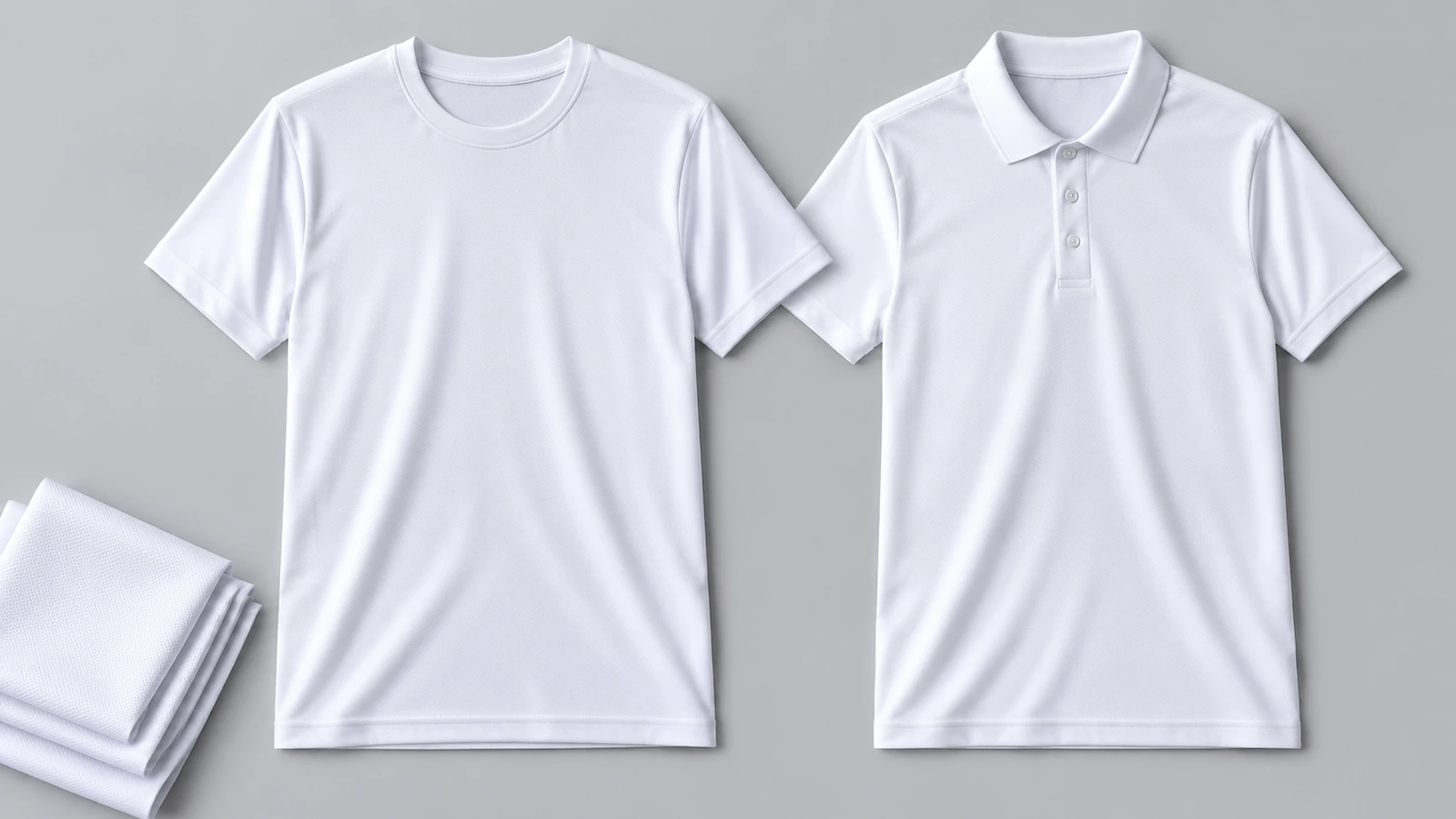
The tee and the polo do different jobs even when they share the same artwork. The table compares them on the attributes that change the buying decision.
Attribute
26051-type poly sublimation tee
All-over-print sublimated polo
How it is printed
Usually pressed as a finished garment; seams and folds may stay white
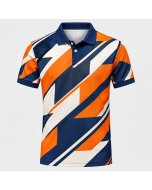
Printed as flat panels, then sewn, so artwork runs across seams, sleeves and often the collar
Performance knit, often polyester with spandex for stretch
Fit risk
Unisex straight block, little stretch
Usually offered in separate men's and women's cuts
Design changes after print
Reprint the tee
Reprint the panels and sew the garment again, so approval must be final
Choose the tee alone when the shirt is a one-day participant item and edge-to-edge coverage does not matter. Upgrade to the polo when wearers face customers, appear in photos as officials, or need the shirt to survive a season of washes as a uniform. The strongest setup for many organizations is to pair the two: participants get the tee and staff get a polo in the same colorway. Because both are dyed into polyester, the artwork can be matched across the two garments, though you should approve physical swatches for both fabrics since knit texture changes how colors read.
If your program has reached the polo stage, our custom all-over-print polo program covers ordering steps, pre-production checks, and how sublimation compares with embroidery, DTF and overseas OEM. We do not repeat that comparison here. Send us your artwork, wearer count and in-hand date for a quote.
FAQ
FAQ: Is the 26051 100% polyester?
The style is sold as a poly sublimation blank, but confirm the exact fiber percentage on the current spec sheet or care label before ordering. For prints that hold up through repeated washing, 100% polyester is the target. Blends below about 65% polyester fade noticeably.
FAQ: Can I sublimate the 26051 in a dark color?
Not with good results. Sublimation dye is translucent, and there is no white ink, so artwork on a dark ground disappears or looks muddy. Use white or very light grounds, and choose another decoration method for dark garments.
FAQ: Does the 26051 run small?
Buyer reports on unisex polyester sublimation tees conflict, with some saying size up and others saying true to size. The consistent complaints are narrow bodies and no stretch. Measure a size set flat and publish chest width and body length on your order form instead of relying on the size label.
FAQ: Why are there white lines near the seams after printing?
On a finished garment, seams and folds keep the transfer paper from making full contact, so those areas stay undyed. It is a limit of the process, not a defect in one shirt. For seam-to-seam coverage, the garment has to be printed as flat panels before sewing.
FAQ: How should wearers wash a sublimated tee?
Cold water, inside out, no chlorine bleach, no fabric softener or dryer sheets, and low or no dryer heat. Do not iron directly over the print, because heat can reactivate the dye and transfer it onto other items.
FAQ: When should a program switch from the tee to a polo?
Switch when the shirt becomes a uniform: staff who meet customers, coaches on the sideline, or anyone who wears it weekly for a season. Many programs keep the tee for participants and add a matching polo for staff.
Key Takeaways
Request a home-laundering colorfastness result before approving bulk. — AATCC TM61 for fading and TM135 for shrinkage (Source)
Heat stability of polyester dyes has its own published test. — ISO 105-P01, edition 1993 (Source)
Adult clothing textiles in the U.S. must meet the federal flammability standard. — 16 CFR Part 1610 sorts fabrics into 3 classes (Source)
Shirts shipping to California must be free of regulated PFAS. — 100 ppm total organic fluorine limit now, 50 ppm from January 1, 2027 (Source)
A recycled-polyester label needs certified content behind it. — at least 50% recycled content for a consumer-facing GRS label (Source)
Chemical-safety claims should cite a certificate and class. — OEKO-TEX STANDARD 100 Class II for skin-contact articles (Source)
Conclusion
The royal apparel adult 26051 unisex poly sublimation tee does one job well: it carries bright, soft, full-color artwork on a light polyester ground for people who wear it casually. Most of its weak points are predictable. Prints fade on low-polyester lots, seams stay white on finished-garment presses, the unisex cut runs narrow, and the knit can look sheer. A size set, a test press on the actual lot, a short wash test and a written care card neutralize most of them. Use the tee for participants and crowds. When the shirt has to look like a uniform, print across every seam, and last a season, move staff into an all-over-print polo in the same colorway. Send us your artwork and wearer count, and we will quote the polo side of your program.
Hi there! I'm Bruce, proud dad to my amazing son. I'm the founder of Zigpac, a printing and packaging company empowering small and medium-sized businesses with custom solutions. Let's create something great together!



 Blog PDF for offline reading













The information below is required for social login
Sign In
Create New Account